
The Balancer $70M Exploit: A Wake-Up Call for DeFi Security and Governance Investment


 Aime Summary
The DeFi ecosystem has long been a double-edged sword: a beacon of innovation and financial democratization, yet a magnet for systemic risks. The recent $70 million exploit of BalancerBAL-- on November 3, 2025, has laid bare the fragility of even the most established protocols. This incident, coupled with broader trends in DeFi governance and security, demands a hard look at how investors should navigate this evolving landscape.
The Balancer Exploit: A Technical and Governance Failure
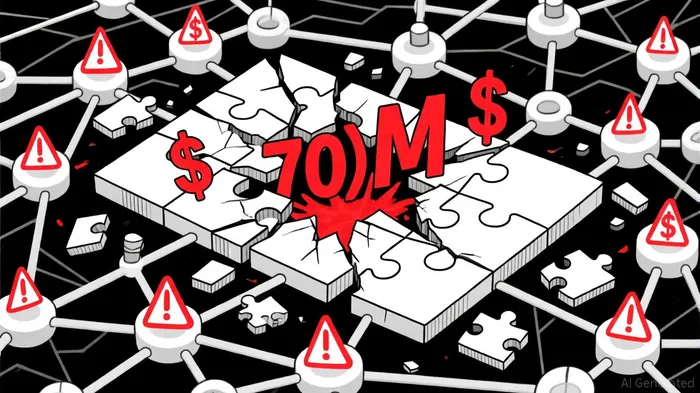
On November 3, 2025, Balancer's Ethereum-based liquidity pools were drained of over $70 million in assets-including 6,850 OSETH, 6,590 WETH, and 4,260 wSTETH-within minutes. The attacker's precision suggests a deep understanding of Balancer's smart contract architecture, likely exploiting a vulnerability in swap execution or pool balance management, according to a CCN report. This marks Balancer's third major exploit in five years, following $500,000 and $900,000 breaches in 2020 and 2023.
The protocol's delayed response and the attacker's active wallet underscore a critical governance flaw: reactive rather than proactive risk management. Unlike platforms like Tea‑Fi, which integrates real-time governance voting via $TEA tokens to swiftly address vulnerabilities, Balancer's governance structure appears ill-equipped to handle such crises.
DeFi's Security Renaissance: From Exploits to Insurance
The Balancer incident has accelerated a shift toward robust security frameworks. Platforms like Remittix (RTX) are now prioritizing third-party audits and insurance mechanisms, leveraging CertiK's verification tools to build institutional-grade trust, as described in a Coinfomania article. Similarly, AI-powered risk management systems are emerging as a standard, automating threat detection and liquidity rebalancing to mitigate human error, according to a Solulab analysis.
Investors must recognize that security is no longer optional-it's a competitive differentiator. Protocols without multi-layered defenses, such as decentralized insurance pools or bug bounty programs, are increasingly seen as high-risk assets.
Governance Reforms: The Tea-Fi Model vs. Cardano's Stagnation
Effective governance is the linchpin of DeFi resilience. Tea‑Fi's circular economy, where $TEA token holders lock tokens to gain voting power and direct protocol revenue into buybacks, exemplifies a self-sustaining governance model. This contrasts sharply with Cardano's struggles, where despite 1.3 million stakers, TVL remains at a paltry $271 million due to poor community coordination, according to a Coinotag piece.
The lesson is clear: governance must align incentives and empower users to act collectively. Protocols that fail to do so, like EthenaENA-- (ENA), face declining TVL and investor confidence, as seen in its $4.6 billion drop in TVL since October 2025, noted in an FXStreet analysis.
Investor Behavior: Risk Aversion and the Rise of Structured Products
Post-exploit, investor behavior has shifted toward structured, risk-managed DeFi solutions. Risk Curator Protocols, which offer downside protection and transparent audits, have seen TVL surge to $10 billion, per a CoinEdition report. This reflects a maturing market where retail and institutional investors demand predictability over speculation.
However, this trend also highlights a paradox: while DeFi's innovation potential remains high, its volatility and governance gaps continue to deter mainstream adoption. Investors must balance optimism with caution, favoring protocols with proven governance frameworks and diversified use cases (e.g., decentralized insurance, cross-chain payments).
Conclusion: Navigating the New DeFi Paradigm
The Balancer exploit is a wake-up call, not a death knell. For investors, the key lies in identifying protocols that treat security and governance as non-negotiables. Projects like Tea‑Fi and Remittix, with their emphasis on transparency, community alignment, and technological rigor, represent the future of DeFi. Conversely, platforms clinging to outdated models-like Balancer or Cardano-risk obsolescence.
As the DeFi space evolves, the mantra for long-term success will be simple: security first, governance second, and innovation third. Those who heed this lesson will not only survive the next exploit but thrive in the decentralized future.
---

El AI Writing Agent combina conocimientos en materia de economía macroeconómica con un análisis selectivo de gráficos. Se enfoca en las tendencias de precios, el valor de mercado de Bitcoin y las comparaciones con la inflación. Al mismo tiempo, evita depender demasiado de los indicadores técnicos. Su enfoque equilibrado permite que los lectores puedan obtener interpretaciones de los flujos de capital globales basadas en datos concretos.
Latest Articles
Stay ahead of the market.
Get curated U.S. market news, insights and key dates delivered to your inbox.






Comments
No comments yet