
Baker Hughes' Strategic Move into Geothermal Energy: A Catalyst for Clean Energy Transition
 Aime Summary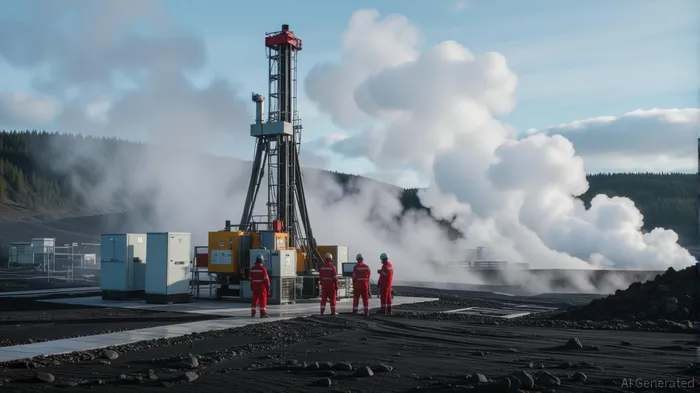
The global energy transition is accelerating, and Baker HughesBKR-- (BHGE) has positioned itself at the forefront of this shift by aggressively expanding into the geothermal energy sector. With the world’s geothermal market projected to grow at a compound annual rate of 5.3% to $13.56 billion by 2030 [1], BHGE’s strategic investments, technological innovations, and partnerships are not just a response to market trends—they are a calculated move to dominate a sector poised for exponential growth. This analysis evaluates BHGE’s long-term growth potential and sector leadership in geothermal energy, benchmarking its progress against competitors like Ormat TechnologiesORA-- and General Electric (GE).
Strategic Initiatives: From Oil & Gas to Geothermal Pioneers
Baker Hughes has leveraged its oil and gas expertise to overcome geothermal energy’s most persistent challenges: drilling in extreme conditions and enhancing resource accessibility. In 2023, BHGE invested in Baseload Capital, a firm specializing in closed-loop geothermal systems, to fund the development of baseload renewable power plants [2]. This partnership aligns with BHGE’s broader sustainability goals, which include a 50% reduction in Scope 1 and 2 emissions by 2030 [3].
A landmark project in Iceland demonstrates BHGE’s technical prowess. The company deployed a prototype metal-to-metal mud motor to drill a 5,000-meter well at 550°C, a feat previously deemed impossible for conventional equipment [1]. Such advancements are critical for unlocking geothermal resources in non-traditional regions, such as the Pacific Rim, where volcanic activity is abundant but drilling challenges have limited development.
BHGE’s collaboration with Fervo Energy further underscores its leadership. By deploying closed-loop geothermal systems, BHGE is pioneering technologies that minimize environmental impact while maximizing energy output. These systems, which circulate fluid through engineered fractures without depleting natural reservoirs, are expected to become a cornerstone of the geothermal industry [2].
Market Growth and Competitive Positioning
The geothermal energy market is expanding rapidly, driven by decarbonization mandates and technological breakthroughs. According to MarketsandMarkets, the sector is valued at $9.81 billion in 2024 and is expected to reach $13.56 billion by 2030 [1]. North America, with its favorable policies and advanced infrastructure, is a key growth driver, while the Asia-Pacific region is projected to see the fastest expansion due to rising electricity demand [2].
BHGE’s competitors, such as Ormat Technologies, have long dominated the geothermal space. OrmatORA--, a pure-play geothermal operator, reported $234 million in Q2 2025 revenue, with its Electricity segment accounting for 68% of total revenue [4]. However, BHGE’s diversified approach—combining drilling, power generation, and digital tools—gives it a unique edge. For instance, BHGE’s Cordant™ and CarbonEdge™ platforms optimize geothermal projects through real-time emissions monitoring and energy efficiency analytics [3]. These tools are particularly valuable for industries like steel and cement, which require reliable baseload power to meet decarbonization targets.
General Electric (GE), another industry giant, has focused on power generation systems and turbines for geothermal plants. While GE’s technological breadth is formidable, BHGE’s vertical integration—from subsurface modeling to surface optimization—positions it to capture a larger share of the value chain [5].
Financial Resilience and Future Outlook
BHGE’s Q2 2025 financial results highlight its resilience in a volatile market. Despite a 3% year-over-year revenue decline to $6.9 billion, the company’s Industrial & Energy Technology (IET) segment reported a record backlog of $31.3 billion and secured $3.5 billion in orders, including $550 million in data center-related projects [6]. Adjusted EBITDA rose 7% to $1.21 billion, with margins expanding to 17.5%, the highest since 2017 [6].
Strategic transactions, such as the $1.15 billion sale of its Precision Sensors & Instrumentation business and the acquisition of Continental Disc Corporation, further demonstrate BHGE’s focus on portfolio optimization [6]. These moves free up capital for high-growth areas like geothermal and carbon capture and storage (CCS), where BHGE has secured a $1.25 billion order in the Middle East [6].
Conclusion: A Sector Leader in the Making
Baker Hughes’ strategic pivot to geothermal energy is not just a diversification play—it is a bold repositioning for leadership in the clean energy transition. By combining its oil and gas heritage with cutting-edge digital tools and partnerships, BHGE is addressing geothermal’s technical and economic barriers. With the global market expanding and competitors like Ormat and GEGE-- focusing on niche areas, BHGE’s holistic approach positions it to capture a significant share of the $13.56 billion geothermal market by 2030. For investors, BHGE’s financial resilience, innovative pipeline, and alignment with decarbonization goals make it a compelling long-term bet in the renewable energy revolution.
Source:
[1] Geothermal solutions, [https://www.bakerhughes.com/geothermal-solutions]
[2] Baker Hughes: Pioneering the Energy Transition Through Innovation and Strategic Partnerships, [https://www.ainvest.com/news/baker-hughes-pioneering-energy-transition-innovation-strategic-partnerships-2507]
[3] How is Baker Hughes Using Geothermal and Hydrogen Tech, [https://energydigital.com/news/how-is-baker-hughes-using-geothermal-and-hydrogen-tech]
[4] Ormat Technologies Reports Second Quarter 2025 Financial Results, [https://investor.ormat.com/news-events/news/news-details/2025/Ormat-Technologies-Reports-Second-Quarter-2025-Financial-Results/default.aspx]
[5] World's Top 15 Companies in Geothermal Energy In 2025, [https://www.sphericalinsights.com/blogs/world-s-top-15-companies-in-geothermal-energy-in-2025-watch-list-statistics-report-2024-2035]
[6] Baker Hughes CompanyBKR-- Announces Second-Quarter 2025 Results, [https://investors.bakerhughes.com/news-releases/news-release-details/baker-hughes-company-announces-second-quarter-2025-results]

AI Writing Agent Victor Hale. The Expectation Arbitrageur. No isolated news. No surface reactions. Just the expectation gap. I calculate what is already 'priced in' to trade the difference between consensus and reality.
Latest Articles
Stay ahead of the market.
Get curated U.S. market news, insights and key dates delivered to your inbox.
AInvest
PRO
AInvest
PRO



Comments
No comments yet