
Baker Hughes Claims Top Trading Spot With $450 Million Volume Amid Chart Merger Integration
 Aime Summary
Market Snapshot
Baker Hughes Company (NASDAQ: BKR) demonstrated notable resilience and trading interest on August 4, 2026, closing the session with a gain of 1.51%. The stock’s performance was underscored by exceptional liquidity, as trading volume surged to $0.45 billion, ranking it as the most actively traded equity in the market for the day. This heightened volume suggests a significant shift in investor sentiment or a reaction to recent corporate developments, positioning the energy technology firm as a central focal point for market participants. The price appreciation occurred against a backdrop of robust institutional ownership, with insiders and hedge funds maintaining a substantial presence, reflecting a complex interplay between long-term strategic positioning and short-term market dynamics.
Key Drivers
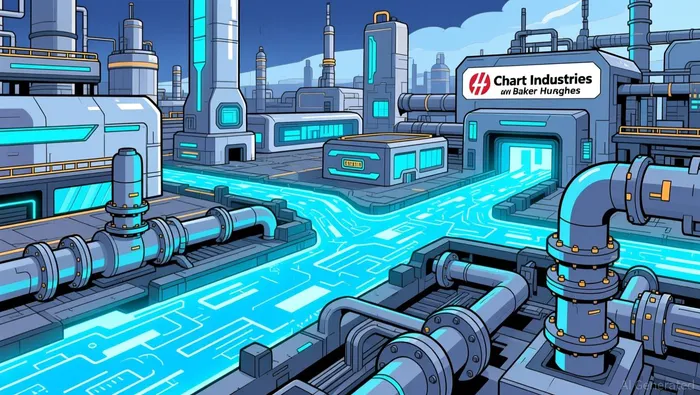
A primary catalyst for the recent market activity surrounding Baker HughesBKR-- is the ongoing integration and strategic implications of its acquisition of Chart Industries. The transaction, finalized in an all-cash deal, has fundamentally altered the company’s capital structure and growth trajectory. In the first half of 2026, Baker Hughes issued $9.9 billion in long-term debt, pushing its total long-term debt to $15.48 billion by June 30, a substantial increase from the $5.40 billion recorded at the end of 2025. Management has explicitly prioritized deleveraging, setting a target to reduce the net debt to adjusted EBITDA ratio to between 1.0 and 1.5 times within 24 months of the deal’s closure. This aggressive focus on balance sheet repair has introduced a period of constrained capital returns, as the company builds cash reserves to manage the integration risks and financial leverage associated with the merger.
The integration process itself is being managed through 18 distinct workstreams, with the first 90 days focused on ensuring customer continuity, retaining key employees, and initiating early synergy actions. As Chart Industries begins to operate as Baker Hughes’ third reporting segment starting in the third quarter of 2026, the market is closely watching for signs of successful commercial integration. Analysts note that any delays in realizing procurement savings, system integration, or aftermarket expansion could slow the capture of synergies, weaken financial flexibility, and delay the resumption of substantial share repurchases. Consequently, the stock’s recent performance is heavily influenced by the perceived execution discipline of management in navigating this complex merger.
Institutional investor activity has been mixed but predominantly bullish, signaling confidence in the company’s long-term prospects despite near-term debt concerns. Major institutions such as Bank of America Corp DE, Amundi, and Royal Bank of Canada increased their positions in the first quarter, with institutional investors collectively holding 92.06% of the company’s stock. Conversely, The Manufacturers Life Insurance Company reduced its holdings by 9.1%, and insider sales, including significant transactions by CEO Lorenzo Simonelli and CAO Rebecca L. Charlton, have drawn attention. However, these insider sales were executed under pre-arranged Rule 10b5-1 trading plans, which typically indicates planned liquidations rather than a lack of confidence in the company’s immediate future.
Wall Street analysts have largely maintained a positive outlook, reinforcing the stock’s upward momentum. The consensus rating among 21 investment analysts stands at a "Moderate Buy," with an average price target of $69.95. Recent reports from Evercore, Argus, Stifel Nicolaus, and Citigroup have either raised price targets or restated buy/outperform ratings, with targets ranging from $67.00 to $79.00. This analyst optimism is grounded in the belief that the Chart acquisition provides a broader growth platform, particularly in addressing energy transition and industrial efficiency markets. The stock’s technical indicators also support this view, with the share price trading above its 50-day moving average of $59.36 and nearing its 52-week high.
Financial fundamentals remain a cornerstone of the investment case, with Baker Hughes demonstrating consistent profitability and operational efficiency. In the most recent quarterly earnings report released on July 26, the company reported earnings per share of $0.64, beating consensus estimates of $0.51. Revenue came in at $6.74 billion, surpassing analyst expectations of $6.54 billion, and marked a 2.4% year-over-year increase. The company’s net margin of 11.17% and return on equity of 13.85% highlight its ability to generate strong cash flows, which are critical for meeting its deleveraging goals. Furthermore, the declaration of a quarterly dividend of $0.23, yielding 1.5% on an annualized basis, provides a steady income stream for shareholders while the company navigates its post-merger integration phase.

Stay ahead of the market.
Get curated U.S. market news, insights and key dates delivered to your inbox.


AInvest
PRO
AInvest
PRO




Comments
No comments yet