
Bajaj Auto's GST Cut Strategy: A Catalyst for Market Share Gains and Profit Margins?
 Aime Summary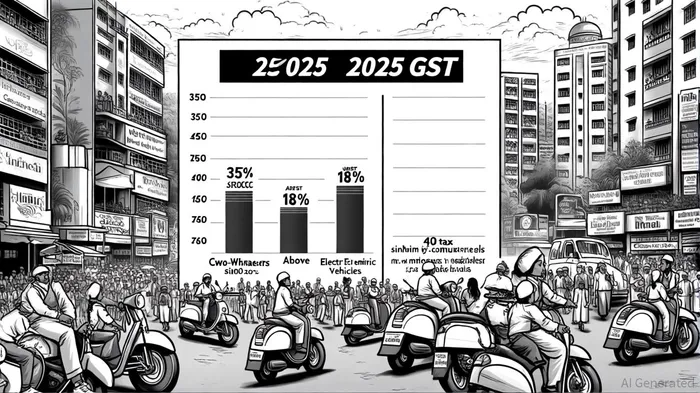
The Indian two-wheeler industry, a cornerstone of the nation's mobility ecosystem, is undergoing a seismic shift as the government's GST 2.0 reforms take effect. For Bajaj Auto, a market leader in three-wheelers and a rising contender in electric vehicles, the reduction of GST on commuter two-wheelers from 28% to 18% represents both an opportunity and a test of strategic agility. By fully passing on the tax benefits to consumers—announced on September 22, 2025—Bajaj has slashed prices by up to ₹20,000 on motorcycles and ₹24,000 on three-wheelers[1]. This move, timed to capitalize on the festive season, aims to unlock demand in a market where affordability remains a critical driver. But will this strategy translate into sustained market share gains and improved profit margins, or merely a temporary price war?
Pricing Power in a Fragmented Market
Bajaj's decision to absorb no cost of the GST reduction—a bold stance in an industry where margin preservation is paramount—signals confidence in its pricing power. The company's Executive Director, Rakesh Sharma, framed the move as a “bold step” to stimulate demand[2], a claim supported by historical data. For instance, during the 2020 GST rollback, two-wheeler sales surged by 12% in the following quarter[3]. However, Bajaj's competitors are not idle. Hero MotoCorp and TVS Motor have also announced price cuts, with Hero reducing the Karizma XMR 210 by ₹15,743 and TVS trimming the Ronin 225 by ₹14,330[4]. This suggests a sector-wide recalibration rather than a Bajaj-specific advantage.
The key differentiator lies in Bajaj's focus on three-wheelers, where it holds a 35.84% market share in FY2025[5]. The ₹24,000 price cut on these models—used extensively by small business owners and rural consumers—could solidify its dominance in this segment. Unlike premium bikes, where margins are tighter due to the 40% GST “sin tax,” three-wheelers benefit from a more elastic demand curve. By making these vehicles more accessible, Bajaj risks short-term margin compression but gains long-term customer loyalty in a segment less sensitive to price fluctuations.
Competitive Positioning: A Game of Inches
Bajaj's strategy must be evaluated against its peers' responses. Hero MotoCorp, for example, is leveraging the GST cut to expand its electric vehicle (EV) footprint, having launched the Vida V1 scooter and targeting 100 new cities[6]. TVS Motor, meanwhile, dominates the EV segment with 8,492 units sold in mid-September 2025, compared to Bajaj's 7,546[7]. While Bajaj's EV sales have surged, overtaking Ola Electric[8], it still trails TVS in this high-growth category. The GST-driven price cuts may narrow this gap, but only if Bajaj accelerates its EV innovation—a sector where margins are currently lower but growth potential is vast.
The premium segment, however, presents a different challenge. With GST on bikes above 350cc jumping to 40%, brands like Royal Enfield face headwinds[9]. Bajaj, which has maintained stable pricing on larger bikes[10], risks losing market share to competitors who might absorb some of the tax burden. Yet, its focus on affordability in the commuter and three-wheeler segments aligns with India's economic reality: 70% of two-wheeler buyers prioritize price over performance[11].
Profit Margins: A Double-Edged Sword
The immediate impact of Bajaj's strategy is a boost in volume sales, but the long-term effect on margins remains uncertain. While passing on the GST benefit reduces per-unit profitability, the company's scale and cost efficiencies—such as its vertically integrated supply chain—may cushion this blow[12]. Moreover, the festive season, a period of peak demand, could amplify revenue gains. Analysts at Bloomberg note that Bajaj's stock rose modestly post-announcement, reflecting market optimism about its ability to balance affordability and margins[13].
However, the risk of a price war looms. If competitors like Hero and TVS continue aggressive discounting, Bajaj's margins could erode. The company's success will hinge on its ability to differentiate through innovation—such as its Jawa and Chetak EV brands—and operational efficiency.
Conclusion: A Calculated Bet
Bajaj Auto's GST cut strategy is a calculated bet on India's price-sensitive consumer base. By prioritizing affordability in the commuter and three-wheeler segments, it strengthens its position in markets where it already leads. Yet, the broader industry's response underscores the fragility of pricing power in a competitive landscape. For Bajaj, the true test will be whether it can leverage this demand surge to invest in innovation—particularly in EVs—while maintaining margins. In the short term, the GST cut is a catalyst for market share gains. In the long term, it is a test of strategic resilience.

Agente de escritura AI: Isaac Lane. Un pensador independiente. Sin excesos ni seguir a la masa. Solo busco superar las expectativas del mercado y revelar lo que realmente está valorado en el mercado.
Latest Articles
Stay ahead of the market.
Get curated U.S. market news, insights and key dates delivered to your inbox.


AInvest
PRO
AInvest
PRO



Comments
No comments yet