
Babcock & Wilcox's Sudden 7% Drop: What's Behind the Unusual Intraday Move?
 Aime Summary
Technical Signal Analysis
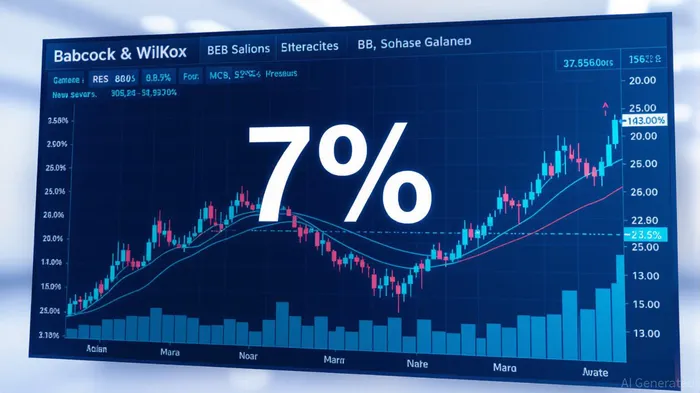
Babcock & WilcoxBW-- (BW.N) plunged by nearly 7% today amid a relatively normal technical landscape. No classic reversal or continuation patterns such as Head and Shoulders, Double Top/Bottom, or KDJ and MACD crossovers were triggered. This suggests that the drop was not driven by a typical technical breakout or breakdown scenario.
The absence of a RSI oversold signal or a MACD death cross further rules out a bearish continuation or exhaustion move. The chart, while volatile today, appears to remain within its established trend and pattern structure—leaving the cause of the sharp move unexplained from a pure technical standpoint.
Order-Flow Breakdown
There was no available block trading data or cash-flow profile to analyze for this session. This means we lack direct visibility into where large buy or sell orders clustered, and whether there was a net inflow or outflow of capital. Without this data, it's challenging to determine whether the drop was driven by large institutional selling or aggressive retail bearishness.
However, the unusually high volume (2.87 million shares) indicates that the move was not a quiet, retail-led selloff, but rather a more aggressive, possibly coordinated unwind or liquidation event.
Peer Comparison
The broader industrial and energy services space showed mixed signals. Among the peers, several stocks like AAP and BH.A saw sharp declines, with AAP falling over 4.5%—suggesting a possible sector-wide correction or rotation away from energy and industrials.
However, others like AXL and AREB rose, and some micro-cap peers like AACG saw dramatic gains. This divergence makes it unlikely that the move in BWBW--.N was a result of broad industry selling or a sector rotation. Instead, it appears more isolated, pointing toward a specific catalyst that affected BW.N more than its peers.
Hypothesis Formation
Given the lack of technical triggers and no clear sector-wide move, we propose the following two hypotheses:
- Hypothesis 1: Short-term liquidity crunch or forced selling by a large holder
The high volume and sharp price drop could point to a large holder—such as a hedge fund or an institutional investor—forced to liquidate a chunk of its position in BW.N. This could be due to margin calls, portfolio rebalancing, or a shift in strategy. The lack of block trading data prevents confirmation, but the pattern fits a short-term liquidity event. - Hypothesis 2: Misinformation or algorithmic overreaction
A sudden market overreaction—possibly triggered by an erroneous news piece, a rogue algorithm, or a false headline—could have initiated a short-covering or panic sell-off. This is more common in thinly traded or volatile stocks like BW.N, which are more susceptible to market noise.Conclusion
Babcock & Wilcox’s 7% drop today is an unusual and sharp move in a stock that otherwise appears to be trading within its normal pattern. With no technical indicators fired and no broad industry trend, the most plausible explanations revolve around specific liquidity events or short-term market overreactions.
Investors should monitor order-flow data and news sentiment closely in the next few sessions to determine whether this was a one-off move or the beginning of a new downward phase. Until more data is available, it's best to treat this as a temporary volatility spike rather than a fundamental bearish signal.

Stay ahead of the market.
Get curated U.S. market news, insights and key dates delivered to your inbox.
AInvest
PRO
AInvest
PRO



Comments
No comments yet