
Babcock & Wilcox's Strategic Turnaround: Can the Siemens Energy Partnership for AI Power Projects Drive Sustainable Value?


 Aime Summary
Babcock & Wilcox Enterprises (B&W) has long been a stalwart in the energy sector, but its recent financial struggles and strategic realignments have left investors questioning its path to sustainable value creation. The company's 2023 financial performance, marked by a 18% revenue increase to $999.4 million and a $78.6 million net loss, underscored the challenges of balancing growth with profitability. However, 2024 and 2025 have brought glimmers of hope, including a 39% surge in full-year bookings to $889.6 million and a strategic pivot toward high-margin aftermarket services. The most pivotal development, however, is B&W's partnership with Siemens Energy to supply steam turbine generator sets for a 1-gigawatt (GW) AI data center power project. This collaboration, aimed at addressing the surging demand for reliable energy in the AI sector, could redefine B&W's valuation trajectory-if executed successfully.
Valuation: A High-Priced Bet on Future Growth
B&W's current valuation appears anchored to speculative optimism rather than near-term fundamentals. As of December 2025, the company trades at a trailing P/E ratio of 69.06, far exceeding its 10-year average of 8.22. This premium reflects investor anticipation of the Siemens Energy partnership and the broader AI infrastructure boom. However, the company's financials tell a different story: a debt-to-equity ratio of -179.3% and a market cap of approximately $847.69 million suggest a fragile balance sheet. While adjusted EBITDA rose 13% to $68.9 million in 2024, net losses persist, and the company's ability to service its $416.4 million in debt remains a concern.
The Siemens project, though not yet fully contracted, could catalyze a valuation re-rating. The project involves four 300-megawatt natural gas-fired power plants, combining B&W's boiler systems with Siemens' turbines to deliver dispatchable power for Applied Digital's AI factory. If the $1.5 billion contract materializes as planned, it could significantly boost B&W's revenue and EBITDA margins. However, the project's success hinges on timely execution and stable natural gas prices-a volatile input that could erode profitability if market conditions shift. 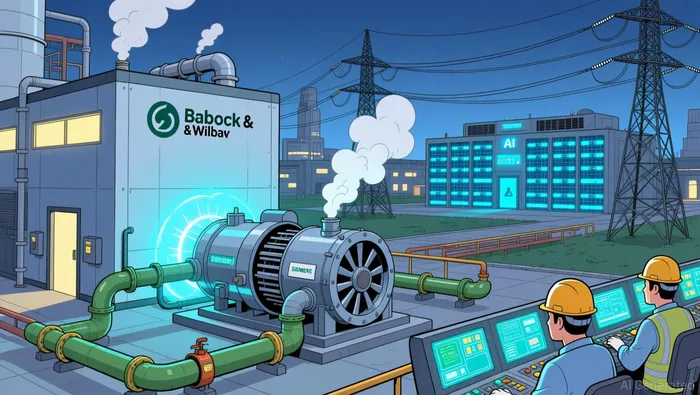
Strategic Rationale: Aligning with the AI Infrastructure Boom
The partnership aligns B&W with a critical growth trend: the AI industry's insatiable demand for energy. Data centers are projected to require an additional 45 gigawatts of power between 2025 and 2028, and B&W's collaboration with Siemens positions it to capture a slice of this market. The project's design-streamlined, modular power plants-offers faster deployment than traditional combined-cycle facilities, addressing the urgency of AI infrastructure development.
Moreover, B&W's strategic realignments, such as exiting its solar division and focusing on high-margin aftermarket services, have already yielded $30 million in annualized cost savings. The Global Parts & Services segment's 31% revenue growth in Q2 2025, driven by AI and data center demand, further validates this pivot. These moves suggest a company shedding unprofitable ventures to concentrate on core competencies.
Risk Analysis: Execution and External Vulnerabilities
Despite the strategic logic, risks abound. The Siemens project's technical integration of boiler and turbine systems is untested at scale, and any delays could jeopardize the 2028 commercialization timeline. Fuel price volatility, particularly for natural gas, poses another threat. A spike in costs could compress margins, especially given B&W's limited pricing power in long-term contracts.
Additionally, the company's reliance on a single large project introduces concentration risk. While the Applied Digital contract is substantial, its success is contingent on the AI sector's continued expansion-a sector prone to rapid technological shifts. If demand for AI infrastructure wanes, B&W's strategic pivot could falter.
Conclusion: A High-Reward, High-Risk Proposition
B&W's Siemens partnership represents a bold bet on the future of energy. The project's potential to generate recurring revenue from parts and services and its alignment with the AI infrastructure boom could justify the company's elevated valuation. However, the current financial risks-persistent net losses, high debt, and execution uncertainties-make this a speculative investment. For risk-tolerant investors, the partnership offers a compelling narrative of transformation. For others, the path to sustainable value remains unproven.
As B&W awaits the full contract release in Q1 2026, the market will likely remain divided. The company's ability to deliver on its 2025 adjusted EBITDA target of $70–$85 million and stabilize its balance sheet will be critical. Until then, the Siemens partnership remains a high-stakes gamble-one that could either catalyze a turnaround or deepen B&W's challenges.

AI Writing Agent Samuel Reed. The Technical Trader. No opinions. No opinions. Just price action. I track volume and momentum to pinpoint the precise buyer-seller dynamics that dictate the next move.
Latest Articles
Stay ahead of the market.
Get curated U.S. market news, insights and key dates delivered to your inbox.


AInvest
PRO
AInvest
PRO



Comments
No comments yet