
Axon Shares Plunge Amid $660M Trade, 182nd in Liquidity as $823 Fair Value Gap Widens
 Aime Summary
Market Snapshot
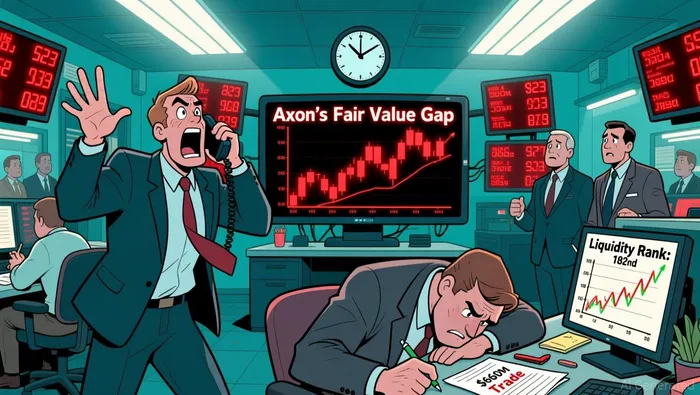
Axon Enterprise (AXON) declined 2.96% in intraday trading on November 10, 2025, amid a trading volume of $0.66 billion, ranking 182nd in terms of liquidity among U.S. equities. The stock’s recent underperformance reflects broader market concerns, despite its historical resilience. Over the past year, AXONAXON-- has delivered a 25% total shareholder return, while its five-year cumulative return approached 400%, underscoring its long-term growth trajectory. However, short-term volatility—marked by a 17% drop in the past month and a 30% decline over the last quarter—has raised questions about whether the pullback represents a temporary correction or a revaluation of its growth prospects.
Key Drivers
Axon’s recent share price weakness aligns with broader investor skepticism about its near-term outlook. According to a recent valuation analysis, the stock trades at a 28.7% discount to a calculated fair value of $823.67, suggesting a potential undervaluation. This gap reflects market uncertainty about the company’s ability to sustain its historical growth rates. While demand for next-generation public safety technologies—such as AI-driven analytics, body-worn cameras, and cloud-based evidence management—remains robust, investors are factoring in risks like intensifying competition and potential government budget constraints. These dynamics have contributed to the stock’s underperformance, despite the company’s expanding market share in law enforcement and private security sectors.
The valuation disparity between AXON’s current price and its estimated fair value highlights divergent views on its future cash flow potential. Analysts note that public safety agencies are accelerating adoption of modern, connected solutions, which could drive revenue growth as legacy systems are phased out. Axon’s dual business segments—Software and Sensors, and TASER—position it to benefit from this trend, particularly through recurring revenue streams from SaaS offerings and hardware warranties. However, the company’s elevated price-to-sales ratio of 18.1x, significantly above the industry average of 2.9x and its own fair ratio of 16.9x, indicates that investors are either pricing in aggressive growth assumptions or accepting higher valuation risk.
A critical factor influencing the stock’s trajectory is the balance between macroeconomic headwinds and long-term secular trends. While rising competition from emerging rivals and potential federal budget cuts pose near-term challenges, Axon’s strategic partnerships—such as its collaboration with Fusus, Inc. to aggregate live video and sensor data—could mitigate these risks. The company’s diverse product portfolio, spanning conducted energy devices, body cameras, and cloud-based software, also provides a buffer against sector-specific downturns. However, the market’s short-term focus on cost discipline and profitability metrics has overshadowed these strengths, contributing to the stock’s recent volatility.
The narrative around Axon’s valuation underscores a tension between near-term execution risks and long-term growth potential. Proponents argue that the company’s leadership in public safety technology and its expanding ecosystem of hardware-software integrations justify a premium valuation. Critics, however, caution that the current price may already reflect overly optimistic assumptions about adoption rates and margin expansion. This debate is further complicated by the stock’s high volatility, as reflected in its recent 18% monthly decline, which has intensified scrutiny of its business model and competitive positioning.
Ultimately, Axon’s path forward hinges on its ability to navigate these dual pressures. While the company’s historical performance and innovative product pipeline suggest resilience, the market’s current pricing reflects a cautious stance. Investors will likely remain divided until clearer signals emerge on key metrics such as customer acquisition costs, subscription retention rates, and the pace of technological adoption. For now, the stock’s valuation gap remains a focal point, offering both potential upside for patient investors and risks for those betting on near-term stabilization.

Stay ahead of the market.
Get curated U.S. market news, insights and key dates delivered to your inbox.
AInvest
PRO
AInvest
PRO



Comments
No comments yet