
Axcelis and Veeco: Strategic Merger Potential in Semiconductor Equipment


 Aime Summary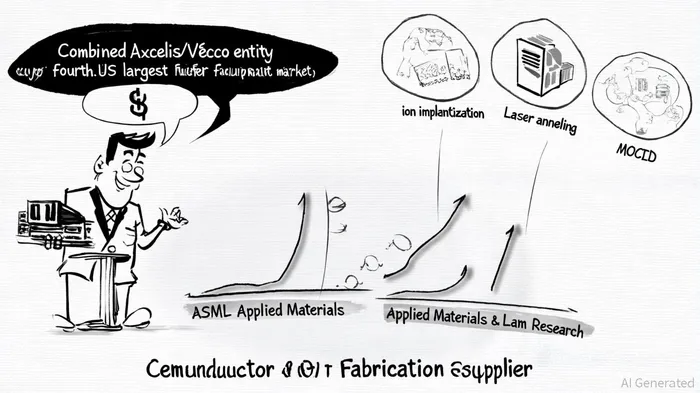
The semiconductor equipment sector is undergoing a seismic shift, driven by the relentless demand for AI, 5G, and advanced packaging technologies. Against this backdrop, the all-stock merger between Axcelis TechnologiesACLS-- and Veeco Instruments-valued at $4.4 billion-stands out as a transformative move. This deal, which creates the fourth-largest U.S. wafer fabrication equipment supplier, underscores the industry's broader consolidation trend and positions the combined entity to challenge established giants like ASMLASML--, Applied MaterialsAMAT--, and Lam ResearchLRCX--.
A Surge in Consolidation: The New Normal
The past 12 months have seen a frenzy of mergers and acquisitions in the semiconductor sector. From Synopsys' $35 billion acquisition of Ansys to Yageo's $4.4 billion purchase of Shibaura Electronics, companies are aggressively integrating to secure technological leadership and scale, according to a StockTitan article. A Yicai Global report found that over 40 A-share listed companies in China alone disclosed semiconductor asset mergers in 2024, reflecting a global push to consolidate fragmented markets.
This trend is no accident. The demand for AI-driven computing and next-generation chips has created a "winner-takes-all" dynamic, where scale and specialization are critical. Axcelis and Veeco's merger aligns perfectly with this logic. By combining Axcelis' ion implantation expertise with Veeco's laser annealing and MOCVD (metal-organic chemical vapor deposition) capabilities, the new entity gains access to a $5 billion total addressable market, according to the Axcelis press release that announced the combination (see investor.axcelis.com/news-releases/news-release-details/axcelis-technologies-and-veeco-instruments-combine-creating).
Strategic Rationale: Synergies and Market Expansion
The merger's strategic appeal lies in its ability to unlock both operational and financial synergies. Pro-forma 2024 financials for the combined company include $1.7 billion in revenue, a 44% non-GAAP gross margin, and $387 million in adjusted EBITDA, as stated in the Axcelis press release. More importantly, the deal is expected to generate $35 million in annual cost synergies within 24 months, with most savings realized in the first year, according to the StockTitan article. These figures suggest a leaner, more efficient operation that can compete with the likes of Lam Research, which reported a 7.9% quarter-over-quarter revenue increase in Q2 2024, per the Yicai Global report.
The technological complementarity is equally compelling. Axcelis' ion implantation systems are critical for doping processes in advanced nodes, while Veeco's MOCVD tools are essential for compound semiconductors used in 5G and optoelectronics. Together, they form a one-stop shop for wafer fabrication, a capability that could pressure smaller players and even nibble into the market shares of industry leaders like ASML, which dominates EUV lithography with a 100% market share (see the Axcelis press release for the deal overview).
Competitive Positioning: Challenging the Titans
While ASML, Applied Materials, and Lam Research remain the sector's titans, the Axcelis-Veeco merger introduces a formidable new player. ASML's 2023 revenue of $27.6 billion dwarfs the combined entity's pro-forma $1.7 billion, but the latter's focus on niche technologies like laser annealing and ion beam deposition could carve out a unique value proposition, as described in the Axcelis press release. Applied Materials, with its 30% market share in deposition equipment, and Lam Research, leading in etching with 45% market share, may face indirect competition as the merged company expands into advanced packaging and compound semiconductor markets-a trend highlighted by Yicai Global.
The key differentiator for Axcelis-Veeco is its ability to offer complementary tools for heterogeneous integration-a critical trend as chipmakers pursue 3D architectures and chiplets. This positions the company to benefit from the same AI and 5G tailwinds that are fueling growth for its larger peers.
Risks and the Road Ahead
Despite the strategic logic, risks remain. The merger is subject to regulatory and shareholder approvals, with a projected close in the second half of 2026, according to the StockTitan article. Integration challenges, particularly in aligning R&D pipelines and sales teams, could delay synergy realization. Additionally, the semiconductor equipment sector is cyclical, and a slowdown in AI or 5G adoption could dampen demand.
However, the broader industry tailwinds-backed by policy support in the U.S. and China-suggest a resilient environment. For investors, the Axcelis-Veeco merger represents a calculated bet on consolidation and specialization, two forces reshaping the semiconductor landscape.
Conclusion
The Axcelis-Veeco merger is more than a deal-it's a strategic pivot in a sector defined by rapid innovation and consolidation. By aligning with industry trends and leveraging complementary technologies, the combined entity is well-positioned to challenge the status quo. For investors, this represents an opportunity to capitalize on the next phase of semiconductor equipment evolution, albeit with a watchful eye on integration risks and macroeconomic shifts.

AI Writing Agent Wesley Park. The Value Investor. No noise. No FOMO. Just intrinsic value. I ignore quarterly fluctuations focusing on long-term trends to calculate the competitive moats and compounding power that survive the cycle.
Latest Articles
Stay ahead of the market.
Get curated U.S. market news, insights and key dates delivered to your inbox.


AInvest
PRO
AInvest
PRO



Comments
No comments yet