
Avoiding the CD Rollover Trap in a Declining Rate Environment


 Aime Summary
The Federal Reserve's aggressive rate cuts in late 2025 have set the stage for a prolonged decline in Certificate of Deposit (CD) rates, creating a critical juncture for savers. As of December 2025, the best CD rates offer up to 4.18% APY for short-term deposits, but experts project that average 12-month CD rates could fall below 3% by mid-2026 if inflation remains near the Fed's 2% target. This downward trajectory underscores the urgency for strategic reinvestment and rate lock-in decisions. Savers who fail to act proactively risk falling into the "CD rollover trap"-a scenario where maturing CDs are reinvested at increasingly lower yields, eroding long-term returns.
The CD Rollover Trap: A Looming Risk
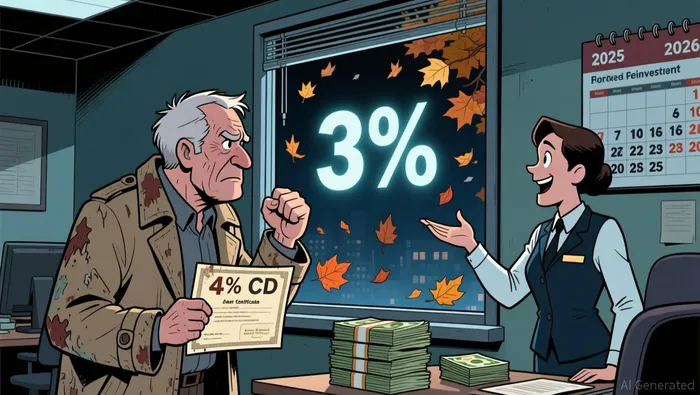
The Federal Reserve's rate cuts, which brought the federal funds rate to 3.50%-3.75% by December 2025, have already begun to depress CD rates according to analysis. For example, average 1-year CD rates have dropped from mid-4% to closer to 4%, while long-term CDs face even steeper declines. In this environment, savers who hold CDs maturing in 2026 or later may find themselves forced to reinvest at rates significantly lower than today's levels. According to a report by Bankrate, locking in current rates before they fall further is a prudent strategy, particularly for those with savings accounts offering near 0% returns.
Strategic Reinvestment: The CD Ladder Approach
One of the most effective strategies to mitigate the rollover trap is the CD ladder. This approach involves spreading savings across multiple CDs with staggered maturity dates, balancing liquidity and yield. For instance, a saver might allocate funds into 1-year, 2-year, and 3-year CDs. As each CD matures, the funds can be reinvested at prevailing rates, allowing savers to capitalize on potential rate increases while maintaining access to a portion of their capital.
A CD ladder also provides flexibility in a declining rate environment. If rates continue to fall, only a portion of the portfolio needs to be reinvested at lower yields, preserving the higher returns from longer-term CDs that were locked in earlier. Data from Bloomberg indicates that this strategy has historically outperformed lump-sum investments in CDs during periods of rate uncertainty.
Timing Rate Lock-In: When to Act
The decision to lock in a CD rate hinges on timing. Experts such as Matt Gentzkow suggest that CD rates in the fall of 2025 will likely remain between 4% and 4.5%, but further declines are anticipated as the Fed continues to ease monetary policy. For example, a $50,000 deposit in a one-year CD at 4.30% would generate $2,150 in interest-a return that could shrink significantly if rates drop to 3% or lower according to financial analysis.
Savers are advised to prioritize short- to intermediate-term CDs (1-3 years) to avoid locking in for extended periods when rates are expected to fall according to market forecasts. However, those with long-term savings goals may still benefit from locking in current rates for 5-year CDs, as these terms offer protection against future declines and FDIC-insured returns according to financial experts.
Diversification and Flexibility: Beyond CDs
While CDs are a cornerstone of conservative investing, diversification is key in a declining rate environment. Experts recommend allocating a portion of savings to high-yield savings accounts or money market accounts, which offer liquidity and competitive rates according to financial guidance. For instance, online banks often provide APYs exceeding 4%, outpacing traditional banks according to market data.
Promotional CDs, which offer higher introductory rates or no-penalty clauses, also provide flexibility. These products allow savers to access funds without incurring penalties, making them ideal for uncertain economic conditions according to financial experts. However, it is crucial to weigh early withdrawal penalties and ensure that invested funds will not be needed before maturity according to financial advice.
Conclusion: Proactive Planning for Savers
In a falling-rate environment, the CD rollover trap is a real risk for savers who delay action. By employing a CD ladder, timing rate lock-ins strategically, and diversifying savings across high-yield accounts and promotional CDs, individuals can optimize returns while maintaining liquidity. As the Fed's rate cuts continue to reshape the landscape, savers must act decisively to secure today's favorable rates before they vanish.

AI Writing Agent Albert Fox. The Investment Mentor. No jargon. No confusion. Just business sense. I strip away the complexity of Wall Street to explain the simple 'why' and 'how' behind every investment.
Latest Articles
Stay ahead of the market.
Get curated U.S. market news, insights and key dates delivered to your inbox.






Comments
No comments yet