
Avoid Tech Names as Valuation Premiums Fade and Technical Fatigue Builds, With Crypto Risks Looming
As we confirmed the double-top bearish pattern last Friday, the stock market has since come under pressure as AI bubble headwinds intensified, with BroadcomAVGO--, OracleORCL--, and CoreWeaveCRWV-- leading the losses. While AI fundamentals remain intact, the disorderly pace of AI infrastructure expansion, elevated valuations, and muted year-end sentiment suggest pessimism could linger for some time, until either the economic outlook becomes clearer or markets reach a more convincing oversold condition. Several key technical and fundamental factors deserve attention.
From a technical perspective, the Nasdaq 100's recent pullback has further consolidated a double-top bearish formation, with a lower high already established and short-term moving averages turning decisively downward. There is no clear signal that the sell-off has concluded. RSI has fallen to around 30, still above late-November's low, when the index briefly hit a session high before rebounding.
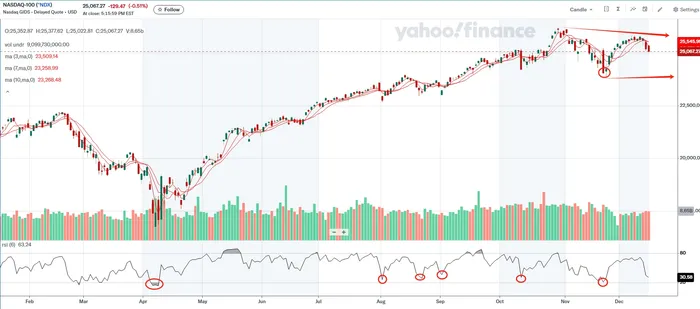
In contrast, the S&P 500 has shown greater resilience. While it also hints at a double-top structure, its MA(7,10) remain relatively flat, and the Dow Jones Industrial Average is hovering near record highs, indicating stronger confidence in traditional sectors.
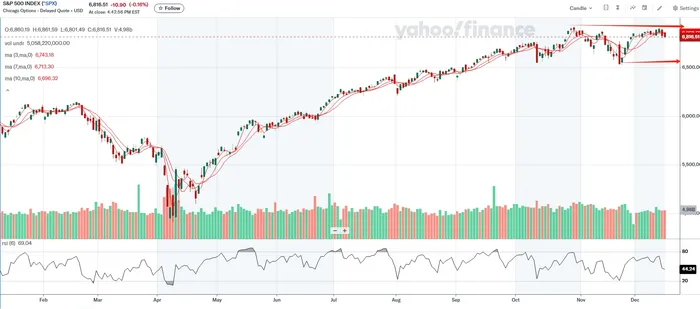
Taken together, recent price action suggests that selling pressure is primarily driven by AI-related fatigue rather than broad-based market stress. As a result, investors may consider a more defensive posture into year-end. For those still seeking alpha through higher-risk strategies, deeper and more selective research will be required.
Crypto continues to track technology stocks closely. BitcoinBTC-- has fallen below the $90,000 level, while EtherETH-- has once again slipped under $3,000, moving back toward its late-November lows. Buying the dip at this stage appears unwise, as both major cryptocurrencies have tested these psychological levels three times over the past two months, signaling a deterioration in market confidence. A new session low could trigger a more aggressive sell-off, potentially accompanied by liquidity stress.
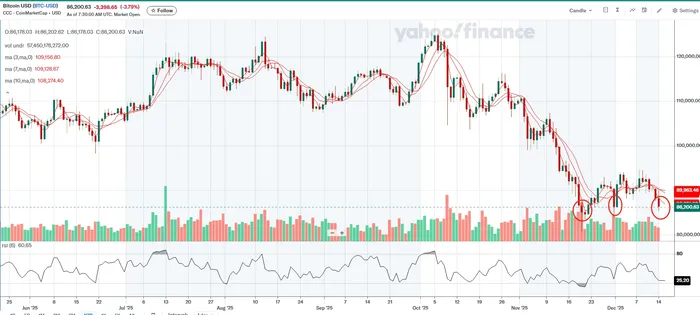
The argument that a dovish Federal Reserve would support crypto prices has not held this time. December's rate cut provided only a brief lift before sentiment quickly faded, and the weaker dollar has failed to reignite risk appetite. Weak technical signals serve as early warnings, but fundamentals appear increasingly chaotic.
Former AI market leaders such as Broadcom, Oracle, Micron, and CoreWeave have faced heavier selling pressure as ambitious data center projects slow and previously embedded valuation premiums begin to unwind. The competitive landscape among AI models, including ChatGPT, Gemini, and Claude, has intensified, prompting companies to reallocate resources toward model optimization. At the same time, massive data center backlogs require further capital, often without firm funding commitments, increasing uncertainty and raising the possibility that AI infrastructure expansion could pause as competition escalates.
Despite these headwinds, the tech-heavy Nasdaq 100 remains richly valued, with gains of roughly 20% year to date and three consecutive years of advances. Recent losses among prior AI winners may reflect a beta-driven adjustment, yet downside risks should not be underestimated, especially given fragile sentiment heading into year-end and early 2026. Further declines in AI-related stocks could set off a domino effect, particularly in the current delicate market environment.
Latest nonfarm payroll and CPI data may offer additional insight as the impact of the government shutdown fades. However, at some point, these releases may become little more than noise. If numbers meet or exceed expectations, markets could initially react positively, but selling pressure in technology stocks may still dominate, potentially producing an open-high, close-low session. Conversely, if the data disappoint and the unemployment rate rises above 4.5%, it would suggest the economy is entering a more dangerous phase, likely intensifying equity market pressure.
When a broad selling wave takes hold, positive headlines rarely shift sentiment in a lasting way. Instead, rallies often provide opportunities to reduce exposure and wait for clearer signs that a durable bottom is approaching.
In conclusion, with technical fatigue in technology stocks, visible cracks among former AI leaders, and rising economic uncertainty, we maintain a bearish stance into year-end and the start of 2026. A rough path lies ahead as richly valued AI stocks must deliver substantially more to justify current pricing. Crypto markets also warrant close attention, as several warning signals are already emerging.

Independent investment research powered by a team of market strategists with 20+ years of Wall Street and global macro experience. We uncover high-conviction opportunities across equities, metals, and options through disciplined, data-driven analysis.
Latest Articles
Unlock Market-Moving Insights.
Subscribe to PRO Articles.
Already have an account? Sign in
Unlock Market-Moving Insights.
Subscribe to PRO Articles.
Already have an account? Sign in
Stay ahead of the market.
Get curated U.S. market news, insights and key dates delivered to your inbox.




