
How to Avoid the 'Pre-Revenue' Trap: Valuing Junior Miners Before Production
 Aime Summary
Investing in the stock market often feels like navigating a landscape of predictable terrain, but the junior mining sector is a different beast entirely. These are small-cap companies exploring for gold, lithium, copper, or rare earth elements. They hold the promise of discovering the next major deposit, but they also carry the risk of total loss. For many investors, the allure of turning a small investment into a fortune is strong, but without understanding the unique valuation challenges of pre-revenue miners, it is easy to fall into a costly trap. This article explores how to evaluate these high-risk assets responsibly.
The core concept here is 'pre-revenue valuation.' Unlike established companies that can be valued based on current profits or cash flow, junior miners have no product to sell and no income to report. Therefore, traditional metrics like the Price-to-Earnings (P/E) ratio are useless. Instead, investors must rely on speculative valuation methods. The value of a junior miner is not derived from what it is earning today, but from the perceived potential of its assets tomorrow. This potential is driven by geological data, the quality of the exploration site, the experience of the management team, and the commodity’s long-term price outlook. Understanding this shift from income-based to asset-and-potential-based valuation is crucial for navigating this sector.
Applying this concept requires a strategic shift in mindset. Investors should not look for immediate returns but rather for asymmetric upside potential. A common strategy is 'basket investing,' where an investor spreads capital across several junior miners rather than betting everything on one. This mitigates the risk of a single project failing. Another strategy is focusing on 'proximity plays.' Sometimes, a junior miner is valued not just on its own merits, but on its location near a major producer. If a large mine is expanding and needs more ore, nearby junior explorers often see their stock prices rise due to speculation of acquisition or supply contracts. Additionally, investors should monitor the 'drill results.' Each new drill core sample is a data point that either validates the geologist’s hypothesis or disproves it. Consistent, high-grade drill results are the primary catalyst for stock price appreciation in this sector.
Consider the case of a fictional company, 'Greenstone Metals,' which was trading at $0.50 per share in 2018. The company held an exploration permit in a historically productive gold region. While the market ignored it, a new geological survey suggested the presence of a large, shallow deposit. 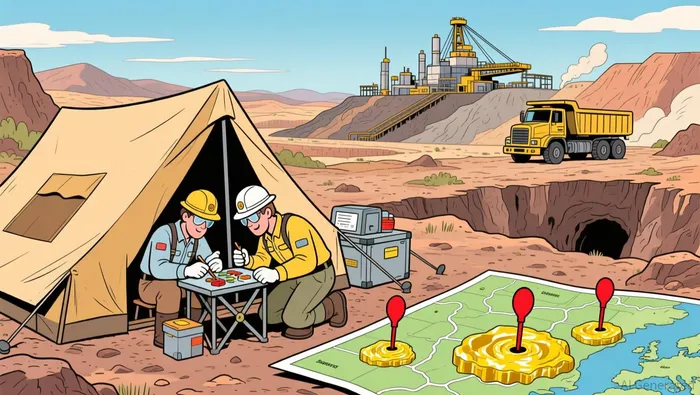 Greenstone announced initial drill results showing significant gold grades. The market reacted not to revenue, but to the revised estimate of the resource size. Over the next two years, as they defined more of the deposit, the stock rose to $2.00, not because they were selling gold, but because the probability of a future mine became higher. However, another company in the same region, 'RedRock Minerals,' announced similar-looking results that turned out to be misleading due to poor sampling. Its stock collapsed. This case illustrates that geological data is the currency of the pre-revenue miner, and accuracy is paramount.
Despite the potential for high rewards, the risks are severe. The majority of junior miners fail to find economically viable deposits. Even if they find gold, they may never secure the financing to build a mine. Furthermore, they are highly sensitive to commodity price swings and regulatory changes. To mitigate these risks, investors must conduct thorough due diligence. Read the technical reports filed with regulatory bodies, such as NI 43-101 in Canada, which provide independent scientific assessment of the mineral resources. Never invest money you cannot afford to lose. Diversify your holdings within the sector, and always have an exit strategy. By respecting the complexity of pre-revenue valuation and focusing on geological fundamentals rather than hype, investors can participate in the mining sector’s potential while protecting their capital from the inevitable traps.

Stay ahead of the market.
Get curated U.S. market news, insights and key dates delivered to your inbox.


AInvest
PRO
AInvest
PRO




Comments
No comments yet