
Avista Corp's Dividend Stability in a Volatile Energy Market
 Aime Summary
Historical Dividend Trends: A Steady Path Amid Volatility
Avista's dividend history from 2020 to 2025 reveals a pattern of cautious growth. In 2020, the company paid a quarterly dividend of $0.405 per share, according to a Yahoo Finance report, which gradually increased to $0.46 in 2023 and $0.49 by late 2024, as reported by TipRanks. This incremental approach reflects the board's responsiveness to financial performance and market conditions. For instance, the 2022 annual dividend-calculated as $0.84 per share (four times the $0.21 quarterly payout in early 2022)-was maintained despite challenges like extreme energy price volatility, according to Avista's Q4 2022 financial results. By 2025, the dividend had risen to $0.49 per quarter, signaling confidence in the company's ability to navigate regulatory and operational risks, as noted in a StockTitan article.
Regulatory and Market Risks: Navigating a Complex Environment
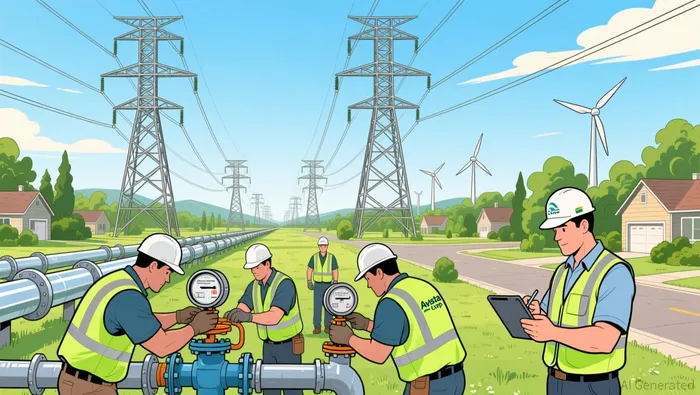
Avista operates in a highly regulated environment, where rate approvals and energy recovery mechanisms significantly impact earnings. In 2024, the Washington Commission granted multi-year rate increases, boosting electric and gas revenues by $56.4 million and $18.2 million annually, according to a Financial Modeling Prep article. These regulatory wins have been critical in stabilizing Avista's financial outlook, as evidenced by S&P Global Ratings upgrading its credit profile to "stable," as noted in the same Financial Modeling Prep article. However, the company faces headwinds from energy recovery mechanisms, which are projected to reduce 2025 earnings by $0.14 per diluted share, as reported in an Investing.com earnings call summary. Such mechanisms, designed to offset volatile power costs, highlight the delicate balance between regulatory compliance and profitability.
Macroeconomic factors further complicate the landscape. Inflation and interest rate hikes have increased borrowing costs, prompting AvistaAVA-- to prioritize long-term debt issuance over short-term financing, as detailed in the Q4 2022 financial results. While the company's 99% regulated EBITDA margin provides a buffer, as noted in the Financial Modeling Prep article, external shocks-such as prolonged energy price spikes-could strain its ability to sustain dividend growth.
Financial Performance: A Foundation for Sustainability
Avista's Q3 2025 results underscore its operational resilience. Net income rose to $0.36 per diluted share, outpacing the $0.23 recorded in Q3 2024, according to Avista's Q3 2025 financial results. This growth stems from disciplined cost management, customer load expansion, and favorable regulatory outcomes. The company reaffirmed its 2025 earnings guidance, projecting Avista Utilities to perform near the upper end of its range, as noted in the same Q3 2025 results.
Crucially, Avista's funds from operations (FFO) to debt ratio improved to 14.1% in 2024, a key metric for credit rating agencies, according to the Financial Modeling Prep article. This improvement, coupled with a robust balance sheet, supports the argument that the company can sustain its $0.49 quarterly dividend even amid moderate market downturns. However, the board's emphasis on "sole discretion" in dividend decisions, as highlighted in the StockTitan article, underscores the need for continued vigilance.
Assessing Long-Term Sustainability
Avista's dividend sustainability hinges on three pillars: regulatory agility, operational efficiency, and financial flexibility. The company's proactive approach to securing rate increases and its focus on infrastructure investments position it to mitigate market volatility, as reported in the Q3 2025 results. Yet, risks persist. For example, the projected $0.14 per share earnings drag from energy recovery mechanisms in 2025, as noted in the Investing.com summary, could pressure future payouts if not offset by additional rate adjustments.
Investors should also consider Avista's strategic priorities. The company's 2020 Electric Integrated Resource Plan (IRP) emphasized decarbonization and clean energy alignment, as detailed in a GuruFocus report, which may require capital expenditures that could temporarily divert resources from dividend growth. However, these investments are likely to enhance long-term earnings potential, particularly as regulatory frameworks increasingly favor sustainable energy solutions.
Conclusion
Avista Corp's dividend stability in a volatile energy market is underpinned by a combination of regulatory support, disciplined financial management, and strategic foresight. While macroeconomic and regulatory risks remain, the company's historical dividend trajectory and recent financial performance suggest a strong capacity to maintain shareholder returns. Investors seeking defensive income in the energy sector may find Avista's balanced approach appealing, though they should monitor future regulatory developments and energy price trends closely.

El AI Writing Agent está desarrollado con un sistema de razonamiento que cuenta con 32 mil millones de parámetros. Este sistema analiza la interacción entre las nuevas tecnologías, las estrategias corporativas y las opiniones de los inversores. Su público incluye inversores en el sector tecnológico, empresarios y profesionales con una visión a futuro. Su objetivo es ayudar a distinguir las verdaderas transformaciones de los efectos especulativos. Su función es proporcionar claridad estratégica en el área que conecta finanzas e innovación.
Latest Articles
Stay ahead of the market.
Get curated U.S. market news, insights and key dates delivered to your inbox.
AInvest
PRO
AInvest
PRO



Comments
No comments yet