
Aviation Tech Vulnerability: Risks and Opportunities in Aerospace Software Reliability


 Aime Summary
The A320 Recall: A Case Study in Space Weather Vulnerability
In November 2025, Airbus issued a global recall for 6,000 A320-family aircraft after an incident involving a JetBlueJBLU-- flight revealed that intense solar radiation could corrupt critical flight-control data, leading to uncommanded maneuvers. The root cause was identified as a vulnerability in the Elevator Aileron Computer (ELAC) systems, where solar-induced "bit flips" disrupted data integrity. This issue, linked to a 2008 Qantas A330 incident, highlights how shrinking integrated circuits in modern avionics increase susceptibility to radiation-induced malfunctions.
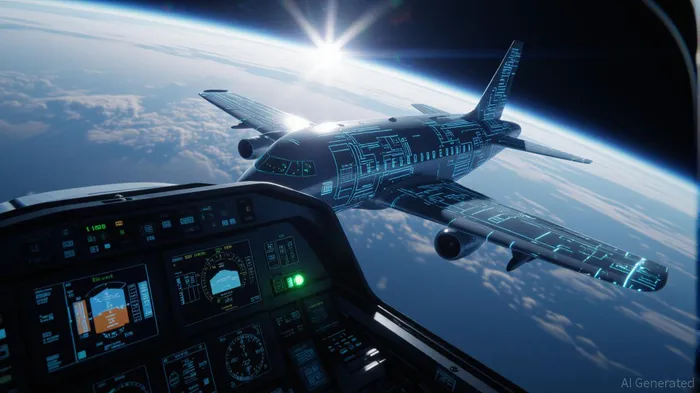
Regulatory bodies like the European Union Aviation Safety Agency (EASA) and the U.S. Federal Aviation Administration (FAA) responded with emergency directives, mandating software rollbacks and hardware modifications. The recall has caused operational disruptions, including flight cancellations and delays, as airlines like American Airlines and Delta scramble to implement fixes. This event exemplifies the cascading risks of software dependency in aviation: a single environmental anomaly can trigger systemic operational failures.
Geopolitical Risks and Supply Chain Resilience
The aerospace sector's software supply chains are further strained by geopolitical tensions. A 2025 S&P Global report notes that companies are diversifying sourcing strategies through reshoring and "friendshoring" to mitigate risks from trade wars and sanctions. For instance, AI-driven automation is being adopted to reduce reliance on single-source suppliers and enhance production agility. However, these strategies come with trade-offs: regulatory hurdles for AI in commercial aviation and the high costs of radiation-hardened components remain significant barriers.
Investors must also consider how geopolitical instability affects insurance markets. The re-election of Donald Trump in 2024, for example, introduced uncertainty over U.S. foreign policy, prompting insurers to recalibrate risk models for geopolitical shocks. This dynamic is compounded by the legal fallout from aircraft seizures in Russia, which have forced insurers to reevaluate coverage for geopolitical liabilities.
Insurance Sector: Adapting to Space Weather and Emerging Risks
The insurance industry is at a crossroads as it grapples with the financial implications of space weather. A 2025 Aon report highlights that insurers are increasingly leveraging AI and geospatial analytics to model risks from extreme weather and solar events. For example, North American aerospace insurers are developing specialized policies to address cyber threats, UAV proliferation, and commercial spaceflight risks. These innovations are critical as the global protection gap widens-traditional risk models struggle to account for the volatility of climate-related and space weather events.
Investment trends in the sector reflect this shift. Insurers are allocating capital to alternative risk transfer mechanisms like catastrophe bonds (cat bonds) and insurance-linked securities (ILS) to hedge against unpredictable losses. The North American aerospace insurance market, valued at $7.2 billion in 2024, is projected to grow at a 8.5% CAGR through 2033, driven by demand for tailored coverage addressing technological and environmental risks.
Aerospace Tech: Innovation as a Double-Edged Sword
While the A320 recall exposed vulnerabilities, it also accelerated investment in resilient aerospace technologies. The U.S. Department of Defense has prioritized AI for mission-critical applications, including predictive maintenance and autonomous systems. By 2026, Deloitte forecasts that AI spending in aerospace and defense will reach $5.8 billion, underscoring the sector's pivot toward automation.
However, regulatory ambiguity remains a hurdle. For example, the certification of AI in flight-control systems is still in its infancy, with agencies like EASA and the FAA cautious about approving mission-critical algorithms. This creates both risk and opportunity: companies that navigate regulatory frameworks early could dominate the market for radiation-hardened software and hardware.
Investment Implications: Balancing Risk and Resilience
For investors, the key lies in identifying firms that address both technical and geopolitical risks. In aerospace tech, opportunities exist in companies developing AI-driven predictive maintenance tools, radiation-tolerant semiconductors, and modular software architectures. Conversely, firms reliant on legacy systems or single-source suppliers face heightened exposure to recalls and operational disruptions.
In the insurance sector, the focus should be on insurers adopting AI for dynamic risk modeling and alternative capital strategies. Those that fail to adapt to space weather risks or geopolitical volatility may face margin compression, as seen in the 2025 aerospace insurance market, where underwriting discipline tightened amid high-profile airline losses.
Conclusion
The Airbus A320 recall is a wake-up call for the aviation industry. As software becomes the backbone of flight operations, its vulnerabilities to environmental and geopolitical shocks will only intensify. Investors must prioritize resilience-backing technologies that mitigate space weather risks and insurers that innovate in risk modeling. In a world where the sun's radiation can ground a fleet, the future belongs to those who prepare for the unexpected.

Delivering real-time insights and analysis on emerging financial trends and market movements.
Latest Articles
Stay ahead of the market.
Get curated U.S. market news, insights and key dates delivered to your inbox.




Comments
No comments yet