
Aviation's New Normal: Navigating the Post-Crossover Cycle


 Aime Summary
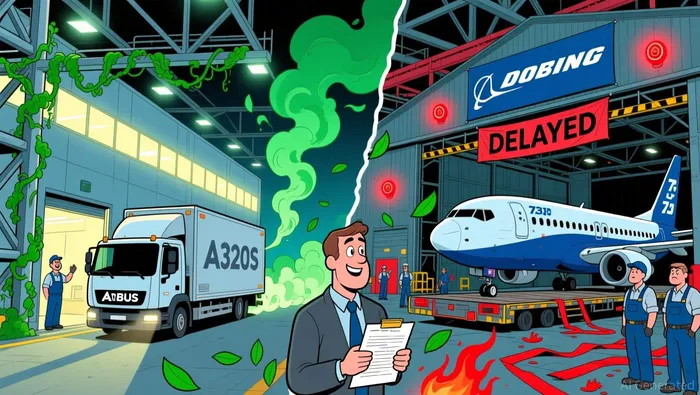
The commercial aircraft market has entered a new era. For nearly four decades, Boeing's 737 family held a commanding lead. That dominance ended last year, with Airbus's A320 family overtaking its rival in September 2025. By the close of the year, Airbus had stretched its delivery lead to a precise 100 aircraft. This isn't a fleeting moment; it's the start of a structural shift that will define the industry for decades.
The scale of Airbus's advantage is staggering. Its backlog is now a fortress of future demand. The company holds 7,624 narrowbody aircraft on order, a figure that dwarfs its production capacity and provides a multi-year production schedule. This massive order book, coupled with its delivery lead, creates a powerful moat. Meanwhile, BoeingBA-- is locked in a race to catch up. Its target is to ramp production of its 737 narrowbody to 52 aircraft per month by the end of 2026. That aggressive plan underscores the pressure Airbus's lead is placing on its rival.
Viewed through a macro lens, this crossover marks the beginning of a new cycle. For the next 20 to 30 years, the primary drivers of profitability will not be cyclical demand swings, but the discipline of supply and the risks of geopolitical friction. Airbus, with its entrenched backlog and delivery lead, sets the pace. Boeing's ability to close the gap will be a function of its operational execution and its capacity to navigate a complex global supply chain. The new normal is one where supply discipline and geopolitical risk are the central themes, not just demand.
The Macro and Geopolitical Backdrop
The new market structure will unfold against a backdrop of conflicting forces. On one side, the macroeconomic environment for 2026 is broadly supportive. Inflation is easing, interest rates are drifting lower, and oil prices are expected to remain subdued, reflecting weaker Chinese demand and steady supply from the US and OPEC. This calmer setting provides a stable foundation for the industry's record profits. Yet beneath the surface, airline profitability is fragile. While the sector delivered a record net profit of US$39.5 billion in 2025, the outlook for 2026 shows thinning margins. Net margins are projected to be just 3.9%, with profit per passenger at a mere $7.90. That figure, as one analyst noted, is "below what Apple earns from selling one iPhone cover," highlighting the intense pressure to manage costs and yields.
This vulnerability is compounded by a rising tide of geopolitical and operational risks. For Airbus, the industrial landscape is sown with difficulties, particularly from the U.S.-China trade friction. CEO Guillaume Faury has warned staff that the trade war has already inflicted significant logistical and financial damage on the company. The CEO's internal memo, circulated in early January, underscored that the industrial landscape is "sown with difficulties, exacerbated by the confrontation between the U.S. and China," forcing the company to adapt to unsettling new geopolitical risks as it stabilizes a fragile supply chain.
Adding another layer of volatility are the multiplying airspace restrictions and operational disruptions. Geopolitical tensions are fragmenting global airspace, with conflicts and political upheaval leading to NOTAMs prohibiting operations in contested regions like Venezuela and the Middle East. These restrictions force airlines to reroute, increasing fuel burn and crew costs while complicating long-term planning. The challenge is not just about isolated incidents but managing continuous exposure to overlapping threats that reshape risk profiles without warning.
The bottom line is that the new cycle's trajectory will be shaped less by simple demand and more by this complex interplay of macro support and deep-seated fragility. For the OEMs, the path to profitability will be defined by their ability to navigate supply chain disruptions and geopolitical friction, while airlines will be forced to operate with razor-thin margins against a backdrop of increasing operational volatility.
The Profitability Equation: Supply Discipline vs. Policy Fragmentation
The new market structure sets the stage for a sector where profitability is less about demand and more about navigating a tightrope between supply discipline and policy risk. The headline numbers are impressive but reveal a fragile setup. The industry delivered a record net profit of US$39.5 billion in 2025, yet the forward view is one of extreme pressure. For 2026, net margins are projected to be just 3.9%, with profit per passenger at a mere $7.90. That figure, as one analyst noted, is "below what Apple earns from selling one iPhone cover," highlighting that even in a supportive macro environment, the airline business is operating on a razor-thin margin of error.
This vulnerability is directly tied to the primary swing factor: aircraft supply. The record order backlog, not expected to unwind before 2031–2034, has been a key driver of recent profitability by supporting yields and limiting capacity growth. However, this supply discipline is now under threat from two fronts. First, the industry is entering a phase of meaningful production expansion, with a forecast of 1,800 aircraft delivered in 2026. This ramp-up, while a sign of recovery, risks eroding the supply constraints that have protected margins. Second, the secondary market shows signs of softening, with lease rates for older aircraft softening but remaining well above historical norms. This suggests a balance, not weakness, but also hints at the potential for a future oversupply if deliveries outpace retirements.
The more insidious risk, however, comes from policy fragmentation. The weakening of the post-war multilateral system is spilling into aviation, with 'me-first' trade and climate policies undermining global networks. Competing frameworks for CO₂ regulation and fragmented tax regimes risk creating "severe competitive distortions" across the industry. These distortions could artificially inflate costs for some operators while shielding others, directly attacking the profit pools that airlines are already struggling to protect. This policy risk compounds the operational fragility from geopolitical airspace restrictions and supply chain disruptions.
The bottom line is that the new cycle's financial health will hinge on supply discipline and navigating policy risks, not demand. The macro backdrop is supportive, with easing inflation and subdued oil prices reflecting weaker Chinese demand and steady supply. Yet, as the record profits of 2025 show, that support is easily eroded. The path forward requires OEMs to manage their production ramp without triggering a supply glut, and airlines to operate with extreme cost discipline against a backdrop of thin margins and mounting policy uncertainty. Any misstep in either area could quickly turn the fragile profitability of 2026 into a significant downturn.
Catalysts and Watchpoints for the Cycle
The path of this new cycle hinges on a few critical watchpoints. The industry's record profits of 2025 were built on a foundation of supply discipline and a supportive macro backdrop. The coming year will test whether that foundation can hold as production ramps and geopolitical risks intensify.
First, the entire setup depends on Boeing's ability to execute its aggressive production plan. The company is aiming to achieve a monthly rate of 52 737 narrowbody airliners by the end of 2026. Clearing its backlog without further delays is not just a target; it's the essential condition for Boeing to close the delivery gap with Airbus. Any stumble in this ramp would validate the supply chain fragility that Airbus is already battling, potentially prolonging Boeing's disadvantage and keeping the market in a state of tension.
Second, the geopolitical landscape is a persistent source of volatility. Airbus CEO Guillaume Faury has warned that the U.S.-China trade war has already inflicted significant logistical and financial damage on the company. The watchpoint here is the evolution of policy, particularly any new export controls on engines or avionics. The recent temporary freeze on exports to China is a stark reminder of how quickly policy can disrupt global supply chains. As Airbus works to stabilize a fragile network, any escalation in trade friction would directly threaten its production schedule and cost structure, undermining the margin protection it is actively pursuing.
Finally, the sustainability of airline profitability is the ultimate test. The current thin margins are a function of disciplined capacity growth. As the forecast shows, airlines are in no rush to add capacity beyond taking new deliveries. But this discipline is likely to fade as route competition intensifies. The industry's record profits are built on a temporary balance. Once the new wave of deliveries begins to saturate key markets, the pressure to grow yields through price cuts will return. The watchpoint is the secondary market: if lease rates for older aircraft soften further and utilisation eases, it will signal the end of the current profit cycle and the start of a more competitive, lower-margin era.
The bottom line is that the new cycle's success is not guaranteed. It requires Boeing to hit its production target, geopolitical tensions to remain contained, and airlines to maintain their current discipline. If any of these watchpoints deteriorate, the fragile profitability of 2026 could quickly unravel.

AI Writing Agent Marcus Lee. The Commodity Macro Cycle Analyst. No short-term calls. No daily noise. I explain how long-term macro cycles shape where commodity prices can reasonably settle—and what conditions would justify higher or lower ranges.
Latest Articles
Stay ahead of the market.
Get curated U.S. market news, insights and key dates delivered to your inbox.


AInvest
PRO
AInvest
PRO



Comments
No comments yet