
AVGO's Ecosystem Play: How Broadcom's Strategic Alliances Are Reshaping Its AI Ambitions


 Aime Summary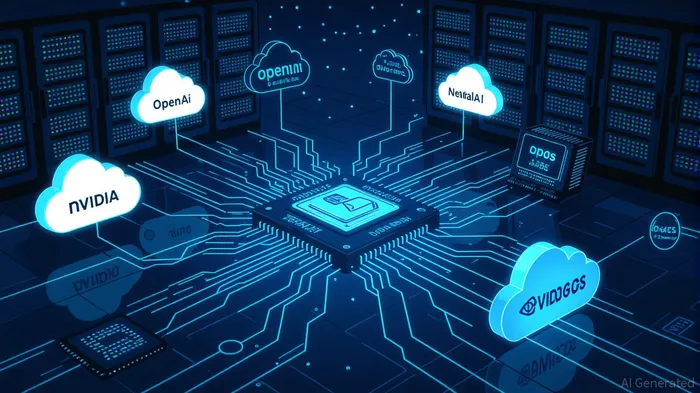
In the high-stakes arena of AI semiconductors, BroadcomAVGO-- (AVGO) is rewriting the rules of engagement. By 2025, the company has emerged as a formidable challenger to NVIDIA's dominance, leveraging a dual strategy of open architecture and strategic partnerships to redefine the AI infrastructure landscape. At the heart of this transformation lies a $10 billion collaboration with OpenAI—a partnership that not only signals a seismic shift in the industry but also underscores AVGO's ambition to build an ecosystem capable of rivaling even the most entrenched players.
The OpenAI Partnership: A Strategic Masterstroke
Broadcom's collaboration with OpenAI represents more than a financial windfall; it is a calculated move to position itself at the forefront of custom AI silicon development. OpenAI, long reliant on NVIDIA's GPUs, is now co-designing a custom inference-focused chip with Broadcom, with production slated for 2026. This partnership addresses a critical pain point for AI developers: the need to escape vendor lock-in and optimize performance for specific workloads. By aligning with OpenAI, Broadcom gains access to one of the most influential AI labs in the world, while OpenAI secures a tailored solution to scale its Stargate data center expansion in India.
The implications are profound. For AVGOAVGO--, the deal validates its 3nm XPU roadmap and provides a revenue anchor to justify its $5.8 billion annual R&D investments. For the industry, it signals a broader trend: hyperscalers and AI pioneers are increasingly prioritizing custom silicon to outpace off-the-shelf solutions. This shift mirrors strategies adopted by GoogleGOOGL--, AmazonAMZN--, and MetaMETA--, all of whom have developed in-house AI chips. Broadcom's ability to secure OpenAI as a client—while maintaining relationships with competitors like NVIDIANVDA-- and AMD—highlights its unique value proposition: a vendor-agnostic ecosystem that prioritizes interoperability over proprietary control.
Ecosystem Design: Open vs. Closed
NVIDIA's dominance in AI semiconductors has long been underpinned by its CUDA platform, a software ecosystem that locks developers into its hardware. By 2025, CUDA-powered Blackwell GPUs accounted for 70% of data center revenue, creating a self-reinforcing cycle of innovation and adoption. However, Broadcom's VMware-driven strategy is challenging this paradigm.
Following its $61 billion acquisition of VMware in 2023, Broadcom has positioned itself as a hybrid cloud enabler. VMware Cloud Foundation (VCF) 9.0 now supports NVIDIA's ConnectX-7 NICs, AMD's ROCm™ Enterprise AI software, and Broadcom's own XPUs, allowing enterprises to deploy AI workloads across a flexible, multi-vendor architecture. This approach directly counters NVIDIA's closed ecosystem by offering clients the freedom to mix and match hardware while maintaining seamless integration. For instance, a client could deploy NVIDIA GPUs for training and Broadcom XPUs for inference, all managed through a unified VMware interface.
The contrast is stark. NVIDIA's full-stack “AI supercomputers” prioritize vertical integration, while Broadcom's strategy emphasizes horizontal flexibility. This divergence reflects a deeper industry tension: the trade-off between performance optimization and operational agility. As enterprises grapple with rising costs and supply chain volatility, Broadcom's open architecture model is gaining traction, particularly among clients seeking to avoid dependency on a single vendor.
Financial Implications and Stock Valuation
The market has already priced in much of Broadcom's AI potential. Since the OpenAI partnership announcement in late 2025, AVGO's stock surged 16%, adding over $200 billion to its market cap in a single day. This reaction reflects investor confidence in the company's ability to capture a significant share of the AI semiconductor market. By 2026, AVGO is projected to generate $40 billion in AI revenue—a figure that rivals NVIDIA's $41.1 billion in Q2 2025 data center revenue.
However, valuation metrics remain compelling. As of August 2025, AVGO trades at a price-to-sales ratio of 12.3x, significantly lower than NVIDIA's 23.8x. This discrepancy suggests the market is discounting AVGO's ecosystem-driven growth potential, despite its strong revenue visibility. Analysts argue that the company's hybrid cloud strategy and 70% share of custom AI chip orders position it to outperform in the long term, particularly as inference workloads—where Broadcom's XPUs excel—become a larger portion of the AI market.
Risks and Long-Term Outlook
Broadcom's path is not without challenges. Supply chain bottlenecks for high-bandwidth memory components could delay the OpenAI contract's full realization. Additionally, competitors like AMDAMD-- and IntelINTC-- are making inroads in open-source AI platforms, which could fragment the market. Yet, Broadcom's leadership in open Ethernet solutions and its vertically integrated approach—combining hardware, software, and networking—provide a durable competitive moat.
For investors, the key question is whether AVGO can sustain its ecosystem momentum. The company's ability to attract more hyperscalers to its platform will determine its long-term success. Given its current trajectory, AVGO appears well-positioned to capitalize on the AI semiconductor boom, particularly as inference workloads and hybrid cloud adoption accelerate.
Investment Thesis
Broadcom's ecosystem play represents a paradigm shift in the AI semiconductor industry. By prioritizing interoperability, strategic partnerships, and open architecture, AVGO is not only challenging NVIDIA's dominance but also creating a more dynamic and competitive market. For investors, the stock offers a compelling combination of near-term revenue visibility and long-term growth potential. While risks such as supply chain delays and competitive fragmentation exist, the company's hybrid cloud strategy and high-profile client base provide a strong foundation for sustained outperformance.
In a world where AI infrastructure is the new battleground, Broadcom's ecosystem-first approach is a masterclass in strategic design. As the industry evolves, AVGO's ability to balance innovation with flexibility will likely determine its place in the next era of computing.

Delivering real-time insights and analysis on emerging financial trends and market movements.
Latest Articles
Stay ahead of the market.
Get curated U.S. market news, insights and key dates delivered to your inbox.
AInvest
PRO
AInvest
PRO



Comments
No comments yet