
AVEM's 2025 Surge: A Factor-Driven ETF's Macro and Concentration Risks for 2026


 Aime Summary
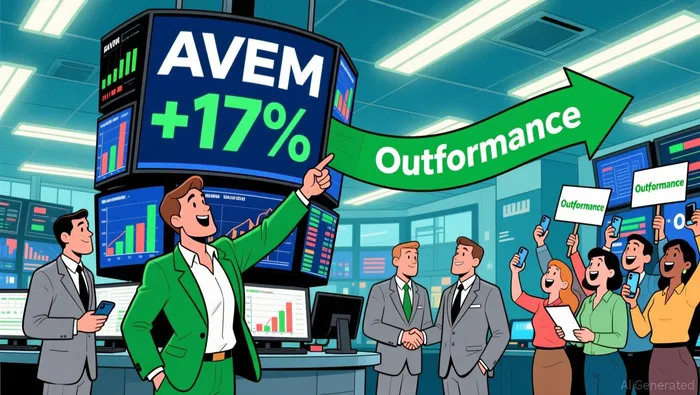
The Avantis Emerging Markets Equity ETF delivered a commanding 35% return in 2025, a performance that decisively beat the U.S. market benchmarks. Its outperformance was not marginal; it beat both Vanguard S&P 500 ETF (VOO) and Vanguard Total Stock Market ETF (VTI) by roughly 17 percentage points. This wasn't just a good year; it was a statement that emerging markets, particularly in Asia, were having their moment. The central question for 2026 is whether this was a sustainable factor-driven story or a cyclical event powered by specific, potentially fleeting, tailwinds.
The macro backdrop provided a clear tailwind. A 9% decline in the U.S. dollar through much of 2025 boosted returns for U.S. investors in foreign assets. This dollar weakness made emerging market equities more attractive, lowered the cost of servicing dollar-denominated debt for local companies, and amplified local currency returns. For AVEMAVEM--, this was a powerful, external catalyst that amplified its underlying portfolio performance. The fund's success, therefore, was a story of aligning with two powerful trends: a weakening dollar and a resurgent Asian tech cycle.
That alignment was baked into the portfolio's structure. AVEM's 6.35% allocation to Taiwan Semiconductor was the single largest position, with heavy exposure to other Asian tech giants. This concentration was the engine of its outperformance. As AI chip demand surged, the fund's semiconductor-heavy tilt captured massive gains. The risk, however, is equally concentrated. This heavy bet on a single sector and a single geographic region-Taiwan being a significant portion of holdings-creates a single-point vulnerability. The fund's returns are now inextricably linked to the fortunes of a cyclical industry and a geopolitically sensitive region. If the semiconductor cycle turns or supply chain disruptions emerge, AVEM will feel the impact immediately.
The bottom line is that AVEM's 2025 success was a high-conviction, concentrated play on a powerful macro and sector convergence. It leveraged dollar weakness and the AI chip boom through a portfolio tilted toward Asian technology. This strategy delivered exceptional returns but also concentrated risk. The fund's future performance will depend on whether these tailwinds persist and whether its concentrated bets continue to outpace broader market trends. For investors, the story is clear: the 2025 return was impressive, but it was also a story of specific, high-conviction bets that may not be easily repeatable.
The 2026 Thesis: Sustaining Factor Alpha Amidst Geopolitical and Macro Friction
The 2025 success of the Avantis Emerging Markets Equity ETF (AVEM) was a powerful demonstration of factor alpha in action. The fund's systematic tilt toward smaller, undervalued stocks, combined with a concentrated bet on the AI-driven semiconductor cycle, powered a 35% return that decisively beat broad U.S. market benchmarks. This outperformance was amplified by a 9% dollar decline, which boosted emerging market assets. For 2026, the thesis hinges on whether this combination of active management, factor exposure, and sector concentration can withstand a more challenging macro and geopolitical backdrop.
The first headwind is cost. AVEM's 0.33% expense ratio is a significant premium over the 0.09% fee of a broad-market alternative like IEMG. This gap is a persistent drag on returns, especially in a year where the fund's strategy may face a broader market shift. The fund's framework is built on capturing value and size premiums, but these factors are not guaranteed to lead. If large-cap emerging market dominance reasserts in 2026, AVEM's active tilt toward smaller, undervalued names could become a source of underperformance, not outperformance.
The second, and more acute, risk is concentration. AVEM's portfolio is dominated by a handful of semiconductor giants, with Taiwan Semiconductor (TSM) at 6.35% of the portfolio. This is a symptom of a far more systemic vulnerability: the global supply chain for advanced chips is 90% concentrated in TSMC. This creates a single point of failure for the fund's returns. While TSMC's expansion into Arizona and other regions provides a long-term diversification benefit, it does not eliminate the immediate geopolitical friction. The fund's performance remains tethered to the stability of Taiwan, a flashpoint in U.S.-China relations. Any escalation in cross-strait tensions or a shift in U.S. tech policy could trigger a sharp de-rating in these core holdings, overwhelming any factor alpha the fund might generate.
The bottom line is that AVEM's 2026 thesis is a high-wire act. The fund's active management framework, which seeks to exploit inefficiencies in the market, now operates against two powerful headwinds: a higher cost structure and a portfolio heavily exposed to a single, geopolitically sensitive sector. The macro tailwind of a weak dollar remains a potential ally, but it is a variable outside the fund's control. For AVEM to sustain its alpha, it must not only navigate a potential factor rotation but also avoid being caught in a supply chain shock. The fund's concentrated semiconductor bet, which delivered spectacular results in 2025, is now its greatest vulnerability.
Risk & Guardrails: Where the 2026 Narrative Could Break
The bullish narrative for AVEM is built on a powerful, recent performance. The fund delivered a 19.19% return over the past year, a figure that outpaces its 14.55% three-year annualized return. This gap signals a sharp acceleration in momentum, driven by a potent macro tailwind: a 9% dollar decline that boosted emerging market assets. In practice, this means the fund's outperformance in 2025 was not solely due to superior stock selection, but was significantly amplified by currency moves. This creates a fragile foundation. If the dollar reverses its trend, AVEM's momentum could stall regardless of the underlying performance of its holdings. The fund's success is now inextricably linked to the direction of the U.S. dollar, a variable it cannot control.
The concentration risk is more direct and geographically specific. AVEM's portfolio is heavily tilted toward Asian technology, with Taiwan Semiconductor (TSM) as its largest holding at 6.35%. This semiconductor exposure delivered spectacular results in 2025 as AI chip demand surged, but it also creates a single point of vulnerability. A reversal in the semiconductor cycle or any supply chain disruption would hit the fund immediately. The geopolitical risk from Taiwan is a constant, subtle threat that does not exist in broad U.S. market funds. Any escalation in cross-strait tensions or a shift in U.S.-China tech policy could trigger a sharp de-risking of this concentrated position.
The most profound threat, however, comes from AVEM's deep exposure to China. The fund holds significant positions in Chinese tech giants and banks, making it a pure-play on Beijing's economic trajectory. The government's recent support for the private sector helped fuel 2025's gains. But this support is a policy variable, not a structural certainty. If Beijing tightens its regulatory grip or if broader economic growth in China falters, AVEM's holdings would face direct headwinds. The fund's performance is thus a proxy for China's policy direction, a high-stakes bet on a single, complex economy.
The bottom line is that AVEM's impressive recent run is a story of perfect macro alignment-dollar weakness, a booming semiconductor cycle, and supportive Chinese policy. The guardrails are thin. A reversal in any one of these three pillars-a stronger dollar, a semiconductor downturn, or a shift in China policy-could break the narrative and leave the fund vulnerable to a sharp pullback. The mixed picture between short-term strength and longer-term metrics underscores this fragility. The fund is priced for continued perfection, leaving little margin for the inevitable shifts in global macro and geopolitical winds.

El Agente de Redacción AI: Julian West. El estratega macroeconómico. Sin prejuicios. Sin pánico. Solo la Gran Narrativa. Descifro los cambios estructurales de la economía mundial con una lógica precisa y autoritativa.
Latest Articles
Stay ahead of the market.
Get curated U.S. market news, insights and key dates delivered to your inbox.




Comments
No comments yet