
Avalanche Targets $1B Institutional Capital Via Treasury Strategy
 Aime Summary
- Avalanche is pursuing a $1 billion institutional capital strategy through corporate treasuries and a SPAC according to reports.
- The initiative involves creating Nasdaq-listed AVAXAVAX-- treasury entities to provide regulated institutional exposure according to analysis.
- Technical upgrades like Particle Chain aim to enhance cross-chain interoperability and scalability according to industry sources.
- Analysts project a potential path to $100 by 2028 if adoption and execution continue according to forecasts.
Avalanche (AVAX) is executing a bold strategy to attract institutional capital into its ecosystem. The platform's foundation aims to lock $1 billion through corporate treasury vehicles and a special purpose acquisition company according to market reports. This approach seeks to create regulated entry points for traditional finance while managing token supply dynamics. Concurrently, technical upgrades are enhancing Avalanche's capabilities for enterprise adoption.
How Is AvalancheAVAX-- Attracting $1 billion in Institutional Capital?
Avalanche is replicating MicroStrategy's corporate treasury model with a crypto-native twist. The first $500 million will establish a Nasdaq-listed entity led by Hivemind Capital Partners and advised by SkyBridge Capital according to sources. This vehicle will hold AVAX directly, allowing institutions to gain exposure through regulated stocks rather than direct token ownership. The structure provides familiar investment pathways while reducing circulating supply pressure.
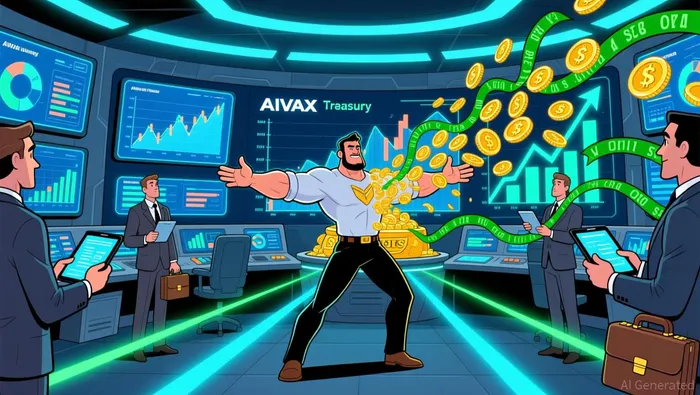
The second $500 million allocation will fund a SPAC backed by Dragonfly Capital to purchase AVAX from foundation reserves according to analysis. This mechanism locks tokens in long-term corporate holdings, stabilizing tokenomics while building strategic reserves for ecosystem development. That dual-track approach accelerates institutional adoption through Wall Street-compatible channels. It also demonstrates blockchain's growing integration with traditional capital markets infrastructure.
What Technological Upgrades Could Boost Avalanche's Utility?
Avalanche's 2026 roadmap centers on the Particle Chain upgrade, which introduces a Universal Transaction Layer according to industry experts. This innovation builds upon November 2025's Granite upgrade by unifying chains, assets, and applications under one framework. Particle Chain enables seamless cross-chain interoperability while boosting transaction capacity to 6,500 TPS. Such scalability is critical for handling enterprise-grade DeFi and real-world asset tokenization volumes.
The upgrade complements Avalanche's Elastic Subnets and Avalanche9000 innovations according to analysts. These allow developers to create custom blockchains with tailored compliance rules and virtual machines. By supporting specialized infrastructure, Avalanche positions itself for institutional subnet adoption in areas like regulated finance. The technical improvements could enhance AVAX's utility as the primary settlement and staking asset across this expanding ecosystem according to market projections. That utility foundation supports long-term value accrual.
Can AVAX Reach $100 by 2028?
Analysts suggest AVAX could reach $100 by 2028 if key adoption milestones are met. The projection depends on successful execution of treasury initiatives and technological enhancements according to forecasts. Growth in tokenized real-world assets through institutional subnets would generate sustained demand for AVAX as the settlement layer according to industry analysis. Ecosystem expansion beyond 200 active projects could further drive transaction activity and staking participation.
Conservative 2026 price targets range between $45 and $60, reflecting current adoption curves according to market data. Hitting $100 requires overcoming regulatory uncertainty and competitive pressures from other layer-1 solutions according to analysts. Macroeconomic conditions must also support risk asset appreciation. If Avalanche captures significant enterprise adoption and RWA tokenization volume by 2028, the $100 threshold becomes mathematically feasible according to projections. Still, market dynamics remain unpredictable.

Blending traditional trading wisdom with cutting-edge cryptocurrency insights.
Latest Articles
Stay ahead of the market.
Get curated U.S. market news, insights and key dates delivered to your inbox.






Comments
No comments yet