
Avalanche AVAX Targets $150 Amid Record Network Activity and Subnet Growth
 Aime Summary
- Macro breakout and retest patterns suggest potential upside if the $4–$6 support zone holds, with analysts targeting $15 to $150.
- On-chain activity surged in Q2 2026, with AvalancheAVAX-- processing 235.6 million transactions while average fees dropped to 0.14 cents.
- The network is expanding into real-world assets, recently awarding grants to platforms tokenizing physical trading cards.
- Despite strong infrastructure growth, the AVAX tokenAVAX-- has declined 95% from its 2021 peak, raising questions about value capture.
- Institutional partnerships and subnet adoption continue to drive long-term development despite near-term market volatility.
AVAX is currently trading near $6.45 with a market capitalization of $2.78 billion, presenting a highly speculative yet potentially rewarding scenario that technical analysts view. Industry observers point to a recurring macro breakout and retest structure that has historically preceded significant rallies in 2020, 2021, and 2024 . This pattern suggests that if the critical accumulation zone between $4 and $6 holds, the asset could see substantial upside, with targets ranging from $15 to $150 . However, failure to hold below the $3 level would invalidate this bullish setup, signaling a potential breakdown in the current market structure .
Beyond price action, the Avalanche network is demonstrating robust underlying fundamentals. A recent quarterly report revealed that the C-Chain saw a four-fold increase in volume to 235.6 million transactions during the second quarter of 2026. This surge in activity occurred alongside a dramatic drop in transaction costs to just 0.14 cents, indicating that protocol improvements are successfully expanding blockspace capacity . The data suggests that lower token prices have not reduced network utilization; instead, greater efficiency and capacity are supporting higher activity at lower costs .
What Is Driving Avalanche's Subnet Expansion?
Avalanche's multi-chain architecture continues to attract enterprise and developer interest through its subnet technology. The network recently rebranded its subnets as Avalanche L1s, allowing for custom blockchains with isolated execution and customizable economics. By late 2025, the platform had reached 75 active subnets, representing a 158% year-over-year growth in adoption. This expansion is supported by the Avalanche9000 upgrade, which removed the 2,000 AVAX staking requirement for subnet validators, thereby lowering barriers for custom chain deployment.
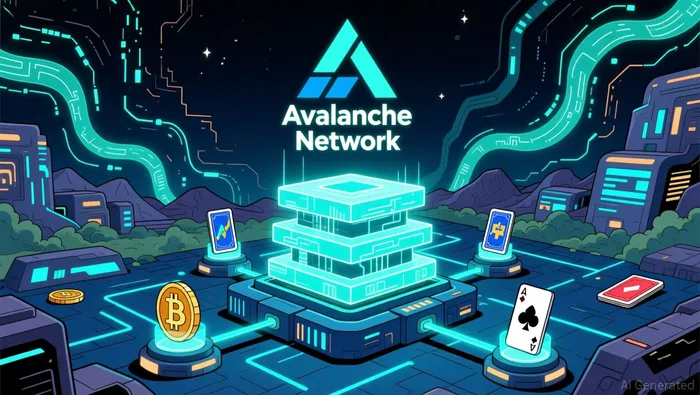
The ecosystem is also diversifying into real-world assets (RWA), moving beyond simple token trading. The Avalanche Team1 Accelerator recently awarded a $30,000 grant to YourGrails, a platform focused on tokenizing physical, graded trading cards on-chain . This initiative aims to expand blockchain use into tangible assets, adding to the network's existing $839 million tokenized treasury market . Such developments underscore the project's efforts to build substantive ecosystem utility alongside speculative market dynamics .
How Does AVAXAVAX-- Compare to Competitors?
Avalanche faces intense competition from networks like SolanaSOL--, which utilizes a monolithic design targeting high throughput . Solana handles billions of transactions with fees as low as $0.0006, whereas Avalanche fees remain around $0.02 . Despite this cost disadvantage, Avalanche benefits from EVM compatibility, attracting EthereumETH-- developers who prefer Solidity-based smart contracts . The network's approach allows for application-specific chains, contrasting with Solana's shared liquidity model .
Institutional traction remains a key differentiator for Avalanche. The platform has secured integrations involving BlackRock's BUIDL fund, Apollo, Citi, and KKR . However, a critical weakness persists in token value capture. Daily protocol revenue is modest relative to usage, suggesting that much of the activity is low-value or subsidized . The relationship between network growth and AVAX demand remains unclear, with fee burns potentially insufficient to offset staking emissions .
The token's price performance reflects these mixed signals. AVAX has declined 95% from its 2021 peak, signaling eroded speculative conviction among retail investors . Despite this, the token employs a deflationary burn mechanism and a hard cap of 720 million tokens . Staking requirements currently lock a significant portion of the supply, with staking ratios reaching 41% . Long-term value depends on whether institutional deployments translate into recurring, fee-generating activity that directly benefits AVAX holders .
Market sentiment remains influenced by broader crypto trends, particularly Bitcoin's movement . Strategic partnerships, such as the integration with Bitget for the Indian market, have historically triggered price appreciation . However, liquidity remains fragmented across Avalanche L1s, unlike the unified environment of competitors . TVL has been volatile, dropping to $636 million in May 2026, highlighting the challenges of maintaining capital inflow .
Investors are closely monitoring the Etna upgrade and the success of the Avalanche9000 campaign in driving adoption . The network's ability to balance enterprise utility with decentralized finance growth will determine its trajectory . While the infrastructure shows strength, the token's ability to capture this value remains the primary question for long-term holders .

Blending traditional trading wisdom with cutting-edge cryptocurrency insights.
Latest Articles
Stay ahead of the market.
Get curated U.S. market news, insights and key dates delivered to your inbox.


AInvest
PRO
AInvest
PRO




Comments
No comments yet