
Avalanche (AVAX) Staking Hits $204M As Fuji Testnet Activates Helicon Upgrade
 Aime Summary
- Avalanche (AVAX) is trading near a critical $6.55 support zone while daily active addresses surge 30% to nearly 119,600 users, signaling rising network usage despite flat price action .
- Staked AVAXAVAX-- value has reached approximately $204.77 million, representing 43% of circulating supply, while the Fuji testnet activates the Helicon upgrade for pre-deployment testing .
- Derivatives markets show elevated open interest and strong long-to-short positioning, suggesting traders are actively positioning around the staking and upgrade news .
- Despite ecosystem growth, AVAX trades 95% below its all-time high with weak token value capture, as daily protocol revenue remains modest relative to total value locked .
Avalanche (AVAX) is currently trading near a significant support level that has historically attracted buyers during previous market cycles . As of the latest data, AVAX trades at $6.55 with a market capitalization of $2.83 billion and 24-hour trading volume of $233.19 million . The asset is testing a long-term monthly demand zone, a technical area where buying pressure previously returned after downtrends . Crypto analyst The Boss highlighted this zone, noting that while AVAX lost several intermediate support levels during its recent decline, this current area marks a potential reversal point . If the price holds above this support, upside targets are identified at $9.15, $10.85, $14.48, $19.65, $22.78, and $29.97 . However, a confirmed monthly close below this zone would likely extend the current downtrend .
On-chain metrics present a divergent picture from price action . Data from MSB Intel indicates that daily active addresses on the AvalancheAVAX-- network rose approximately 30% over the past week, reaching near 119,600 users . This surge in wallet activity suggests growing adoption and usage of applications built on the Avalanche blockchain, even while the token price remains neutral . Despite this fundamental growth, AVAX price action remains constrained by broader market conditions . Bitcoin’s recent downward movement has kept the wider crypto market cautious, with traders awaiting clearer directional signals before committing to larger moves . For AVAX to break out toward the identified resistance levels, buyers must successfully defend the current demand zone while BitcoinBTC-- stabilizes .
How Are Staking Metrics and Technical Upgrades Shaping Network Participation?
Avalanche staking value has reached about $204.77 million, while the Fuji testnet has activated the Helicon upgrade, giving AVAX watchers two separate network signals to track . The validated notes show staked AVAX representing roughly 43% of circulating supply . The Helicon upgrade activated on Fuji testnet on July 30, 2026, while derivatives positioning remained active, with high open interest and long-to-short positioning . The key caveat is that the $204 million figure refers to the total USD value of staked AVAX, not one whale buying $204 million worth of tokens . That distinction matters because staking stories are often misread as accumulation headlines . This is really about network participation and upgrade progress .
Staking is one of the clearest ways to measure long-term network participation . When users stake AVAX, they are helping secure the network and locking capital into the ecosystem . A high staked share can suggest stronger alignment between holders and network operation . A 43% staked share is meaningful because it shows a large portion of supply is being used in network security rather than sitting entirely liquid . Still, the value of staked AVAX changes with price . The Helicon upgrade activating on Fuji testnet is another important detail . Testnet activation means the upgrade is being tested in an environment designed to catch issues before broader production deployment . Validators, developers, infrastructure providers, and app teams need time to see how changes behave before mainnet deployment . Fuji gives Avalanche a proving ground . If the Helicon upgrade performs as expected, it can move the ecosystem closer to broader activation .
Derivatives Add A Market Layer The validated notes also point to active whale derivatives positioning, elevated open interest, and strong long-to-short data . That suggests traders are paying attention to Avalanche around the staking and upgrade news . But derivatives positioning can cut both ways . Heavy long positioning may show confidence, but it can also create liquidation risk if price moves against crowded traders .
What Are the Fundamental Structural Weaknesses in Avalanche’s Investment Thesis?
Avalanche maintains a top-40 market position with solid liquidity and broad exchange support . However, the 95% drawdown from peak and the 41.33% decline in derivatives open interest over 90 days signal that speculative conviction has substantially eroded despite ongoing ecosystem development . Avalanche's core technical differentiation centers on its customizable Avalanche L1 model, which allows applications to deploy dedicated blockchains with configurable validators, consensus rules, execution environments, and fee tokens . This architecture differs fundamentally from monolithic Layer-1s like SolanaSOL-- and from Ethereum's Layer-2 approach . The platform consists of three primary components: C-Chain (EVM-compatible), Platform Chain (coordinates validators), and Avalanche L1s (application-specific chains) . The Octane upgrade in 2025 reportedly reduced C-Chain base fees by approximately 99.6% and subnet costs by approximately 83%, materially improving the economics of high-volume applications .
Avalanche has developed a relatively strong institutional narrative, with reported deployments including BlackRock’s BUIDL tokenized fund, Apollo-related tokenized credit products, and Citi institutional pilots . The network reportedly reached 75 active subnets or Avalanche L1s by the end of 2025, representing 158% year-over-year growth . This expansion demonstrates developer interest in customizable infrastructure and ecosystem diversification across gaming, DeFi, payments, and enterprise applications . The central structural weakness in the Avalanche investment thesis is weak and inconsistent token value capture . AVAX is used for transaction fees, staking, and governance, but the relationship between network growth and token demand remains unclear . VanEck’s February 2026 analysis reported daily protocol revenue of approximately $8,094 against TVL of approximately $1.23 billion . This relationship suggests that network usage may be economically low-value, subsidized, or concentrated in transactions that generate minimal fees . The core issue is whether fee burns are large enough to offset staking emissions . If they are not, token holders experience net dilution .
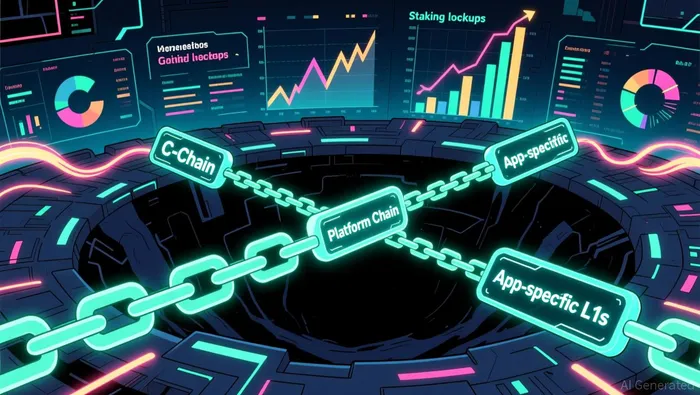
Fragmented Liquidity Across Avalanche L1s Application-specific chains provide customization but can fragment liquidity across multiple chains, users, and developer attention . A token or application operating on one Avalanche L1 may require bridges to interact with another . By contrast, Solana maintains a more unified liquidity environment . This trade-off is explicit: Avalanche L1s offer customization and performance but sacrifice some shared liquidity and security relative to EthereumETH-- Layer-2s .
Revenue Model and Sustainability Analysis Avalanche’s direct protocol revenue is principally generated from transaction fees . Fees are paid in AVAX and burned, creating a deflationary mechanism . However, the reported daily revenue of approximately $8,094 is modest relative to the network’s market capitalization . This suggests that transaction values are low, fee rates are minimal, or activity is concentrated in low-fee transactions . Staking rewards increase AVAX supply until the maximum supply is reached, with inflation rates estimated at 3.9–15% . If fee burns remain below issuance, token holders experience net dilution .

Blending traditional trading wisdom with cutting-edge cryptocurrency insights.
Latest Articles
Stay ahead of the market.
Get curated U.S. market news, insights and key dates delivered to your inbox.


AInvest
PRO
AInvest
PRO




Comments
No comments yet