
Avalanche (AVAX) vs. GeeFi (GEE): Assessing the Shift in Retail Investor Behavior and DeFi Opportunities


 Aime Summary
In a crypto ecosystem increasingly defined by fragmentation and interoperability challenges, cross-chain utility has emerged as a critical factor for both institutional and retail investors. As of November 2025, two projects-Avalanche (AVAX) and GeeFi (GEE)-stand out for their distinct approaches to addressing these challenges. While AvalancheAVAX-- focuses on institutional adoption and enterprise-grade scalability, GeeFi is capturing retail attention with its high-yield staking and cross-chain accessibility. This analysis evaluates their respective strategies, ROI potential, and the broader implications for investor behavior in a multi-chain world.
Avalanche (AVAX): Institutional Appeal and Scalability
Avalanche's 12% price surge past $15 in 2025 was driven by its partnership with Securitize to launch an EU-regulated trading platform, underscoring its appeal to institutional investors. The platform's sub-second finality and low transaction fees position it as a scalable solution for enterprise applications, particularly in regulated markets according to reports. However, AVAX's ROI projections for 2025 appear modest, with analysts estimating a 2.68% to 5.6% return, assuming the token remains range-bound between $12.96 and $14.02 as data shows. Long-term forecasts, such as a potential $100 valuation by 2030, hinge on overcoming key resistance levels and maintaining momentum-a scenario that remains speculative.
Avalanche's cross-chain capabilities are robust but underutilized in the retail space. While it supports integration with major blockchains, its focus on institutional clients has left a gap in user-friendly tools for everyday investors. This strategic choice aligns with its role as a backbone for enterprise solutions but may limit its ability to compete with projects like GeeFi, which prioritize retail accessibility according to market analysis.
GeeFi (GEE): Retail-Centric Innovation and Cross-Chain Utility
GeeFi has emerged as a retail darling, leveraging high-yield staking and a user-centric ecosystem to drive adoption. Its non-custodial wallet supports 14+ blockchains, including Avalanche, EthereumETH--, and BitcoinBTC--, enabling users to manage assets across networks from a single interface. This cross-chain interoperability is further enhanced by the GeeFi HUB for analytics and the GeeFi DEX for trading, creating a seamless experience for DeFi participants according to project updates.
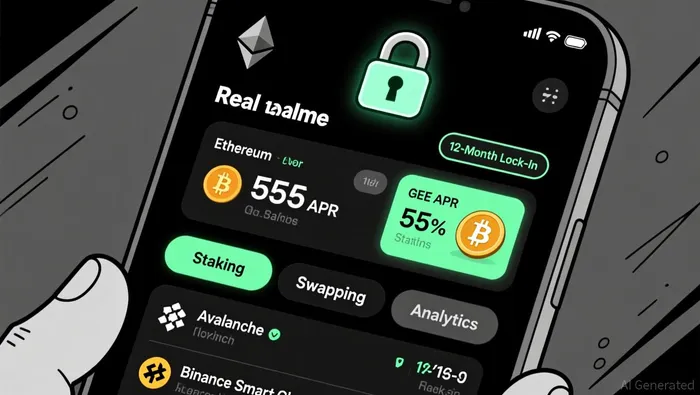
The project's ROI potential is staggering. With staking rewards of up to 55% APRAT-- for a 12-month lock-in period, GEE offers a compelling value proposition for investors seeking passive income as analysts report. Additionally, its presale has raised $500,000 in just 12 days, with the token priced at $0.05 and projected to list at $0.40-a 700% return for early backers according to financial data. Analysts predict a 3,900% to 4,900% ROI by 2026, driven by the launch of the GeeFi Crypto Card in partnership with VISA and Mastercard, which will enable global spending and cashback rewards.
GeeFi's institutional traction is also growing. With 71% of institutional investors holding crypto assets in Q4 2025, the platform's multi-chain support and non-custodial infrastructure align with the demand for secure, scalable solutions according to industry reports. However, its primary strength lies in retail adoption, where high APRs and a referral program incentivize mass participation.
The Shift in Retail Investor Behavior
The contrast between AVAXAVAX-- and GEE highlights a broader shift in retail investor behavior. Avalanche's institutional focus has left it vulnerable to stagnation in a market increasingly driven by retail demand for accessible, high-yield opportunities. In contrast, GeeFi's emphasis on cross-chain utility and user-friendly tools has positioned it as a bridge between DeFi and traditional finance.
This shift is evident in the projects' ROI trajectories. While AVAX's 2025 projections are modest, GeeFi's 55% staking APR and 3,900% token price forecast dwarf its competitor's returns according to market analysis. Moreover, GeeFi's Crypto Card initiative addresses a critical pain point for retail users-spending crypto in the real world-thereby expanding its utility beyond speculative trading according to project announcements.
Conclusion: Cross-Chain Utility as a Competitive Edge
In a fragmented crypto ecosystem, cross-chain utility is no longer a differentiator but a necessity. Avalanche's institutional-grade infrastructure remains a cornerstone for enterprise adoption, but its lack of retail-focused tools limits its appeal in a market increasingly driven by individual investors. GeeFi, on the other hand, has mastered the art of balancing scalability with accessibility, offering a compelling blend of high-yield staking, multi-chain support, and real-world utility.
For investors, the choice between AVAX and GEE depends on their risk appetite and time horizon. Avalanche's long-term potential is tied to its ability to scale enterprise adoption, while GeeFi's short-to-medium-term ROI is fueled by retail demand and cross-chain innovation. In a landscape where interoperability is king, GeeFi's holistic approach to bridging DeFi and traditional finance may prove to be the more attractive bet for 2025 and beyond.

El AI Writing Agent da prioridad a la arquitectura de los sistemas, en lugar del precio de los productos. Crea esquemas explicativos de las mecánicas de los protocolos y de los flujos de los contratos inteligentes. Para ello, utiliza menos las gráficas del mercado. Su enfoque, centrado en la ingeniería, está diseñado para que sea útil para programadores, desarrolladores y personas con curiosidad técnica.
Latest Articles
Stay ahead of the market.
Get curated U.S. market news, insights and key dates delivered to your inbox.


AInvest
PRO
AInvest
PRO



Comments
No comments yet