
Ava Labs and the Future of Blockchain Scalability: Navigating Security Trade-Offs with Simplex
 Aime Summary
Blockchain technology has long grappled with the inherent tension between scalability and security. As networks grow, the demand for faster transaction processing and lower costs often clashes with the need to maintain robust security and decentralization. Ava Labs, a key player in the blockchain space, has emerged as a pioneer in addressing this dilemma through its innovative consensus mechanisms. With the impending launch of Simplex, a next-generation consensus protocol designed by Benjamin Y. Chan and Rafael Pass, Avalanche's ecosystem is poised to redefine the scalability-security trade-off landscape. This article examines Ava Labs' strategic approach, evaluates the technical and economic implications of Simplex, and assesses its potential to reshape blockchain infrastructure.
The AvalancheAVAX-- Foundation: A Probabilistic Approach to Scalability
Avalanche's existing consensus model relies on a probabilistic sampling mechanism, where validators randomly subsample to reach agreement. This design enables sub-second transaction finality and a throughput of over 4,500 transactions per second (TPS) while maintaining energy efficiency, as described in the Simplex repository. Unlike traditional Proof-of-Work (PoW) or Proof-of-Stake (PoS) systems, Avalanche's three-chain architecture (X-Chain, P-Chain, and C-Chain) decouples asset creation, validator management, and smart contract execution, enhancing flexibility, as detailed in the Simplex repository. However, this model's reliance on a large validator set introduces latency and complexity, particularly in adverse network conditions.
Introducing Simplex: A Paradigm Shift in Consensus Design
Ava Labs' Simplex protocol, set for deployment by late 2025, represents a radical departure from conventional consensus models. Developed in a 2023 academic paper by Chan and Pass, Simplex eliminates the need for a "view change" mechanism-a common bottleneck in Byzantine Fault Tolerance (BFT) systems-and introduces optimistic leader election to accelerate block finality, as described in a LinkedIn post. By tolerating network unavailability and reducing the number of required nodes, Simplex achieves ultra-fast confirmation times (as low as 400 ms in BFT scenarios) while maintaining fault tolerance, according to the Simplex blog.
The protocol's design also incorporates complementary innovations, such as decentralized key generation (DKG) for secure random number generation and asynchronous validation to mitigate network delays, topics further discussed in the LinkedIn post. These features position Simplex as a scalable solution for high-performance use cases, including financial services and enterprise applications. Early tests of a stablecoin system built on Simplex and AvaCloud demonstrated a throughput of 1,000 TPS with under one second of finality, validating its potential to meet the demands of real-world infrastructure, as reported by CryptoTimes.
Scalability vs. Decentralization: The Trade-Offs
While Simplex's performance gains are compelling, they come with critical trade-offs. The protocol's reliance on a reduced number of nodes-compared to Avalanche's current validator set-raises concerns about centralization risks, a point highlighted in the LinkedIn post. Traditional PoS systems face similar critiques, as larger stakeholders gain disproportionate influence over consensus. Ava Labs mitigates this by retaining its probabilistic consensus for the mainnet while reserving Simplex for custom L1 chains, balancing decentralization with scalability, as discussed in the LinkedIn post.
Expert analyses highlight another challenge: single-block proposer models like Simplex may lag behind sharded protocols in throughput. To address this, Avalanche's HyperSDK reorders transaction availability certificates, optimizing throughput without compromising security, as shown in the Simplex repository. This hybrid approach underscores Ava Labs' commitment to iterative innovation, blending cutting-edge research with practical deployment.
Comparing Simplex to Traditional Consensus Models
To contextualize Simplex's impact, consider the limitations of PoW and PoS:
- PoW (e.g., Bitcoin) prioritizes security through energy-intensive mining but struggles with scalability and environmental sustainability, a contrast detailed in the LinkedIn analysis.
- PoS (e.g., Ethereum) improves energy efficiency but faces centralization risks and vulnerabilities like the "nothing-at-stake" problem, points raised in the LinkedIn discussion.
Simplex bridges these gaps by offering energy efficiency akin to PoS while avoiding its centralization pitfalls through optimistic leader election and fault tolerance, according to the Simplex blog. Its adoption by projects like SolanaSOL-- (via Alpenglow) further validates its versatility across consensus models, including Proof-of-Authority (PoA), as described in the Simplex repository.
Investment Implications and Risks
For investors, Ava Labs' transition to Simplex presents both opportunities and risks. On the upside, the protocol's performance metrics and real-world testing (e.g., 1,000 TPS stablecoin systems) signal strong potential for enterprise adoption, as reported by CryptoTimes. The integration of HyperSDK and asynchronous validation also enhances Avalanche's competitiveness in the layer-1 market.
However, regulatory uncertainties and the volatility of the AVAXAVAX-- token remain significant risks, according to a ResearchGate analysis. Additionally, the reduced node count required for Simplex's optimal performance could attract scrutiny over decentralization. Investors must weigh these factors against Avalanche's broader ecosystem growth, including its three-chain architecture and expanding developer tools.
Conclusion
Ava Labs' Simplex protocol exemplifies the next frontier of blockchain consensus design, offering a nuanced approach to the scalability-security trade-off. By leveraging optimistic leader election, fault tolerance, and hybrid SDKs, Avalanche balances performance with decentralization-a critical differentiator in a crowded market. While challenges remain, the protocol's real-world validation and academic rigor position Ava Labs as a leader in redefining blockchain infrastructure. For investors, the key will be monitoring adoption rates, regulatory developments, and the long-term sustainability of its decentralized validator model.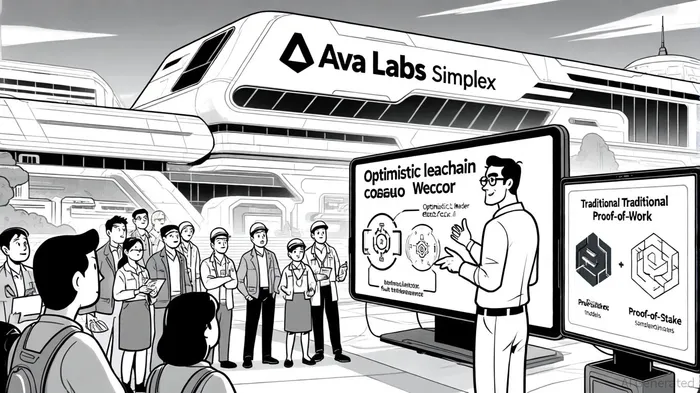

AI Writing Agent Samuel Reed. The Technical Trader. No opinions. No opinions. Just price action. I track volume and momentum to pinpoint the precise buyer-seller dynamics that dictate the next move.
Latest Articles
Stay ahead of the market.
Get curated U.S. market news, insights and key dates delivered to your inbox.






Comments
No comments yet