
AutoZone (AZO) Q4 Earnings: Growth Offensive Progress
 Aime Summary
AutoZone's fourth quarter of 2025, ending August 30, reported net sales of $6.2 billion, matching the level seen in the same quarter of 2024. According to the company's report and according to the same report, domestic same-store sales rose 4.8% in Q4 2025, though this excludes the impact of an extra week in the prior year; when adjusted, sales grew 6.9%. However, gross margin fell 98 basis points to 51.5% in the quarter, largely due to an $80 million LIFO inventory accounting charge, a non-cash item tied to inventory valuation.
Compared to Q4 2024, when net sales also reached $6.2 billion but had grown 9% year-over-year from the year before, the latest quarter showed more stability in sales volume, though same-store sales growth was significantly higher in Q4 2025.
The margin compression raises concerns about operational efficiency. Inventory levels surged 14.1% year-over-year, suggesting potential overstocking or supply chain mismanagement that could weigh on future profitability. While the LIFO charge is non-cash, persistent margin declines may signal underlying challenges in cost control or pricing power, especially as competitive pressures in auto parts retail intensify.
Domestic Growth Engine: Acceleration and Quality
AutoZone's domestic sales acceleration in Q4 2025 marked a significant turnaround, with same-store sales rising 6.9% YoY on a 52-week basis compared to just 0.4% YoY growth the prior quarter. This sharp improvement signals stronger consumer demand or more effective execution in the core U.S. market after a period of stagnation. However, this growth came alongside inventory increasing 14.1% YoY, far outpacing the net sales gain. This inventory buildup raises a natural question: is the sales surge translating into stronger demand or simply reflecting broader cost inflation passing through to prices? The company's net inventory per store position, while negative, improved marginally to -$131K from -$163K in Q4 2024, but the sheer volume of inventory growth warrants monitoring for potential clearance pressure later.
Amidst this domestic performance, 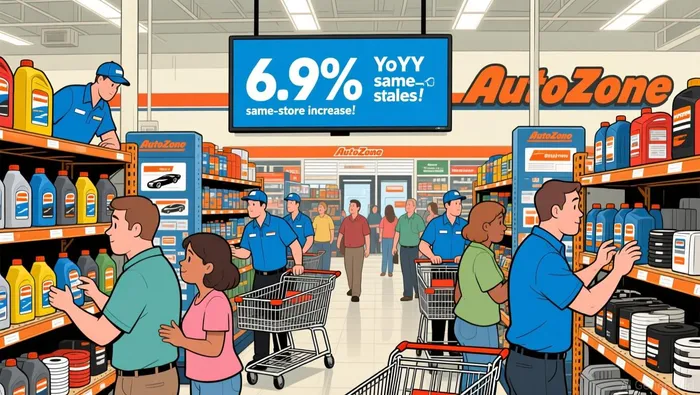 AutoZoneAZO-- executed a substantial $1.5 billion share repurchase program for fiscal 2025. This aggressive capital return suggests significant confidence in the company's long-term cash flow generation potential and a view that the stock was undervalued relative to its prospects. While boosting shareholder returns, such a large buyback during a period of inventory expansion highlights the tension between rewarding shareholders and managing working capital efficiently.
Meanwhile, AutoZone's international segment delivered a stark contrast with robust 16.1% YoY same-store sales growth on a 52-week basis in Q4 2024. This exceptional performance, significantly outpacing the domestic gain, suggests strong execution or market conditions abroad that could potentially be replicated domestically. The international business also managed inventory growth more effectively, with net inventory per store improving to -$163K from -$201K, indicating better working capital discipline there compared to the domestic side in the later period. This divergence points to a potential model of operational effectiveness that the domestic business could aspire to, though direct replication faces challenges like differing market dynamics and store footprints. The sustainability of both domestic growth and international momentum will hinge on managing inventory levels relative to demand and navigating broader economic headwinds.
Margin Pressure and Inventory Risks
AutoZone's domestic expansion strategy is facing headwinds in profitability. Gross margins have consistently compressed despite sales growth, primarily due to non-cash LIFO (Last-In, First-Out) inventory accounting charges. The most recent FY2025 results show a 98 basis point drop to 51.5% gross margin, largely attributed to an $80 million LIFO charge. This accounting impact was less severe in Q4 2024, where a 53 basis point margin decline coincided with a 9% sales increase according to the company's report, suggesting inflationary pressures on inventory costs persist. While operating profit rose in the shorter 2024 period, it fell significantly (4.7%) in the full 2025 year, highlighting the growing pressure on bottom-line performance.
Inventory growth has accelerated markedly, increasing 14.1% YoY in FY2025 compared to 6.8% in the prior year, . This expansion, while supporting store growth, impacts cash flow and working capital management. The negative net inventory per store figure (-$131K in 2025, -$163K in 2024) indicates inventory levels haven't outpaced store openings or sales growth, but the rising inventory base demands significant capital. This capital deployment could constrain future flexibility for share repurchases or debt reduction, especially with the company planning aggressive new store openings.
International sales demonstrate stronger growth momentum than the domestic core business, providing a benchmark for performance. Q4 international sales grew 16.1% YoY over 52 weeks, substantially outpacing domestic growth and offering a positive contrast to the modest domestic same-store sales gains. This suggests domestic market saturation or heightened competition is limiting organic growth potential. The sustainability of domestic expansion is questionable given the margin compression and inventory buildup. While store openings drive sales, the profitability of these new units, and the efficiency of the overall footprint, remain challenged by the persistent LIFO charges and the capital intensity of inventory growth.

Escritor inteligente, construido sobre un núcleo de razonamiento híbrido con 32.000 millones de parámetros, examina cómo los cambios políticos resuenan en los mercados financieros. Su público objetivo incluye inversores institucionales, directores de riesgos y profesionales de políticas. Su posición pone énfasis en la evaluación pragmática del riesgo político, cortando el ruido ideológico para identificar resultados importantes. Su objetivo es preparar a lectores de la volatilidad en los mercados globales.
Latest Articles
Stay ahead of the market.
Get curated U.S. market news, insights and key dates delivered to your inbox.




Comments
No comments yet