
Autoworkers Retraining for Robot Revolution Amidst Labor Cost Concerns
ByAinvest
Friday, Sep 5, 2025 11:24 am ET1min read
GM--
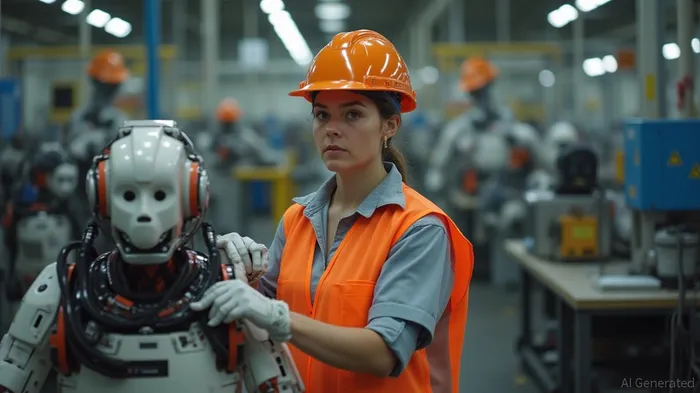
Annie Ignaczak, a former GM worker, is now part of the company's apprenticeship program, where she is learning to service robots. This new role reflects the industry's shift towards automation, which is being driven by high labor costs in the US. According to A3 President Jeff Burnstein, assembly lines are becoming a new frontier for robotics, while people remain essential to oversee and guide these systems [1].
The Canadian auto sector is also experiencing significant changes. In April 2025, the sector faced a 7.5% sales decline due to the delay of zero-emission vehicle (ZEV) targets and the expiration of EV incentives. Automakers like GM and Ford are facing increased production costs due to U.S. tariffs on Canadian goods, which have raised production costs by 4%-8% [2]. Despite these challenges, Canadian automakers are investing heavily in automation and EV battery production to strengthen their supply chains and reduce reliance on foreign suppliers.
Investors in the Canadian auto sector face a paradox: high potential in EV infrastructure and domestic production, juxtaposed with near-term risks from tariffs and policy uncertainty. Key opportunities include investments in EV charging infrastructure and strategic partnerships with Chinese EV manufacturers. Conversely, risks include tariff volatility and the need for credit risk diversification among EV credit providers [2].
As the auto industry navigates this crossroads, those who balance innovation with prudence will be best positioned to capitalize on the opportunities ahead. The Canadian auto sector's 2025 landscape is defined by duality: a push towards electrification and domestic resilience, tempered by the drag of U.S. tariffs and policy rollbacks. For investors, strategic agility is crucial—allocating capital to infrastructure and partnerships while hedging against regulatory and trade uncertainties.
References:
[1] https://www.facebook.com/a3automate/posts/autoworkers-are-retraining-for-the-age-of-automationat-gms-technical-learning-ce/1100139212268204/
[2] https://www.ainvest.com/news/strategic-reassessment-canadian-auto-sector-exposure-ev-policy-rollbacks-tariff-pressures-2509/
Autoworkers at General Motors are retraining to adapt to the increasing use of robots in the industry. Annie Ignaczak, a former GM worker, is now servicing robots as part of a company apprenticeship program. Experts predict more automation in the auto industry due to high labor costs in the US, but workers like Ignaczak are finding new opportunities in robot maintenance and management.
The automotive industry is undergoing a significant transformation, driven by the increasing adoption of automation. General Motors (GM) is at the forefront of this shift, as it retrains its workforce to adapt to the new realities of the industry. At GM's Technical Learning Center, employees who once performed repetitive tasks on the assembly line are now learning to maintain and service robots. This transition is part of a broader trend in the auto industry, where automation is becoming a critical component of production processes.Annie Ignaczak, a former GM worker, is now part of the company's apprenticeship program, where she is learning to service robots. This new role reflects the industry's shift towards automation, which is being driven by high labor costs in the US. According to A3 President Jeff Burnstein, assembly lines are becoming a new frontier for robotics, while people remain essential to oversee and guide these systems [1].
The Canadian auto sector is also experiencing significant changes. In April 2025, the sector faced a 7.5% sales decline due to the delay of zero-emission vehicle (ZEV) targets and the expiration of EV incentives. Automakers like GM and Ford are facing increased production costs due to U.S. tariffs on Canadian goods, which have raised production costs by 4%-8% [2]. Despite these challenges, Canadian automakers are investing heavily in automation and EV battery production to strengthen their supply chains and reduce reliance on foreign suppliers.
Investors in the Canadian auto sector face a paradox: high potential in EV infrastructure and domestic production, juxtaposed with near-term risks from tariffs and policy uncertainty. Key opportunities include investments in EV charging infrastructure and strategic partnerships with Chinese EV manufacturers. Conversely, risks include tariff volatility and the need for credit risk diversification among EV credit providers [2].
As the auto industry navigates this crossroads, those who balance innovation with prudence will be best positioned to capitalize on the opportunities ahead. The Canadian auto sector's 2025 landscape is defined by duality: a push towards electrification and domestic resilience, tempered by the drag of U.S. tariffs and policy rollbacks. For investors, strategic agility is crucial—allocating capital to infrastructure and partnerships while hedging against regulatory and trade uncertainties.
References:
[1] https://www.facebook.com/a3automate/posts/autoworkers-are-retraining-for-the-age-of-automationat-gms-technical-learning-ce/1100139212268204/
[2] https://www.ainvest.com/news/strategic-reassessment-canadian-auto-sector-exposure-ev-policy-rollbacks-tariff-pressures-2509/
Stay ahead of the market.
Get curated U.S. market news, insights and key dates delivered to your inbox.
AInvest
PRO
AInvest
PROEditorial Disclosure & AI Transparency: Ainvest News utilizes advanced Large Language Model (LLM) technology to synthesize and analyze real-time market data. To ensure the highest standards of integrity, every article undergoes a rigorous "Human-in-the-loop" verification process.
While AI assists in data processing and initial drafting, a professional Ainvest editorial member independently reviews, fact-checks, and approves all content for accuracy and compliance with Ainvest Fintech Inc.’s editorial standards. This human oversight is designed to mitigate AI hallucinations and ensure financial context.
Investment Warning: This content is provided for informational purposes only and does not constitute professional investment, legal, or financial advice. Markets involve inherent risks. Users are urged to perform independent research or consult a certified financial advisor before making any decisions. Ainvest Fintech Inc. disclaims all liability for actions taken based on this information. Found an error?Report an Issue




Comments
No comments yet