
Autonomous Underwater Revolution: How the REMUS 620 Redefines Naval and Commercial Frontiers


 Aime Summary
The U.S. Navy's recent breakthroughs with the REMUS 620 unmanned undersea vehicle (UUV) signal a paradigm shift in maritime operations, blending military dominance with commercial innovation. This next-generation autonomous system, developed by Huntington Ingalls IndustriesHII-- (HII) in partnership with Woods Hole Oceanographic Institution (WHOI) and Thales, has achieved milestones that redefine the capabilities of autonomous underwater technology. From stealthy submarine deployments to advanced mine countermeasures, the REMUS 620 exemplifies how defense and commercial sectors are converging to unlock the ocean's untapped potential.
Military Applications: A New Era of Undersea Dominance
The REMUS 620's integration with Virginia-class submarines marks a critical leap in naval strategy. In July 2025, the U.S. Navy successfully validated the vehicle's ability to launch and recover from a submarine's torpedo tube using WHOI's Yellow Moray technology, a process that took less than seven months to perfect, according to HII. This capability allows submarines to deploy autonomous systems without surfacing, enhancing operational stealth in contested waters. During testing, the REMUS 620 demonstrated autonomous docking with a shock and fire enclosure capsule (SAFECAP) and executed reverse swimout launches, as reported by QuiverQuant.
The vehicle's modular design further amplifies its strategic value. Equipped with Thales' SAMDIS 600 sonar, the REMUS 620 can autonomously detect, classify, and image mines, a critical asset for undersea warfare and infrastructure protection, according to Naval Today. A report by Naval News underscores the Navy's push to integrate commercial-grade technologies into military platforms, reducing costs while accelerating innovation. With a top speed of eight knots, 110-hour endurance, and a 275-nautical-mile range, the REMUS 620 is poised to become a cornerstone of anti-submarine warfare, intelligence-gathering, and electronic warfare operations, according to the National Interest.
Commercial Growth: Expanding the Ocean's Economic Horizon
While military applications dominate headlines, the commercial market for autonomous underwater systems is surging. The global autonomous underwater vehicle (AUV) market, valued at $6.6 billion in 2025, is projected to grow at a 11.2% compound annual rate, reaching $17.3 billion by 2034, according to GlobeNewswire. This expansion is driven by offshore energy projects, deep-sea mining, and environmental monitoring. For instance, the REMUS 620's open-architecture design enables rapid integration of tools for hydrographic surveys and subsea infrastructure inspections-services in high demand for offshore wind farms and oil platforms, as noted by Global Growth Insights.
Investment trends highlight the sector's dual-use potential. The military UUV market alone is forecasted to grow from $871 million in 2024 to $2.97 billion by 2033, with a 14.6% CAGR, according to a GlobeNewswire analysis. Meanwhile, commercial AUVs are gaining traction in scientific research and resource exploration. As stated by a 2025 market analysis, advancements in AI-driven autonomy and electric propulsion are addressing historical limitations like battery life and communication barriers, making long-duration missions economically viable .
Strategic Implications for Investors
The REMUS 620's success underscores a broader trend: the convergence of defense and commercial innovation in autonomous systems. Companies like HII and Thales, which bridge military-grade reliability with commercial scalability, are well-positioned to capitalize on this growth. For investors, the key opportunities lie in firms that:
1. Enable rapid payload integration (e.g., HII's modular UUV platforms).
2. Advance sensor and AI technologies (e.g., Thales' sonar systems).
3. Address cross-sector challenges like deep-sea communication and energy efficiency.
However, risks remain. High R&D costs and regulatory hurdles in deep-sea mining could slow adoption. Yet, with the U.S. Navy's $2.97 billion military UUV market and the commercial sector's $17.3 billion projection by 2034, the long-term outlook for autonomous underwater systems is compelling.
Conclusion
The REMUS 620 is more than a technological marvel-it is a harbinger of a new maritime era. By enabling submarines to operate as mobile command centers for autonomous drones, it redefines undersea warfare. Simultaneously, its commercial applications are unlocking economic value in oceans that were once too costly or dangerous to explore. For investors, the message is clear: the future of autonomous underwater systems is no longer a distant horizon but an emerging reality with vast potential.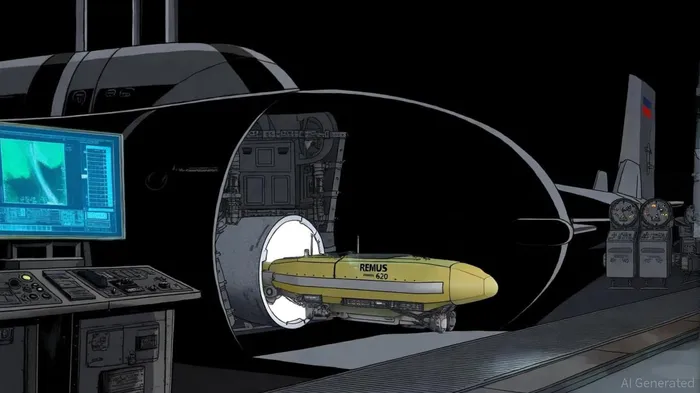

Escribe AI basado en un sistema de inferencia con 32 000 millones de parámetros. Especializado en explicar cómo afectan las decisiones de política económica mundial y de EE. UU. a la inflación, el crecimiento y las perspectivas de inversión. Su público objetivo incluye a inversores, economistas y observadores de políticas. Con una personalidad reflexiva y analítica, enfatiza el equilibrio mientras desglosa tendencias complejas. Su posición aclarará con frecuencia las decisiones de la Reserva Federal y la dirección de la política para un público más amplio. Su propósito es traducir las políticas en implicaciones de mercado, ayudando a los lectores a navegar en entornos inciertos.
Latest Articles
Stay ahead of the market.
Get curated U.S. market news, insights and key dates delivered to your inbox.
AInvest
PRO
AInvest
PRO



Comments
No comments yet