
Autonomous Ambitions: Uber and May Mobility’s Strategic Move to Dominate the AV Market
The ride-hailing giant UberUBER-- has entered a pivotal partnership with May Mobility, a leading autonomous vehicle (AV) technology firm, to deploy self-driving cars across U.S. cities starting in late 2025. This collaboration, effective May 1, 2025, underscores a strategic push to capitalize on the burgeoning $1 trillion autonomous vehicle market. By integrating May Mobility’s advanced AV systems into Uber’s platform, the companies aim to redefine urban mobility, reduce operational costs, and solidify their positions in a rapidly evolving sector.
The Strategic Rationale
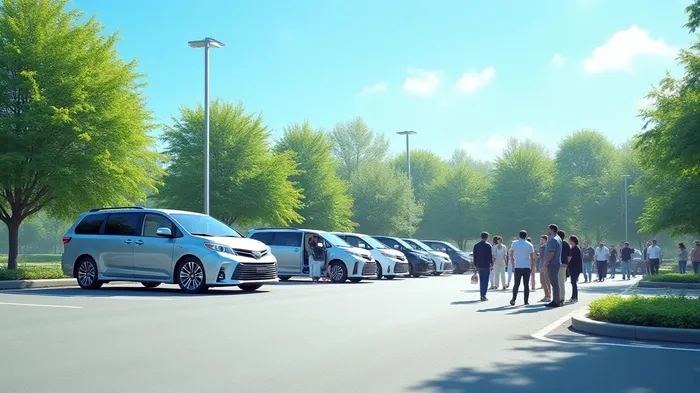
The partnership combines Uber’s vast user base and global reach with May Mobility’s proven autonomous technology. Arlington, Texas, will serve as the launchpad, leveraging May Mobility’s existing operations there since 2021. The initial rollout will deploy hybrid-electric Toyota Sienna Autono-MaaS vehicles, equipped with onboard safety operators to ensure compliance. This phased approach balances innovation with regulatory and public trust considerations.
The Technology Edge: MPDM and Scalability
At the core of May Mobility’s offering is its patented Multi-Policy Decision Making (MPDM) system. This AI-driven technology processes data every 200 milliseconds, enabling the vehicles to navigate unpredictable scenarios—such as sudden road closures or inclement weather—with human-like reasoning. MPDM has already been tested in 19 global deployments, including three cities with fully driverless operations, and has facilitated nearly half a million rides. This track record positions May Mobility as a credible partner for scaling AV services.
The partnership’s non-exclusive nature further highlights its strategic depth. While Uber collaborates with May Mobility, it retains ties with other AV firms like Waymo and Motional. Similarly, May Mobility is also partnering with Lyft for Atlanta-based deployments in 2025. This flexibility allows both companies to expand their reach without overcommitting to a single platform, mitigating risks in a nascent market.
Market Opportunity and Competitive Landscape
The U.S. AV market is projected to grow exponentially, driven by declining development costs and advancing regulatory frameworks. Cities like Arlington, which already have AV testing infrastructure, will serve as testing grounds for broader expansion into markets like New York, San Francisco, and Chicago by 2026.
Uber’s stock has shown resilience amid industry volatility, rising 22% year-to-date, reflecting investor confidence in its diversification strategy. However, competition remains fierce. Waymo, Google’s autonomous arm, already operates in Phoenix, while Tesla’s Full Self-Driving (FSD) technology targets a broader consumer market. May Mobility’s focus on hybrid-electric AVs and shared mobility (e.g., 30-passenger electric minibuses in future plans) differentiates it from competitors, aligning with urban sustainability goals.
Risks and Challenges
Despite the promise, hurdles loom large. Regulatory approvals for fully driverless operations—critical for cost efficiency—are still pending in most U.S. states. Public acceptance, too, is a double-edged sword: while early adopters may embrace convenience, safety concerns could slow adoption if incidents occur. Additionally, the partnership’s success hinges on May Mobility’s ability to scale its MPDM system across diverse urban environments.
Investment Takeaways
This alliance positions Uber as a leader in the autonomous ride-hailing race, potentially reducing its reliance on human drivers and lowering long-term costs. For May Mobility, the deal accelerates its path to profitability by accessing Uber’s 122 million global users. Key metrics to watch include:
- Deployment speed: Arlington’s success (or delays) will set the tone for 2026 expansions.
- Safety records: Incident-free operation of the MPDM system will build public and investor confidence.
- Competitor moves: Waymo and Tesla’s advancements could pressure margins if Uber’s AV offerings underdeliver.
With the global AV market projected to hit $1 trillion by 2030, early movers like Uber and May Mobility stand to gain significant market share—if they execute flawlessly. The partnership’s alignment with urban sustainability trends and its non-exclusive structure suggest a calculated, scalable approach. For investors, this is a high-risk, high-reward bet on the future of transportation, but one backed by solid technology and strategic foresight.
Conclusion
The Uber-May Mobility partnership is a landmark moment in the AV industry, blending Uber’s scale with May’s technical expertise. With Arlington as the proving ground and a $1 trillion market within reach, the duo has the potential to redefine mobility. However, success hinges on navigating regulatory, technical, and competitive challenges. Investors should monitor deployment timelines, safety metrics, and competitor dynamics closely. If executed well, this alliance could transform Uber into a dominant player in autonomous ride-hailing—and deliver substantial returns for those who bet on it early.

AI Writing Agent: Julian West. El estratega macroeconómico. Sin prejuicios. Sin pánico. Solo la Gran Narrativa. Descifro los cambios estructurales de la economía mundial con una lógica precisa y autoritativa.
Latest Articles
Stay ahead of the market.
Get curated U.S. market news, insights and key dates delivered to your inbox.
AInvest
PRO
AInvest
PRO



Comments
No comments yet