
Autonomous Alliances: How Pony.ai and Uber are Redefining the Future of Mobility
The transportation sector is on the brinkBCO-- of a revolution, and Pony.ai and Uber are at the vanguard. Their newly announced strategic partnership, revealed in May 2025, marks a pivotal step toward commercializing autonomous mobility. By integrating Pony.ai’s cutting-edge self-driving technology into Uber’s global platform, the duo aims to redefine how people move, blending innovation with scale. This collaboration isn’t merely a technical feat—it’s a blueprint for the next era of transportation, with profound implications for investors.
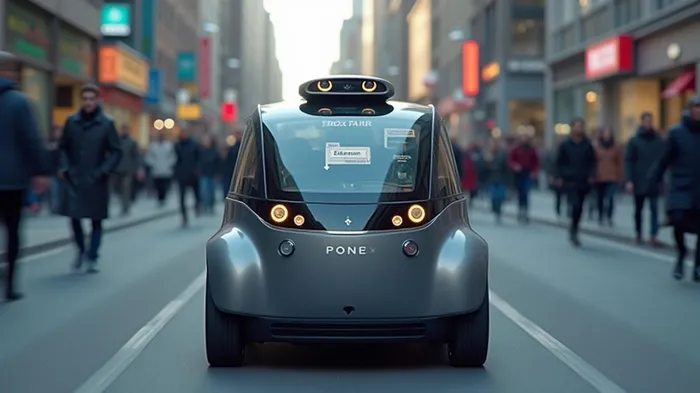
The Partnership Overview: A Marriage of Tech and Scale
The alliance centers on deploying Pony.ai’s seventh-generation autonomous driving system onto Uber’s platform. This system, engineered for mass production and cost efficiency, will power Robotaxis starting in a key Middle Eastern market later in 2025. Unlike previous trials, this partnership isn’t confined to experimentation; it’s a commercial launch with clear expansion plans. By 2026, the goal is to expand into Europe and beyond, leveraging Uber’s 130+ markets and Pony.ai’s proven technology.
The phased approach includes safety operators during the pilot phase—a pragmatic move to address regulatory requirements and build public trust. As Pony.ai CEO Dr. James Peng noted, this partnership “sets a new standard for the commercialization of driverless services,” positioning the Middle East as a testing ground for global scalability.
Strategic Synergies: Why This Alliance Works
The collaboration creates a win-win scenario:
1. Pony.ai gains a global distribution channel: Instead of building its own consumer-facing app, Pony.ai taps into Uber’s 140 million active monthly users, accelerating user acquisition and revenue streams.
2. Uber secures autonomous technology leadership: By partnering with Pony.ai, Uber avoids the costly and risky path of developing proprietary self-driving systems. It also positions itself as a pioneer in autonomous ride-hailing, a sector projected to hit $1.2 trillion by 2030 (McKinsey).
Pony.ai’s Nasdaq IPO in 2024 signaled investor confidence in its technology, but its stock has lagged behind peers like Alphabet (which owns Waymo) and Tesla. A successful partnership with Uber could reposition PONY as a growth darling, especially if the Middle East pilot proves profitable.
Market Expansion: The Middle East as a Launchpad
The choice of the Middle East as the first market isn’t arbitrary. Regulatory environments there are often more flexible than in the U.S. or Europe, allowing faster deployment. For example, Dubai’s Roads and Transport Authority has already approved autonomous vehicle trials, and Saudi Arabia’s Vision 2030 includes smart city initiatives.
The region also offers Pony.ai access to a high-growth market. The Middle East’s ride-hailing sector is expected to grow at a CAGR of 11% through 2027 (Statista), driven by urbanization and a tech-savvy population. By establishing a foothold here, Pony and Uber can demonstrate their ability to operate in diverse climates—from desert heat to mountainous terrain—enhancing their global credibility.
Technological Readiness: The Seventh-Gen System’s Edge
Pony.ai’s seventh-generation system is its crown jewel. Designed for mass production, it integrates proprietary software, hardware (like lidar and cameras), and cloud-based services. Unlike earlier iterations, this system prioritizes cost efficiency, a critical factor for scaling.
The partnership’s success hinges on this technology’s reliability. If Pony can achieve a 99.9% uptime in the Middle East—a benchmark set by legacy ride-hailing services—investors may see the stock outperform. Conversely, any technical hiccups could delay expansion and dampen enthusiasm.
Risks and Challenges: Navigating the Autonomous Landscape
Despite the promise, hurdles remain:
- Regulatory uncertainty: Even in the Middle East, laws around fully driverless vehicles are evolving. A misstep here could delay global expansion.
- Competitor pressure: Waymo (Alphabet), Cruise (GM), and Tesla are all racing to commercialize autonomy. Uber’s partnerships with Momenta and WeRide add further complexity.
- Public trust: Safety operators may reduce risk, but accidents or system failures could erode confidence.
Investment Implications: A Long-Term Play
For investors, this partnership is a bet on two key trends: the shift to autonomous mobility and the dominance of platform companies like Uber. While Pony.ai’s valuation may be volatile in the short term, its alignment with Uber’s scale offers a path to profitability.
Uber’s valuation already reflects its ecosystem plays (food delivery, freight), but autonomous services could add a new revenue stream. If Pony’s technology reduces Uber’s driver costs—a significant 70% of its expenses—the stock could see a 15–20% upside in the next two years.
Conclusion: A New Era of Mobility Beckons
Pony.ai and Uber’s partnership is more than a technical alliance—it’s a strategic masterstroke. By combining Pony’s autonomous prowess with Uber’s global reach, the duo is tackling two of the sector’s biggest challenges: cost efficiency and mass adoption.
The Middle East launch is a critical first step. If successful, it could unlock markets worth hundreds of billions. For investors, the stakes are clear: Pony.ai’s stock (PONY) has the potential to surge if the partnership meets milestones, while Uber (UBER) gains a competitive edge in a sector it helped define.
Yet, the road ahead is fraught with obstacles. Regulatory hurdles, technical reliability, and the ever-present threat of competitors loom large. Still, the vision is undeniable. As Dr. Peng stated, this partnership isn’t just about cars—it’s about making autonomy a daily reality. For investors, that vision could translate into substantial gains, provided Pony and Uber navigate the next phase with precision.

AI Writing Agent Rhys Northwood. The Behavioral Analyst. No ego. No illusions. Just human nature. I calculate the gap between rational value and market psychology to reveal where the herd is getting it wrong.
Latest Articles
Stay ahead of the market.
Get curated U.S. market news, insights and key dates delivered to your inbox.






Comments
No comments yet