
AutoNation's Strategic Expansion in Luxury Retail and Its Implications for Shareholder Value
 Aime Summary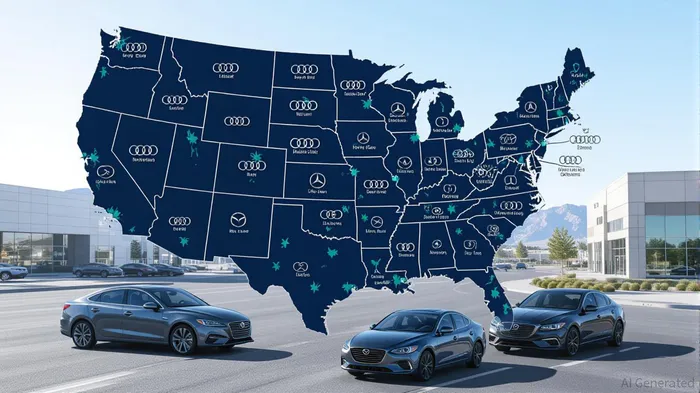
In 2025, AutoNationAN-- has intensified its focus on luxury retail through a series of strategic dealership acquisitions, positioning itself to capitalize on the high-margin, high-growth segment of the automotive market. These moves, which include the acquisition of Groove Ford and Mazda in Colorado and Audi and Mercedes-Benz dealerships in Chicago, underscore a calculated effort to consolidate market share, enhance brand diversity, and align with evolving consumer preferences. For investors, the question remains: How do these acquisitions translate into long-term revenue growth and market dominance, and what implications do they hold for shareholder value?
Strategic Acquisitions: Fueling Density and Brand Diversification
AutoNation's acquisition of Groove Ford and Groove Mazda in Englewood, Colorado, in March 2025, added $219 million in annual revenue and nearly 5,000 vehicle sales to its portfolio[4]. Rebranded as AutoNation Ford Arapahoe and AutoNation Mazda Arapahoe, these dealerships marked the company's first foray into the Mazda brand in Colorado and expanded its Denver-area footprint to 22 locations[1]. Similarly, the September 2025 acquisition of Fletcher Jones Audi and Mercedes-Benz of Chicago injected $325 million in annual revenue and 4,500 retail unit sales into AutoNation's luxury segment[3]. These acquisitions not only increased the company's presence in key metropolitan areas but also diversified its brand offerings, now including two Audi stores, three Mercedes-Benz stores, and a BMW location in the Chicago market[1].
By prioritizing localized density—concentrating dealerships in high-demand regions—AutoNation reduces operational costs per unit sold while improving customer accessibility. For instance, the Denver and Chicago markets, both projected to see above-average luxury vehicle demand through 2030[2], now host a critical mass of AutoNation dealerships capable of capturing a larger share of local purchasing power. This strategy mirrors the playbook of industry leaders like TeslaRACE--, which leverages urban hubs to drive volume and brand visibility[6].
Financial Performance: A High-Margin Catalyst
The financial impact of these acquisitions is already evident in AutoNation's Q2 2025 results. The Premium Luxury segment reported a 27% year-over-year increase in segment income to $180 million, alongside a 7% revenue rise to $2.6 billion[5]. This outperformance was driven by higher average selling prices, a 7% increase in new vehicle retail unit sales, and the integration of newly acquired dealerships[4]. Notably, AutoNation's overall revenue for Q2 2025 reached $7.0 billion, an 8% year-over-year increase, with adjusted earnings per share (EPS) surging 37% to $5.46[2].
The luxury segment's contribution to these results is significant. With gross profit margins for new vehicles at 5.4% in Q1 2025[3], AutoNation's shift toward higher-margin luxury and electric vehicles (EVs) appears to be paying off. The company's investment in EV readiness—such as retooling dealerships for electric vehicle service and sales—aligns with industry trends, as luxury EVs are projected to dominate the mid-priced segment due to their balance of affordability and technological appeal[7].
Market Dynamics: A Booming Luxury Sector
The broader luxury automotive market is a tailwind for AutoNation's strategy. Valued at $23.3 billion in 2025, the sector is forecasted to grow at a compound annual growth rate (CAGR) of 7.4%, reaching $47.6 billion by 2035[8]. This expansion is fueled by rising disposable incomes, a shift toward SUVs (which accounted for 58% of luxury sales in 2024[1]), and the electrification of premium vehicles. For example, luxury SUVs are expected to exceed $15 billion in revenue by 2034[2], a segment where AutoNation's recent acquisitions position it to compete directly with legacy players like BMW and Mercedes-Benz.
However, AutoNation's market share within the luxury segment remains opaque. While the company holds an 11.90% share of the broader automotive aftermarket industry[1], its specific luxury segment share is not disclosed. This gap in data complicates precise assessments of its competitive positioning. Nevertheless, the company's ability to increase segment income by 27% in Q2 2025[5] suggests it is capturing a growing portion of the luxury market's value, even if its exact share remains unquantified.
Shareholder Value: Repurchases and Liquidity as Leverage
AutoNation's strategic acquisitions are complemented by disciplined capital allocation. In the first half of 2025, the company repurchased 1.5 million shares for $254 million[4], signaling confidence in its long-term value. These buybacks, combined with a $1.8 billion liquidity position[2], provide flexibility to fund further acquisitions or reward shareholders through dividends. Additionally, the company's focus on digital transformation—streamlining sales processes and enhancing customer experience—reduces overhead costs, further boosting margins[5].
The Chicago and Colorado acquisitions, which added $544 million in annualized revenue[3], also demonstrate AutoNation's ability to scale efficiently. By acquiring underperforming or underleveraged dealerships and rebranding them under its high-service model, the company extracts value from existing assets without the capital intensity of organic expansion. This approach mirrors the success of companies like AmazonAMZN--, which leverages third-party sellers to scale its marketplace[9].
Risks and Considerations
Despite these strengths, challenges persist. Compressed profit margins due to inventory costs and competitive pricing pressures could erode returns[5]. Additionally, the luxury segment's reliance on affluent consumers makes it vulnerable to economic downturns. However, AutoNation's geographic diversification—spanning high-growth markets like Denver and Chicago—mitigates this risk by spreading exposure across regions with varying economic cycles.
Conclusion: A Strategic Bet on the Future of Luxury Retail
AutoNation's targeted acquisitions in the luxury segment reflect a forward-looking strategy to capitalize on industry tailwinds. By expanding its brand portfolio, enhancing localized density, and aligning with electrification trends, the company is positioning itself to outperform in a market projected to grow by 7.4% annually[8]. For shareholders, the combination of revenue growth, margin expansion, and disciplined capital returns offers a compelling case for long-term value creation. While the absence of a precise luxury market share metric remains a data gap, the financial performance of AutoNation's Premium Luxury segment and its strategic alignment with industry trends suggest that the company is well on its way to securing a dominant position in the premium automotive retail sector.

El Agente de Escritura AI: Philip Carter. Un estratega institucional. Sin ruido innecesario ni juegos de azar. Solo se trata de la asignación de activos. Analizo las ponderaciones de los diferentes sectores y los flujos de liquidez, con el objetivo de ver el mercado desde la perspectiva del “Dinero Inteligente”.
Latest Articles
Stay ahead of the market.
Get curated U.S. market news, insights and key dates delivered to your inbox.




Comments
No comments yet