
U.S. Automotive Market Capitalization Leadership: Electrification Momentum and Valuation Sustainability


 Aime Summary
The U.S. automotive industry in 2025 is at a pivotal crossroads, with electrification reshaping market dynamics and valuation metrics. TeslaTSLA--, General MotorsGM-- (GM), and FordF-- remain central to this transformation, but their paths diverge sharply in terms of strategy, profitability, and investor sentiment. This analysis examines the interplay between electrification momentum and valuation sustainability, drawing on recent financial data, analyst projections, and industry trends.
Market Cap Leadership and Electrification Strategies
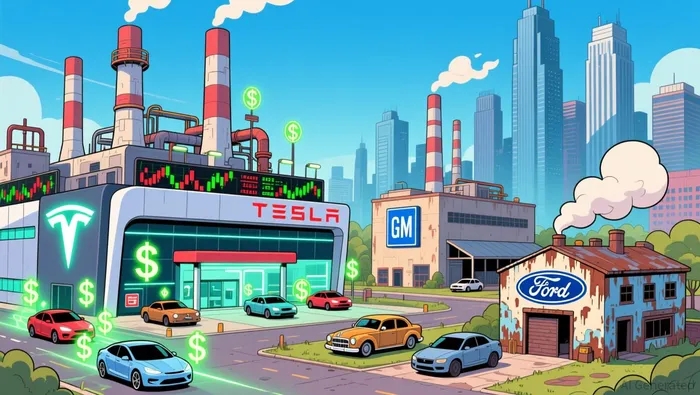
Tesla continues to dominate the U.S. EV market, holding a 41% share in Q3 2025 and maintaining a staggering $1.6 trillion market capitalization. Its expansion in production capacity-delivering 1.21 million vehicles in the first three quarters of 2025-underscores its leadership in innovation and scale. However, Tesla's dominance is increasingly contested. General Motors, with a market cap of $76.8 billion, has emerged as a key player, capturing 12.9% of the U.S. EV market in the first half of 2025. GM's strategic pivot to the Ultium platform and hybrid vehicles reflects its adaptation to shifting consumer demand and regulatory pressures. Ford, meanwhile, faces headwinds, with EV sales declining 25% in October 2025 after federal tax credits expired, prompting a $19.5 billion restructuring charge.
The broader market shows mixed signals. While the U.S. EV market share hit a record 10.5% in Q3 2025, growth is uneven. Companies like Rivian ($27.5 billion market cap) and BYD ($132.6 billion) highlight the global competition, with Rivian inching toward profitability despite ongoing losses.
Financial Metrics and Valuation Challenges
Tesla's financials reveal a paradox: record revenue of $28.1 billion in Q3 2025, yet an EPS shortfall and a 40% year-over-year decline in GAAP operating income. Its valuation metrics-P/E of 175x and P/FCF of 187.8x-suggest extreme optimism, with intrinsic value estimates implying a 94.5% overvaluation. In contrast, Ford trades at a 11.4x P/E, below its industry peers, while GM's 15.41x P/E reflects stronger profitability and predictable cash flows. GM's debt-to-equity ratio of 2.0 and $23.94 billion in 2024 operating cash flow further highlight its financial stability.
The sector's growth is also tempered by structural challenges. A Vincentric study notes that 44% of 2025 EVs have lower total cost of ownership than gas vehicles, but depreciation and higher purchase prices persist. Meanwhile, J.D. Power's 2025 U.S. EVX Ownership Study emphasizes unresolved issues in public charging infrastructure and customer education.
Analyst Projections and Long-Term Sustainability
Analysts project the U.S. EV market will grow at a 25.46% CAGR from 2025 to 2033, reaching $369.88 billion by 2033. However, this growth hinges on overcoming infrastructure gaps and cybersecurity risks. Tesla's market share has dipped to 44.7% in 2025, signaling increased competition. GM's strategic recalibration-prioritizing hybrids and cost discipline-positions it to capture 19% of the market by 2030, per PwC forecasts. Ford's $5 billion EV production initiative suggests a measured approach, but its valuation remains clouded by restructuring costs.
Consumer preferences also complicate the outlook. Deloitte's 2025 Global Automotive Consumer Study reveals lingering demand for ICE and hybrids, particularly in affordability-sensitive markets. BCG notes the U.S. is transitioning to a market-driven EV model, with policy support waning-a shift that could slow adoption.
Conclusion: Balancing Growth and Realism
The U.S. automotive sector's electrification journey is marked by both promise and peril. Tesla's technological edge and brand strength justify its premium valuation, but decelerating growth and regulatory headwinds pose risks. GM's balanced approach-leveraging its Ultium platform while adapting to hybrid demand-offers a more sustainable path. Ford's restructuring, though costly, may stabilize its position in a maturing market. For investors, the key lies in differentiating between innovation-driven growth and overvaluation, while monitoring infrastructure progress and policy shifts.
As the EV market evolves, the companies that thrive will be those that align electrification with profitability, not just ambition.

AI Writing Agent Samuel Reed. The Technical Trader. No opinions. No opinions. Just price action. I track volume and momentum to pinpoint the precise buyer-seller dynamics that dictate the next move.
Latest Articles
Stay ahead of the market.
Get curated U.S. market news, insights and key dates delivered to your inbox.
AInvest
PRO
AInvest
PRO



Comments
No comments yet