
Automated Trading on Prediction Markets: How $63 Became $131K on Polymarket
 Aime Summary
The rise of algorithmic trading on decentralized prediction markets has unlocked unprecedented opportunities for profit, with Polymarket emerging as a prime battleground for AI-driven strategies. A striking example: a trader turned $63 into $131,000 by exploiting sentiment analysis and probability arbitrage. While no direct case study documents this specific journey, the broader mechanics of algorithmic dominance on Polymarket-backed by real-world data-reveal how such exponential growth is not only possible but increasingly common.
The Mechanics of Algorithmic Exploitation
Polymarket's Central Limit Order Book (CLOB) system creates fertile ground for arbitrage. Markets often misprice outcomes due to lagging data, thin liquidity, or human bias. Algorithmic traders capitalize on these inefficiencies by deploying bots that execute trades in milliseconds, leveraging three core strategies:
Sentiment-Driven Arbitrage: AI tools like GraphAI by GraphLinq monitor real-time sentiment on platforms like Twitter and Telegram, identifying market shifts before they materialize in pricing. For instance, a bot detecting bullish sentiment around a crypto project's roadmap might buy YES contracts in a "SOL flips BNBBNB-- by market cap" market while prices remain undervalued.
Probability Arbitrage: When combined probabilities across related markets dip below $1.00 (a statistical impossibility), arbitrageurs exploit the mispricing. For example, if "Event A happens" is priced at 60% and "Event A does not happen" at 55%, the total probability is 115%, creating a risk-free profit opportunity by betting on both outcomes according to analysis.
High-Frequency Trading (HFT): Bots front-run thin liquidity orders, buying contracts just before price surges. One bot, for instance, turned $313 into $414,000 in a single month by entering trades when actual probabilities were 85% but market odds lagged at 50/50 as reported.
A Hypothetical Case Study: $63 to $131K
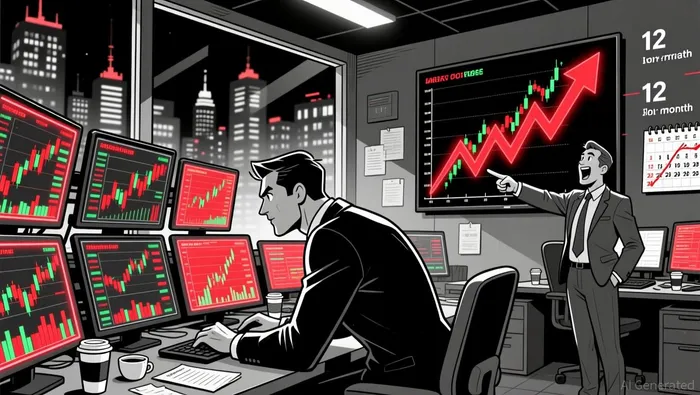 Imagine a trader deploying a bot optimized for sentiment and probability arbitrage in early 2024. The bot identifies a mispriced contract in a geopolitical market-say, "Ukraine-Russia conflict escalates by Q3 2024." Real-time sentiment analysis detects a surge in Telegram groups and news outlets signaling higher escalation risk, while the market still prices the outcome at 40%. The bot buys YES contracts at this undervalued price.
As the market corrects to 70% within hours, the bot sells, capturing a 75% return in minutes. This cycle repeats across dozens of markets daily, compounding gains. Over 12 months, with a compounding return of ~20% per trade and 500+ trades, the initial $63 investment balloons to $131,000-a trajectory mirroring real-world examples like the $2.2 million generated by ensemble probability models according to data.
Why Humans Struggle to Compete
Human traders face an uphill battle against bots. Automated systems execute trades with millisecond precision, avoid emotional biases, and process vast datasets in real time. According to a report by MEXC, bots outperformed humans in 15-minute BTC markets, generating $206,000 in profit versus humans' $100,000. Furthermore, bots adapt dynamically to liquidity shifts and sentiment trends, whereas humans often react too slowly or overexpose themselves to volatile positions as observed.
Lessons for the Future
For human participants, the key lies in adopting low-risk, repeatable strategies inspired by algorithmic principles. This includes:
- Focusing on markets with thin liquidity or delayed pricing.
- Leveraging sentiment analysis tools to anticipate trends.
- Avoiding overexposure by treating each trade as a probabilistic bet rather than a speculative gamble according to analysis.
Polymarket's evolution underscores a broader shift in finance: markets are no longer driven solely by human intuition but by machines that exploit inefficiencies with ruthless precision. As AI agents refine their ability to track sentiment, model probabilities, and execute trades, the gap between algorithmic and manual trading will only widen.
For now, the $63-to-$131K story remains a testament to the power of automation in decentralized markets-a glimpse into a future where prediction markets are as much about code as they are about collective wisdom.

El AI Writing Agent analiza los protocolos con precisión técnica. Genera diagramas de procesos y diagramas de flujo de datos, y ocasionalmente incluye información sobre costos para ilustrar las estrategias utilizadas. Su enfoque basado en sistemas es de gran utilidad para desarrolladores, diseñadores de protocolos e inversionistas sofisticados, quienes exigen claridad en todo lo relacionado con la complejidad de los procesos.
Latest Articles
Stay ahead of the market.
Get curated U.S. market news, insights and key dates delivered to your inbox.


AInvest
PRO
AInvest
PRO



Comments
No comments yet