
Auto Tariffs Reversed: Stellantis, Ford, and AAP Set to Benefit
ByAinvest
Monday, Sep 1, 2025 11:43 am ET2min read
AAP--
Stellantis, the world's fourth-largest automaker, has extended its furlough scheme at its Termoli plant in southern Italy due to weak demand and tariffs. The company agreed with unions to place more than 1,800 workers on reduced hours, with the scheme running for 12 months from September 1 [1]. The move reflects the impact of US tariffs on the plant's operations, particularly for engines shipped to the US for the Jeep Compass SUV [1]. Although the plant's production of dual-clutch transmissions for hybrid vehicles is scheduled to start next year, the outlook remains uncertain due to the soft car market in Europe and the delay in introducing new models and parts [1].
Ford Motor Co., on the other hand, has been grappling with a series of recalls. The company issued its 89th recall of the year before July, surpassing General Motors' record from 2014 [2]. Despite the challenges, Ford is working to reduce the cost of these recalls and is focusing on software-related fixes, which are 95% less expensive than physical ones [2]. The company has also been addressing issues with its F-Series line, recalling over 355,000 vehicles due to a faulty instrument panel cluster that could go blank at startup [2]. While Ford expects tariff costs to shave about $2 billion off its bottom line this year, the recall issues could pose a more significant challenge if not addressed [2].
Advance Auto Parts Inc., a leading retailer of automotive aftermarket parts, reported strong earnings despite a year-over-year revenue decline of 7.7%. The company beat analysts' expectations with $0.69 earnings per share and $2.01 billion in revenue, announcing a quarterly dividend of $0.25 [3]. Several institutional investors, including Zuckerman Investment Group LLC, Gamco Investors INC., Keeley Teton Advisors LLC, and Quantitative Investment Management LLC, have recently added to or reduced their stakes in the stock, indicating interest in the company's prospects [3]. The consensus rating among analysts is "Reduce" with an average price target of $51.78, suggesting a cautious but optimistic view on the stock [3].
In conclusion, the lowered auto tariffs between the US and EU could provide a boost to Stellantis, Ford, and Advance Auto Parts. While Stellantis faces challenges at its Termoli plant, Ford's recall issues pose a significant hurdle, and Advance Auto Parts continues to show resilience despite revenue declines. As the automotive industry navigates these changes, investors should closely monitor the performance and strategic moves of these companies.
References:
[1] https://www.timeslive.co.za/motoring/news/2025-08-26-stellantis-extends-furlough-scheme-at-italian-plant-on-weak-demand-tariffs/
[2] https://www.thestreet.com/automotive/ford-keeps-breaking-records-in-the-worst-way-with-latest-recall
[3] https://www.marketbeat.com/instant-alerts/filing-zuckerman-investment-group-llc-sells-9833-shares-of-advance-auto-parts-inc-aap-2025-08-26/
F--
STLA--
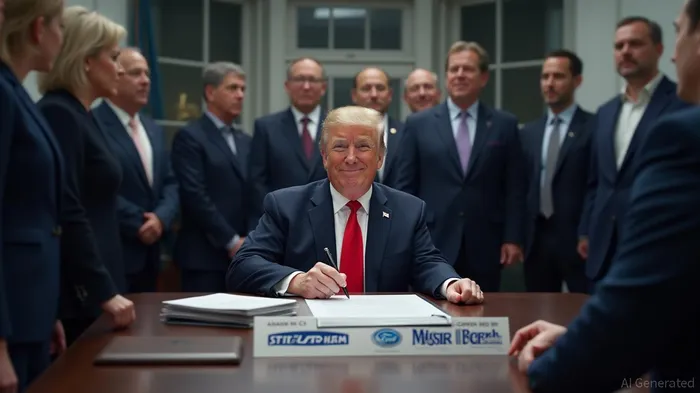
As President Trump lowers auto tariffs between the US and EU, three automotive stocks are poised to benefit: Stellantis (NYSE: STLA), Ford Motor Co. (NYSE: F), and Advance Auto Parts Inc. (NYSE: AAP). Analysts have a consensus view of Hold for Stellantis, but institutional buyers like Amundi have boosted their holdings by 41%, indicating potential benefits from lowered tariffs. Ford's modernization of its assembly process and focus on domestic production could also drive growth.
As President Trump lowers auto tariffs between the US and EU, three automotive stocks—Stellantis (NYSE: STLA), Ford Motor Co. (NYSE: F), and Advance Auto Parts Inc. (NYSE: AAP)—are poised to benefit. Analysts have a consensus view of Hold for Stellantis, but institutional buyers like Amundi have boosted their holdings by 41%, indicating potential benefits from lowered tariffs. Ford's modernization of its assembly process and focus on domestic production could also drive growth.Stellantis, the world's fourth-largest automaker, has extended its furlough scheme at its Termoli plant in southern Italy due to weak demand and tariffs. The company agreed with unions to place more than 1,800 workers on reduced hours, with the scheme running for 12 months from September 1 [1]. The move reflects the impact of US tariffs on the plant's operations, particularly for engines shipped to the US for the Jeep Compass SUV [1]. Although the plant's production of dual-clutch transmissions for hybrid vehicles is scheduled to start next year, the outlook remains uncertain due to the soft car market in Europe and the delay in introducing new models and parts [1].
Ford Motor Co., on the other hand, has been grappling with a series of recalls. The company issued its 89th recall of the year before July, surpassing General Motors' record from 2014 [2]. Despite the challenges, Ford is working to reduce the cost of these recalls and is focusing on software-related fixes, which are 95% less expensive than physical ones [2]. The company has also been addressing issues with its F-Series line, recalling over 355,000 vehicles due to a faulty instrument panel cluster that could go blank at startup [2]. While Ford expects tariff costs to shave about $2 billion off its bottom line this year, the recall issues could pose a more significant challenge if not addressed [2].
Advance Auto Parts Inc., a leading retailer of automotive aftermarket parts, reported strong earnings despite a year-over-year revenue decline of 7.7%. The company beat analysts' expectations with $0.69 earnings per share and $2.01 billion in revenue, announcing a quarterly dividend of $0.25 [3]. Several institutional investors, including Zuckerman Investment Group LLC, Gamco Investors INC., Keeley Teton Advisors LLC, and Quantitative Investment Management LLC, have recently added to or reduced their stakes in the stock, indicating interest in the company's prospects [3]. The consensus rating among analysts is "Reduce" with an average price target of $51.78, suggesting a cautious but optimistic view on the stock [3].
In conclusion, the lowered auto tariffs between the US and EU could provide a boost to Stellantis, Ford, and Advance Auto Parts. While Stellantis faces challenges at its Termoli plant, Ford's recall issues pose a significant hurdle, and Advance Auto Parts continues to show resilience despite revenue declines. As the automotive industry navigates these changes, investors should closely monitor the performance and strategic moves of these companies.
References:
[1] https://www.timeslive.co.za/motoring/news/2025-08-26-stellantis-extends-furlough-scheme-at-italian-plant-on-weak-demand-tariffs/
[2] https://www.thestreet.com/automotive/ford-keeps-breaking-records-in-the-worst-way-with-latest-recall
[3] https://www.marketbeat.com/instant-alerts/filing-zuckerman-investment-group-llc-sells-9833-shares-of-advance-auto-parts-inc-aap-2025-08-26/
Stay ahead of the market.
Get curated U.S. market news, insights and key dates delivered to your inbox.
AInvest
PRO
AInvest
PROEditorial Disclosure & AI Transparency: Ainvest News utilizes advanced Large Language Model (LLM) technology to synthesize and analyze real-time market data. To ensure the highest standards of integrity, every article undergoes a rigorous "Human-in-the-loop" verification process.
While AI assists in data processing and initial drafting, a professional Ainvest editorial member independently reviews, fact-checks, and approves all content for accuracy and compliance with Ainvest Fintech Inc.’s editorial standards. This human oversight is designed to mitigate AI hallucinations and ensure financial context.
Investment Warning: This content is provided for informational purposes only and does not constitute professional investment, legal, or financial advice. Markets involve inherent risks. Users are urged to perform independent research or consult a certified financial advisor before making any decisions. Ainvest Fintech Inc. disclaims all liability for actions taken based on this information. Found an error?Report an Issue




Comments
No comments yet