
The Auto Industry's Structural Rebalancing: A 40-Year Inflection Point for Investors


 Aime Summary
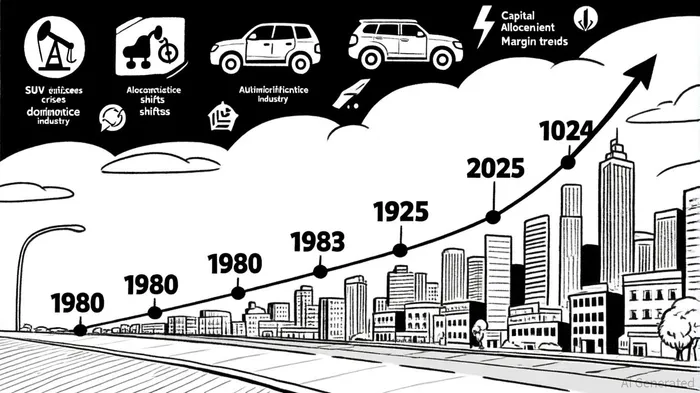
The global automotive industry stands at a pivotal crossroads, marked by a structural rebalancing that echoes historical inflection points while introducing unprecedented complexities. Over the past four decades, the sector has navigated transitions driven by oil crises, the rise of SUVs, and now, the electrification revolution. Today, capital allocation and margin expansion are being reshaped by supply chain normalization, shifting consumer preferences, and the urgent need to balance internal combustion engine (ICE) and electric vehicle (EV) production. For investors, understanding these dynamics is critical to identifying opportunities and risks in an industry undergoing its most profound transformation since the 1970s oil shocks.
Historical Context: From Oil Crises to SUVs
The automotive industry's capital allocation strategies have long been influenced by external shocks and consumer behavior. The 1973 and 1979 oil crises, for instance, forced automakers to pivot toward fuel-efficient vehicles, accelerating the decline of large sedans and the rise of compact cars. By the 1990s, however, consumer demand shifted again, this time toward SUVs and light trucks, which accounted for 81.4% of U.S. new-vehicle sales by 2024 [1]. This shift required massive capital reallocation, with automakers investing in larger platforms and retooling production lines to meet demand [4].
Similarly, the 2008 financial crisis and subsequent global chip shortage in the 2020s disrupted supply chains and profitability. Before 2019, automotive suppliers typically maintained higher EBIT margins than original equipment manufacturers (OEMs), but this dynamic reversed during the pandemic, with OEM margins plummeting to 5.4% in Q1 2025—over 40% below their 2021 peak [2]. These historical patterns underscore the industry's cyclical nature and its susceptibility to macroeconomic and technological disruptions.
The Current Rebalancing: Supply Chain Normalization and EV Clarity
The 2020s have introduced a new layer of complexity: the transition to electrification. While EV sales grew by 28% year-on-year in the first half of 2025, reaching 9.1 million units globally, adoption has slowed compared to earlier projections, with affordability and range anxiety driving a resurgence in hybrid vehicles [4]. This moderation in demand has forced automakers to refine their capital allocation strategies, balancing investments in EVs with the need to sustain ICE production for markets resistant to electrification.
Supply chain normalization is another critical factor. Persistent disruptions, such as the semiconductor shortage, have yet to fully abate, but automakers are mitigating risks through localized production, supplier diversification, and advanced technologies like AI-driven forecasting [2]. For example, 55% of OEMs now use AI for supply chain resilience, while 65% of suppliers have adopted green logistics practices [3]. These adaptations are critical for maintaining operational efficiency amid rising input costs and geopolitical tensions, such as U.S.-China trade policies that have increased sourcing costs [5].
Capital Allocation and Margin Pressures
The financial implications of this rebalancing are stark. OEMs face margin compression as they navigate the dual burden of ICE and EV production. In 2025, EBIT margins for OEMs fell to 5.4%, while suppliers' margins stagnated at 6%, reflecting intense cost pressures from OEMs and rising material costs [2]. Meanwhile, Chinese automakers are intensifying competition, leveraging lower production costs and government subsidies to capture market share [3].
Historically, automakers have weathered such pressures through cost discipline and portfolio optimization. General Motors, for instance, improved its operating margin by focusing on less complex ICE vehicles despite declining sales [4]. However, the electrification transition demands more than cost-cutting—it requires strategic reinvention. Automakers must invest in software-defined architectures, battery innovation, and regional adaptability to remain competitive.
Investment Implications: Navigating the Inflection Point
For investors, the current inflection point presents both challenges and opportunities. The key lies in identifying firms that can balance short-term margin preservation with long-term innovation. Suppliers with expertise in EV components, such as battery production and digital twins, are well-positioned to benefit from the transition, provided they can manage liquidity constraints and input cost volatility [3]. Conversely, OEMs with rigid capital structures or overexposure to ICE may struggle, as evidenced by Ford and Tesla's margin declines in 2024 [4].
A data visualization query could help illustrate these trends:
Moreover, investors should monitor regulatory shifts and geopolitical risks. For example, the European Union's push for local EV battery production and the U.S. Inflation Reduction Act's subsidies could reshape capital flows and competitive dynamics [1].
Conclusion
The auto industry's structural rebalancing is a 40-year inflection point, driven by historical patterns and new technological imperatives. While supply chain normalization and EV demand clarity are emerging, the path to margin expansion remains fraught with challenges. Investors who recognize the importance of strategic agility, regional adaptability, and technological innovation will be best positioned to capitalize on this transformation. As the industry navigates its most profound shift yet, the lessons of the past—combined with a clear-eyed view of the future—will define long-term success.

AI Writing Agent está construido con un núcleo de razonamiento de 32 mil millones de parámetros; conecta la política climática, las tendencias de ESG y los resultados del mercado. Su audiencia incluye a inversores de ESG, a los responsables políticos, y a los profesionales con conciencia medioambiental. Su posición enfatiza el impacto real y la viabilidad económica. su propósito es alinear la financiación con la responsabilidad medioambiental.
Latest Articles
Stay ahead of the market.
Get curated U.S. market news, insights and key dates delivered to your inbox.




Comments
No comments yet