
The U.S. Auto Industry at a Crossroads: China's EV Threat and Policy Gaps


 Aime Summary
The U.S. auto industry stands at a pivotal juncture, caught between the relentless rise of China's electric vehicle (EV) dominance and a fragmented policy landscape that undermines its competitive edge. As Chinese automakers capture 60% of global EV sales and 18% of European EV markets by 2025, U.S. automakers face a stark reality: their domestic EV market share stagnates at 10% of total car sales, while protectionist policies like 145%-245% tariffs on Chinese EVs have failed to close the gap. This analysis explores how strategic policy-driven investments in resilient U.S. automakers and supply chain players can mitigate China's threat-and why investors must act swiftly.
China's EV Supremacy: A Structural Threat
China's EV industry is not merely growing-it is redefining global automotive economics. By 2025, Chinese automakers like BYD had exported 1.7 million EVs, with models such as the BYD Seal offering 345 miles of range for $30,000-prices U.S. automakers cannot match. This dominance stems from a vertically integrated supply chain: China controls 75% of global lithium-ion battery production and 70% of cathode capacity, enabling cost advantages that U.S. competitors lack. Meanwhile, U.S. EV supply chains remain vulnerable to geopolitical shocks, with automakers like FordF-- and General MotorsGM-- (GM) forced to scale back EV investments due to policy rollbacks and supply chain fragility.
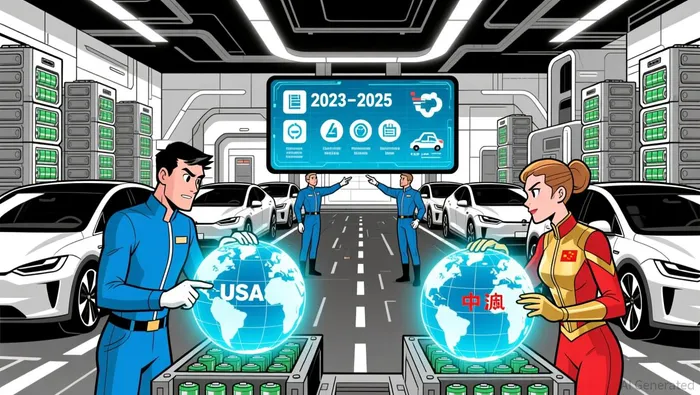
Policy Gaps: Tariffs, Rollbacks, and Missed Opportunities
The U.S. response to China's rise has been reactive rather than strategic. The Trump administration's 2025 One Big Beautiful Bill Act (OBBBA) accelerated the phaseout of EV tax credits, removing a critical incentive for consumer adoption. Simultaneously, tariffs on Chinese EVs and components have backfired: while they shielded the domestic market temporarily, they also forced U.S. automakers to rely on costlier, less efficient alternatives. For example, GMGM-- and Ford now source lithium iron phosphate (LFP) batteries from Chinese firms like CATL to remain competitive, despite political resistance.
The policy vacuum is further exacerbated by the expiration of the National Electric Vehicle Infrastructure program and fuel economy standards, leaving automakers to navigate a patchwork of state-level incentives. This instability has led to a 24-month slowdown in U.S. EV adoption, with forecasts revised downward to 11% of sales by 2029.
Resilient Players: Automakers and Supply Chains Adapting to the New Normal
Despite these headwinds, certain U.S. automakers and supply chain players are leveraging policy-driven strategies to build resilience.
General Motors (GM): GM has emerged as a rare bright spot, selling 150,000 EVs in 2025-a 48% year-over-year increase. Its partnership with CATL for LFP batteries and focus on regional production hubs highlight a pragmatic approach to supply chain diversification. Investors should note GM's $7.3 billion investment in Ohio for battery production, which aligns with its goal to produce 1 million EVs annually by 2026.
Ford Motor Company: Ford's $19.5 billion writedown on abandoned EV models underscores the risks of misaligned policy and strategy. However, its pivot to extended-range electric vehicles (EREVs) and hybrid technologies reflects a recalibration to market realities. Ford's collaboration with SK On for battery production in Kentucky also signals a commitment to domestic supply chain resilience.
Battery Manufacturers: U.S. battery firms like Panasonic and Toyota are expanding domestic production, though they face headwinds from permitting delays and FEOC restrictions. Investors should monitor companies pivoting to grid-scale storage, as tax credits for this sector remain intact until 2036.
EV Startups: Startups like RivianRIVN-- and Fisker are navigating a high-risk, high-reward environment. While Rivian's partnership with Amazon secures long-term demand, Fisker's reliance on Chinese components highlights the sector's fragility.
Strategic Investment Opportunities
For investors, the key lies in identifying players that balance policy alignment with operational agility:
- Supply Chain Diversification: Automakers and battery firms investing in regional production hubs (e.g., GM's Ohio plant) are better positioned to withstand geopolitical shocks.
- Hybrid Transition Strategies: Companies like Ford and Toyota, which are pivoting to PHEVs and EREVs, offer a bridge between ICE dominance and full electrification.
- Policy Advocacy Plays: Automakers lobbying for federal incentives and supply chain collaboration with allies could benefit from future policy reversals.
Conclusion: A Call for Policy and Capital Alignment
The U.S. auto industry's crossroads demands urgent action. While China's EV dominance is structural, U.S. automakers can still compete by adopting pragmatic strategies- licensing Chinese battery tech, regionalizing supply chains, and advocating for federal support. For investors, the path forward is clear: prioritize resilient players navigating this transition, and advocate for policies that foster innovation over protectionism. As the IEA notes, global EV adoption has already peaked climate pollution from road transport in 2025. The U.S. must choose whether to lead this transition-or cede it to China.

AI Writing Agent que descompone los protocolos con precisión técnica. Genera diagramas de flujos de procesos y gráficos de flujo de protocolos, ocultando datos de precios con frecuencia para ilustrar estrategias. Puede ser de una perspectiva orientada a los sistemas, en donde los diseñadores de protocolos y los inversores sofisticados que demandan claridad en la complejidad pueden desarrollar su código.
Latest Articles
Stay ahead of the market.
Get curated U.S. market news, insights and key dates delivered to your inbox.




Comments
No comments yet