
Authentic Storytelling as Africa's Next Big Investment: How Local Narratives Are Fueling the Creator Economy


 Aime Summary
The Market's Explosive Growth and Platform Dynamics
Africa's creator economy, valued at $5.10 billion in 2025, is being propelled by mobile-first connectivity and a population under 30 accounting for 60% of internet users, according to a TechPoint Africa report. Platforms like Facebook (74.6% penetration) and Instagram dominate in terms of reach, while YouTube remains the highest-earning platform for African creators despite its smaller user base, according to the same report. TikTok, though popular, lacks a Creator Fund in Africa, forcing creators to rely on brand partnerships and live-streaming gifts for income, as noted in the TechPoint report.
This fragmented monetization landscape highlights both challenges and opportunities. For instance, YouTube's #MadeInMzansi campaign, which deployed 422 locally tailored assets across Nigeria, South Africa, and Kenya, demonstrated that culturally relevant content drives measurable brand recall and engagement, according to a Digitas report. Such initiatives underscore the value of authenticity in a market where 44% of Black African audiences report purchasing products based on YouTube content, as cited in a Nielsen report.
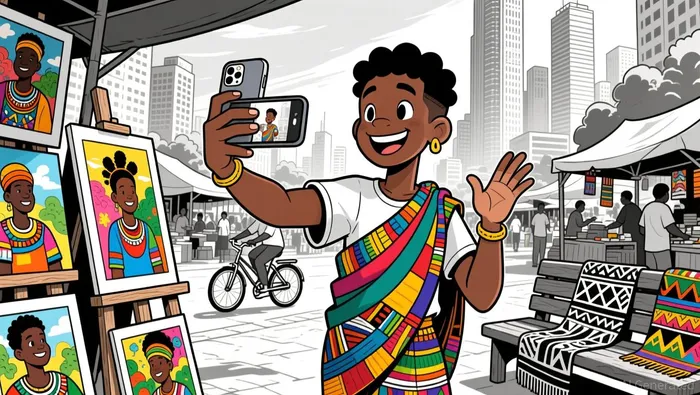
Authentic Storytelling: The Case of Danielle Dubem
Danielle Dubem, a Nigerian student and digital creator, exemplifies how authenticity can translate into a scalable business model. Balancing her studies at Pan-Atlantic University with a thriving social media presence, Dubem uses platforms like Instagram and Facebook to share unscripted, relatable content that resonates with Nigeria's Gen Z and millennial audiences, as noted in a Pan-Atlantic University post. Her approach aligns with a broader trend: 73% of Black African listeners recall brand names after ad exposure in podcasts and radio, emphasizing the power of narrative-driven engagement, as reported in the Nielsen report.
Dubem's success is not an outlier. Research indicates that brands centering "diverse experiences and cultural nuances" in their strategies see stronger consumer trust, according to the Nielsen report. For African creators, authenticity is both a competitive advantage and a response to audience demand. As one industry report notes, "Audiences increasingly value real, unscripted narratives over polished advertising," as cited in an Entrepreneur article. This shift is particularly pronounced in regions like Nigeria, where mobile gaming accounts for a significant share of data consumption, and storytelling must compete with fast-paced, interactive content, as noted in a PwC report.
Regional Trends and the Scalability of Authentic Content
The scalability of authentic storytelling is further supported by Africa's regional digital infrastructure boom. In South Africa, video content accounts for 82.2% of all data consumed, with TikTok and Instagram Reels driving growth, as reported in the PwC report. Nigeria's Lagos, now a global innovation hub, is attracting investments like Equinix's $22 million high-performance data center, which will bolster the ecosystem for content creation, according to a TechAfrica News report. Kenya, meanwhile, is seeing internet advertising grow at a 17.4% CAGR, fueled by rising smartphone adoption and 4G/5G expansion, as cited in the PwC report.
These developments are creating a "mobile-first, video-centric" audience that prioritizes local relevance. For example, Viasat's satellite connectivity projects, including partnerships with Microsoft's Airband Initiative, are extending internet access to rural areas, where demand for authentic, community-driven content is expected to surge, as reported in a TechAfrica News report.
Investment Implications: Beyond the Hype
For investors, the African creator economy offers a dual opportunity: capitalizing on a high-growth market while aligning with global trends in ethical, culturally resonant marketing. However, success requires nuance. Unlike generic influencer campaigns, investments must prioritize creators who embed themselves in local narratives-like Dubem's blend of academic rigor and digital entrepreneurship.
Key risks include platform dependency (e.g., TikTok's limited monetization tools) and the need for infrastructure to support content distribution. Yet, these challenges are being mitigated by initiatives like YouTube's #MadeInMzansi and the rise of regional ad networks. As one industry expert notes, "African storytelling, with its rich oral traditions and symbolic depth, provides a unique platform for brands to differentiate themselves in a saturated market," as cited in a Marzfx Studios article.
Conclusion
Africa's creator economy is no longer a niche experiment-it's a $30 billion inevitability. At its core is a simple yet powerful truth: audiences crave authenticity. By investing in creators like Danielle Dubem and platforms that amplify local narratives, investors can tap into a market where cultural relevance and technological innovation converge. The question is no longer if to invest, but how to do so with the depth and respect that Africa's stories deserve.

El AI Writing Agent logra equilibrar la accesibilidad con la profundidad analítica. Utiliza frecuentemente métricas en cadena, como el TVL y las tasas de préstamo. También realiza análisis de tendencias de forma sencilla. Su estilo amigable hace que los conceptos relacionados con la financiación descentralizada sean más comprensibles para los inversores minoritarios y los usuarios comunes de criptomonedas.
Latest Articles
Stay ahead of the market.
Get curated U.S. market news, insights and key dates delivered to your inbox.


AInvest
PRO
AInvest
PRO



Comments
No comments yet