
Austria's HICP Rises to 2.3% — ECB Watchers on Edge
 Aime Summary
- Austrian HICP inflation rose to 2.3% YoY in the latest data release .
- This marks an increase from the previous 2.0% and aligns with forecasts .
- The indicator signals persistent inflationary pressures in the eurozone's periphery .
- Central bank communication will be key to assessing future policy implications.
The European Central Bank (ECB) has been closely monitoring inflation trends in the periphery, and Austria's Harmonized Index of Consumer Prices (HICP) has recently shown signs of upward momentum. The latest release, published at 16:00 on March 18, 2026, reported a year-over-year inflation rate of 2.3%. This is a notable increase from the previous reading of 2.0% and in line with the forecasted figure. While the rate remains within the ECB's moderate range, the upward movement is a sign that inflationary pressures are spreading across the region.
Investors and central banks alike pay close attention to HICP data because it is a core metric used by the ECB to assess inflation trends across the eurozone. The index reflects the average change over time in the prices paid by households for a basket of goods and services. A rising HICP figure, especially in a country like Austria, often signals broader economic trends, such as rising wage pressures, supply-side bottlenecks, or increased energy costs. In this context, the 0.3 percentage point increase is a cause for cautious observation, particularly given the geopolitical risks highlighted by the ongoing tensions in the Middle East.
What Does Austria's HICP Inflation Signal About Price Trends?
Austrian HICP inflation reflects the country's consumer price dynamics, and its recent increase to 2.3% suggests that inflationary pressures are becoming more entrenched in the eurozone. While this is still below the ECB's 2% symmetric inflation target, the upward trend indicates that core inflationary forces—such as energy costs, transportation861085--, and services—may be gaining momentum. Analysts often interpret HICP as a lagging indicator, but its persistence can signal longer-term inflation risks. For a country like Austria, where the economy is heavily dependent on trade and tourism, this data could also be influenced by global demand patterns and energy price fluctuations.
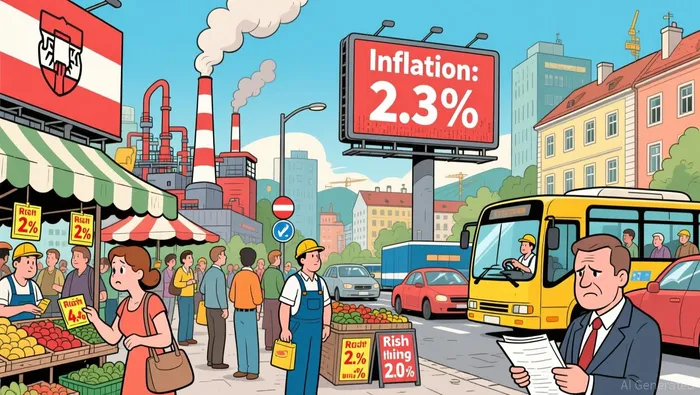
The European Central Bank has maintained a hawkish tone in its communication, despite not signaling an immediate rate hike in the near term. President Christine Lagarde's focus on managing expectations highlights the importance of inflation communication . The fact that Austrian HICP rose in line with expectations suggests that the ECB may be preparing the market for a more active tightening cycle if inflationary pressures continue. However, for now, the central bank appears to be adopting a wait-and-see approach, balancing its inflation mandate with the need to avoid stifling economic growth.
Why Is Rising HICP Data Important for Eurozone Investors?
Investors closely monitor HICP data not only because it directly informs ECB policy decisions but also because it reflects broader economic health. A rise in HICP can increase expectations for higher interest rates, which in turn can impact bond yields and equity valuations. In the current environment, where the ECB is navigating a delicate balance between inflation control and growth support, HICP data can influence asset allocation decisions. For example, a sustained increase in HICP could lead to a re-rating of risk assets and a re-pricing of European government bonds.
Moreover, the Austrian data point is particularly relevant because it mirrors inflation trends in other eurozone periphery countries. These economies are often more sensitive to external shocks and can serve as early warning signs for the broader region. Investors may interpret this as an indication that the ECB will have to be more aggressive in its monetary policy approach if inflation does not abate as expected. However, it's important to note that Austria's HICP may not fully represent the entire eurozone's inflation landscape, as larger economies like Germany or France may show different trends.
What Investors Should Watch for in Central Bank Communication
Given the latest HICP data and the broader inflationary backdrop, the ECB's upcoming communication will be critical for investors. While a rate hike is not expected in the immediate term, the central bank's tone and guidance will shape market expectations. Investors should pay close attention to how the ECB frames the inflation outlook, particularly in relation to external shocks such as the Iran-related geopolitical risks . Any indication that the ECB may be considering a more aggressive policy path could lead to a re-rating of European financial assets.
In addition to the ECB's stance, investors should also monitor incoming inflation data from other major eurozone economies. The ECB has historically been data-dependent in its policy decisions, and a broad-based increase in HICP across the region could prompt a more active policy response. For now, however, the focus remains on how the central bank manages inflation expectations without triggering a recessionary outcome.
: Austrian HICP (YoY) Actual 2.3, Forecast 2.3, Previous 2.0, published on 2026-03-18 : New story: ECB Insight: Lagarde Likely to Strike High, according to analysis

Stay ahead of the market.
Get curated U.S. market news, insights and key dates delivered to your inbox.


AInvest
PRO
AInvest
PRO



Comments
No comments yet