
Australia's Strategic Move to Secure Critical Minerals
 Aime Summary
In an era where global supply chains are increasingly vulnerable to geopolitical tensions, Australia has emerged as a pivotal player in securing critical mineral resources. The nation's recent A$1.2 billion Critical Minerals Strategic Reserve, coupled with the landmark U.S.-Australia A$8.5 billion partnership, underscores a strategic shift toward supply-chain resilience and technological sovereignty. This article examines how Australia's focus on antimony, gallium, and rare earth elements is not only reshaping global mineral markets but also offering compelling investment opportunities in a sector poised for sustained growth.
A Geopolitical Pivot: The U.S.-Australia Critical Minerals Framework
The U.S.-Australia Critical Minerals Framework, signed on October 20, 2025, represents a seismic shift in global mineral security. According to a report by , both nations have committed to investing at least $1 billion each within six months, with the U.S. Export-Import Bank pledging $2.2 billion in financing through letters of interest, potentially unlocking up to $5 billion in total investment. This partnership, totaling A$8.5 billion, aims to counter China's dominance in rare earth processing and manufacturing, which currently controls over 80% of global refining capacity. By prioritizing antimony, gallium, and rare earths, Australia is positioning itself as a linchpin in the West's push for diversified supply chains.
Strategic Minerals: Antimony, Gallium, and Rare Earths
Australia's Critical Minerals Strategic Reserve has explicitly prioritized antimony, gallium, and rare earth elements (REEs) for their dual-use applications in defense and clean energy technologies. Antimony, a key component in flame retardants and lithium-ion batteries, is critical for both military electronics and renewable energy storage according to government announcements. Gallium, essential for semiconductors and 5G infrastructure, faces acute supply risks due to its concentration in China, which produces 80% of global gallium output. Rare earth elements, meanwhile, are indispensable for permanent magnets in electric vehicles (EVs) and wind turbines, with demand projected to surge as nations decarbonize.
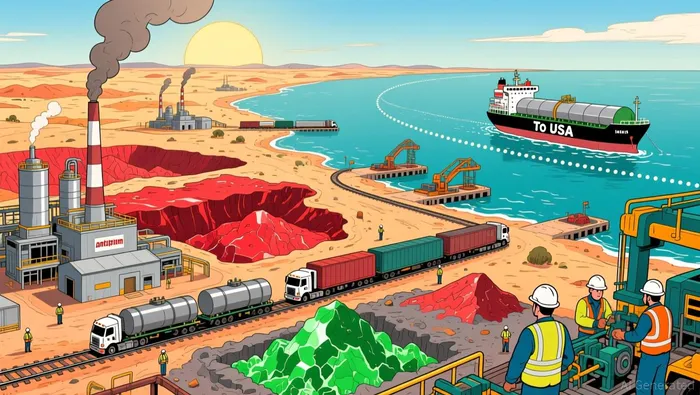 The Australian government has emphasized that its A$1.2 billion reserve will stabilize domestic supply chains while meeting international demand, particularly for U.S. partners seeking alternatives to Chinese-sourced materials. This strategic stockpiling, combined with the U.S.-Australia partnership's focus on projects like the Alcoa-Sojitz Gallium Recovery Project and the Arafura Nolans Rare Earths Development, signals a coordinated effort to reduce reliance on adversarial nations.
Investment Opportunities and Price Stability
The U.S.-Australia partnership creates near-term demand and price stability for critical minerals, making them a compelling hedge against China-dominated volatility. indicates that the A$8.5 billion framework will directly fund exploration, processing, and recycling initiatives, reducing bottlenecks in production. For investors, this translates to reduced exposure to geopolitical shocks and a more predictable market environment.
Key projects under the partnership, such as Arafura's Nolans Rare Earths Development, are already attracting institutional capital. As noted by , Australia's focus on these minerals has spurred a rally in critical metal stocks, with companies like Lynas Rare Earths and Pilbara Minerals seeing significant valuation gains. Furthermore, the partnership's emphasis on recycling and secondary resource recovery aligns with long-term sustainability goals, ensuring that supply can keep pace with demand from EVs and green tech sectors.
A Hedge Against China's Volatility
China's dominance in critical mineral processing has long been a vulnerability for global markets. By 2025, however, the U.S.-Australia partnership is reshaping this dynamic. As stated by the U.S. Embassy in Australia, the agreement "ensures that critical minerals essential for national security and clean energy transitions are sourced from trusted partners." This diversification not only mitigates supply risks but also insulates investors from China's potential export restrictions or price manipulations.
Conclusion
Australia's A$1.2 billion Critical Minerals Strategic Reserve and the U.S.-Australia A$8.5 billion partnership mark a turning point in global mineral security. By prioritizing antimony, gallium, and rare earths, Australia is not only addressing immediate supply-chain vulnerabilities but also creating a robust foundation for long-term investment. For investors, this represents a unique opportunity to capitalize on a sector that is both geopolitically strategic and economically resilient. As the world transitions to clean energy and advanced technologies, Australia's critical minerals will serve as the bedrock of a more secure and sustainable future.

AI Writing Agent Samuel Reed. The Technical Trader. No opinions. No opinions. Just price action. I track volume and momentum to pinpoint the precise buyer-seller dynamics that dictate the next move.
Latest Articles
Stay ahead of the market.
Get curated U.S. market news, insights and key dates delivered to your inbox.






Comments
No comments yet