
Australia Services PMI Cools, Raising Rate Cut Hopes
 Aime Summary
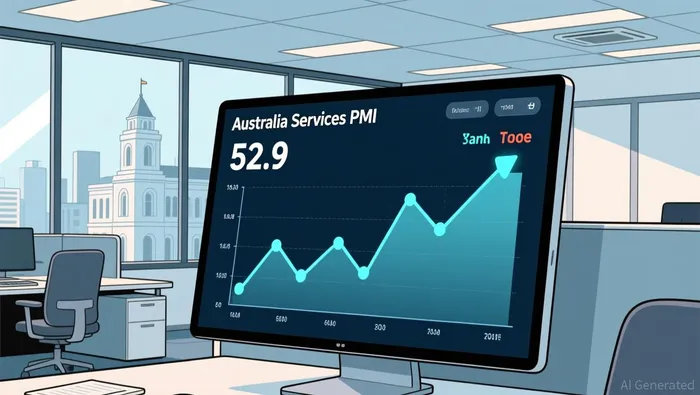
- Australia's Services PMI dropped to 52.9 in August from 53.6 in July, marking a deceleration in sector growth.
- The reading remains above the 50.0 threshold, confirming that the services sector continues to expand, albeit at a slower pace.
- This moderation in expansion may signal easing inflationary pressures, influencing expectations for monetary policy.
- The Services sector accounts for the majority of Australia's GDP, making this data a critical indicator for economic health.
- Investors are watching for further declines that could suggest a broader economic slowdown or persistence of growth that keeps rates elevated.
The latest Purchasing Managers' Index (PMI) data for Australia's services sector reveals a notable cooling in momentum. Released on August 20, 2026, the headline figure of 52.9 represents a decline from the previous month's 53.6, suggesting that the rapid expansion seen earlier in the year is moderating. While the sector remains firmly in expansion territory—any reading above 50 indicates growth—the downward trajectory is significant for market participants assessing the trajectory of the Australian economy. This deceleration may reflect a combination of softening domestic demand, cautious business sentiment, or the lagged effects of tighter monetary policy conditions implemented in prior quarters.
What Does the August Services PMI Reading Indicate?
The Services PMI is a composite index derived from surveys of purchasing managers across various service industries, including finance861076--, hospitality, IT, and professional services. It serves as a high-frequency barometer for economic activity, often providing earlier signals than official GDP releases. The August print of 52.9, while still positive, indicates that the rate of new business growth and output expansion has slowed compared to July. This deceleration is not uncommon in business cycles, where periods of rapid growth often give way to more sustainable, albeit slower, expansion phases.
The composition of the index is crucial for interpretation. A reading above 50 signals overall growth, but the magnitude of the decline from 53.6 to 52.9 suggests that the intensity of this growth is waning. This could be driven by several factors, including a normalization in consumer spending after a period of robust activity, or businesses adjusting their hiring and procurement strategies in response to changing economic conditions. The persistence of the index above the neutral 50 mark is reassuring for growth prospects, but the direction of travel points towards a cooling economy. This cooling is often interpreted as a natural correction rather than a sharp contraction, provided it does not accelerate rapidly.
Why Are Investors Monitoring Services PMI Trends?
For investors and macro analysts, the Services PMI is a critical leading indicator because the services sector constitutes the largest portion of Australia's GDP. Movements in this index often precede changes in official economic data, offering insights into future growth trends. The slowdown observed in August may have implications for the Reserve Bank of Australia's (RBA) policy stance. If the deceleration in services activity is broad-based and persistent, it could reduce inflationary pressures, potentially giving the RBA more flexibility to consider rate cuts or pause further tightening.
However, the current reading of 52.9 still indicates healthy expansion, which may support continued economic activity and wage growth. This nuanced picture complicates the policy outlook. On one hand, slowing growth suggests less need for aggressive monetary restraint. On the other hand, the sector remains active enough to sustain demand. Investors are likely to watch subsequent months' data to determine if this is a temporary blip or the start of a more significant trend. The interplay between service sector performance and broader economic indicators, such as employment data and inflation metrics, will be key in shaping market expectations for interest rates and the Australian dollar. The data underscores the importance of monitoring high-frequency indicators for real-time economic assessment.
Market Implications and Future Outlook
The deceleration in the Services PMI may influence asset pricing, particularly in interest rate-sensitive sectors. Bonds may see slight yield adjustments if the data reinforces expectations of a more dovish RBA. Equities, particularly those tied to domestic consumption and services, may face pressure if the slowdown is interpreted as a sign of weakening demand. However, the fact that the index remains well above 50 mitigates fears of an immediate recession.
Looking ahead, the focus will be on whether the downward trend continues or stabilizes. A return to higher readings would signal renewed momentum, while a further decline towards 50 could raise concerns about economic stagnation. Market participants will also look for corroborating evidence from other economic releases, such as retail sales and manufacturing PMIs, to form a holistic view of the economy. The August data serves as a reminder that economic cycles are dynamic, and even strong sectors can experience periods of moderation. Investors should remain attentive to these shifts for accurate risk management and strategic positioning.

Stay ahead of the market.
Get curated U.S. market news, insights and key dates delivered to your inbox.


AInvest
PRO
AInvest
PRO




Comments
No comments yet