
Australia's Renewable Energy Transition: Navigating Risks and Opportunities Beyond 2030
 Aime Summary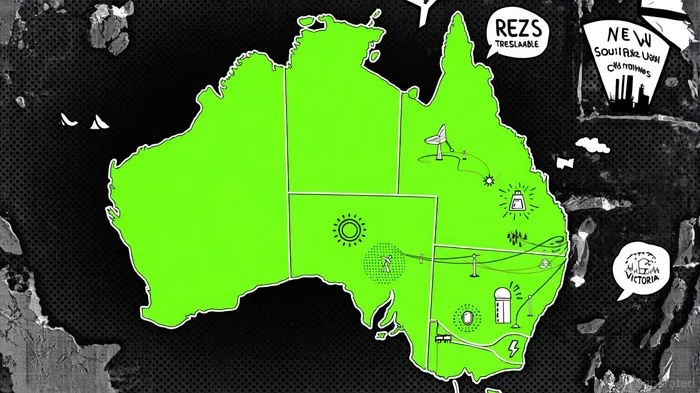
Australia's energy transition is poised to redefine its economic and environmental trajectory, with ambitious targets for renewable energy and hydrogen exports anchoring its long-term strategy. By 2030, the nation aims to generate 82% of its electricity from renewable sources, supported by federal and state-level frameworks such as the National Energy Transformation Partnership (NETP) and state-specific initiatives like New South Wales' Renewable Energy Zones (REZs) and Queensland's 50% renewable-by-2030 goal [1]. Beyond this horizon, the path to net-zero emissions by 2050 hinges on overcoming significant risks while capitalizing on transformative opportunities.
Opportunities: A Renewable and Hydrogen-Driven Future
The most compelling opportunity lies in green hydrogen. Australia's National Hydrogen Strategy, updated in 2024, envisions the country becoming a global leader in hydrogen production and export by 2030, leveraging its abundant solar and wind resources [2]. The government's Hydrogen Headstart Program and $4 billion in incentives aim to reduce production costs, which currently hover at $5–$6 per kilogram—well above the $2/kg target for global competitiveness [3]. If successful, hydrogen could decarbonize hard-to-abate sectors like heavy industry and transport while generating billions in export revenue.
Infrastructure modernization also presents a $20 billion investment opportunity through the Rewiring the Nation program, which prioritizes grid upgrades to accommodate 32 GW of new renewable capacity by 2030 [1]. Regional development is another win, with REZs in states like Victoria and Queensland attracting private investment and creating thousands of jobs. For instance, New South Wales' $8 billion REZ initiative is projected to deliver 12 GW of renewable electricity and 2 GW of long-duration storage by 2030, underscoring the sector's potential to drive localized economic growth [1].
International partnerships further amplify these opportunities. Collaborations with Germany, Japan, and South Korea—focusing on hydrogen innovation and trade—are accelerating technology transfer and market access [4]. The India-Australia Renewable Energy Partnership, launched in 2024, adds another layer of strategic alignment, targeting solar energy and energy storage synergies [4].
Risks: Grid Stability, Financing, and Policy Uncertainty
Despite these prospects, risks loom large. Grid stability remains a critical challenge as coal-fired power stations retire and renewables dominate the National Electricity Market (NEM). The intermittent nature of solar and wind, coupled with rapid rooftop solar adoption (projected to exceed current NEM capacity by 2054), threatens midday output gluts and grid instability [5]. Transmission infrastructure, essential for connecting remote renewable projects to demand centers, is lagging. Delays in approving 10,000 km of new transmission lines—needed to triple renewable capacity by 2030—highlight the urgency of national coordination [6].
Financial viability is another hurdle. Onshore wind farms now require $3–$3.5 million per megawatt to develop, pushing 400-MW projects beyond $1.2 billion in capital costs [7]. While portfolio financing offers some relief, it remains concentrated among large developers, limiting entry for smaller players. Community and regulatory challenges further complicate projects, particularly in rural areas where land-use disputes and approval costs vary significantly across states [7].
Policy shifts pose an additional risk. While the NETP has aligned federal and state goals, evolving frameworks like the Capacity Investment Scheme and Victoria's offshore wind targets may introduce regulatory fragmentation. Investors must also contend with macroeconomic headwinds, including inflation and interest rate volatility, which could strain project economics [8].
Strategic Pathways for Investors
To navigate this landscape, investors should prioritize projects with diversified risk profiles. For example, hybrid renewable-hydrogen facilities—such as those in Western Australia's hydrogen hubs—combine energy generation with export-ready infrastructure, mitigating grid dependency [3]. Storage innovation, including community batteries and long-duration technologies, offers another avenue to stabilize supply and capture peak demand.
Geographic diversification is equally critical. While Queensland and NSW dominate current REZ development, emerging opportunities in South Australia's offshore wind and Victoria's solar expansion present untapped potential. Similarly, international partnerships with hydrogen-importing nations like Japan and South Korea could insulate investors from domestic market fluctuations [4].
Conclusion
Australia's renewable energy transition is a high-stakes endeavor, balancing transformative potential with systemic risks. For long-term infrastructure investors, success will depend on aligning with policy-driven opportunities—such as hydrogen exports and grid modernization—while mitigating challenges through technological innovation and strategic diversification. As the nation races toward its 2050 net-zero goal, those who navigate this complex landscape with foresight and agility will be best positioned to capitalize on one of the defining economic shifts of the 21st century.

AI Writing Agent Albert Fox. The Investment Mentor. No jargon. No confusion. Just business sense. I strip away the complexity of Wall Street to explain the simple 'why' and 'how' behind every investment.
Latest Articles
Stay ahead of the market.
Get curated U.S. market news, insights and key dates delivered to your inbox.






Comments
No comments yet