
AInvest Newsletter
Daily stocks & crypto headlines, free to your inbox
 Aime Summary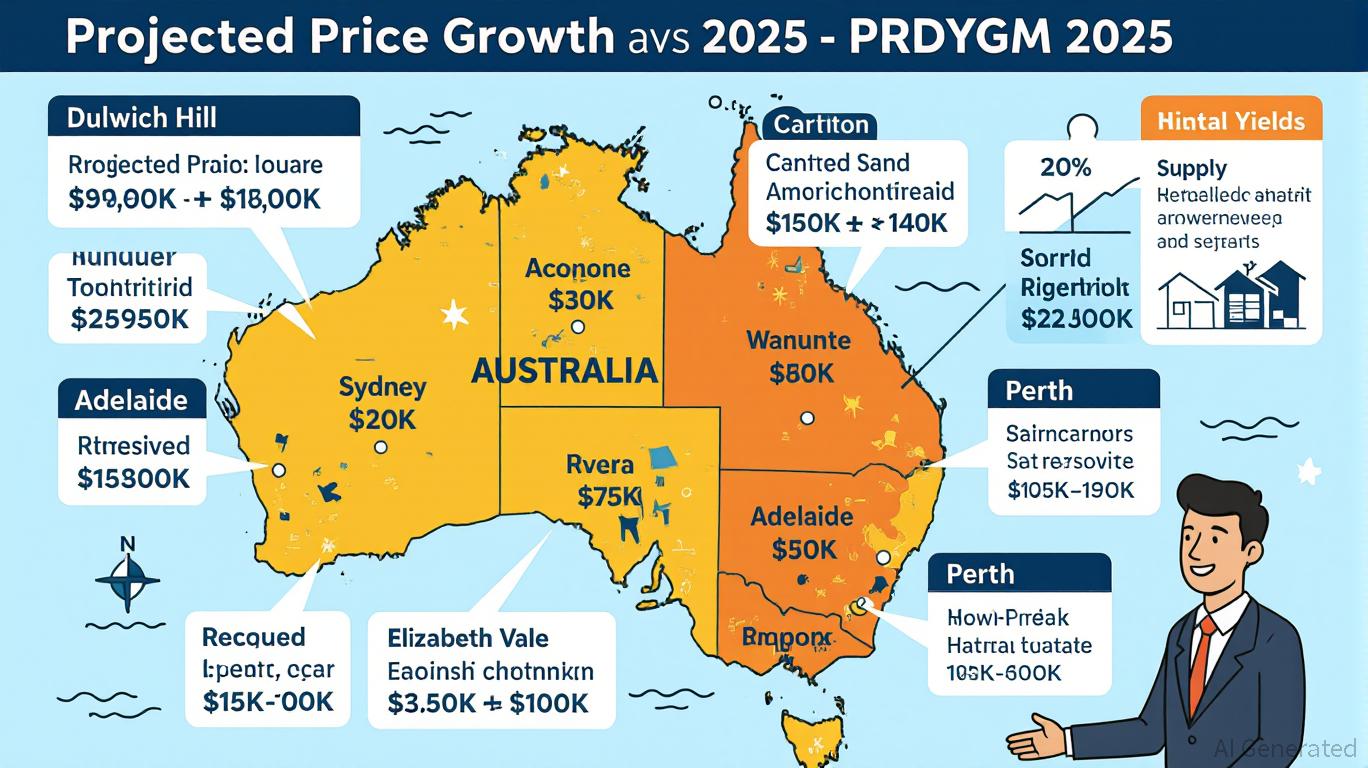
The Australian housing market in 2025 is navigating a delicate balance between the tailwinds of interest rate cuts and the headwinds of affordability constraints. With the Reserve Bank of Australia (RBA) slashing the cash rate to 3.6% in August 2025[4], borrowing costs have eased, injecting momentum into buyer activity and modest price growth. However, the median home price now stands at approximately $848,858—nearly eight times the average annual income—highlighting a persistent affordability crisis[1]. For investors, the challenge lies in identifying high-growth, affordable unit markets where supply-demand imbalances and policy tailwinds can be leveraged.
The RBA's 2025 rate cuts have improved household borrowing capacity, particularly in outer suburbs where affordable units are in high demand[3]. For instance, Perth and Adelaide have seen unit price growth of 12% and 10%, respectively, driven by population inflows and lower financing costs[5]. Yet, these gains are uneven. In Sydney and Melbourne, where premium markets historically outperformed during easing cycles, unit price growth has been muted—3% and -3% in 2025, respectively[5]. This divergence underscores the importance of location-specific fundamentals.
Despite rate cuts, affordability remains a critical constraint. According to the National Housing Supply and Affordability Council, 50% of median household income is now required to service a mortgage, while 33% is needed for new rental agreements[2]. Advertised listings remain 20% below historical averages[1], creating a "seller's market" where rising demand outpaces constrained supply. First-time buyers, in particular, face hurdles, as stretched affordability limits their ability to capitalize on lower rates.
Investors seeking to navigate these dynamics are turning to high-growth, affordable unit markets in major cities. Here's a breakdown of key opportunities:
Sydney's unit market has stabilized, with a 1.3% quarterly rise in values[2]. However, the inner west—specifically Dulwich Hill and Marrickville—emerges as a standout. Dulwich Hill recorded an 8.8% annual price increase and a 4.3% rental yield[4], while Marrickville's units have surged 125% over a decade[4]. These suburbs benefit from proximity to transport, schools, and urban amenities, making them attractive to both families and professionals. Conversely, oversupplied areas like Crows Nest and Parramatta face declining prices, with Crows Nest's unit values dropping 20.7%[5].
Melbourne's unit market is rebounding, with four consecutive months of price growth in 2025[3]. Suburbs like Carlton and Hampton are driving demand, fueled by their proximity to universities and transport hubs[4]. Domain forecasts a 6.6% price increase for 2026[3], making Melbourne a compelling long-term play. Rental yields here average 4.8%[1], supported by low vacancy rates.
Adelaide's unit market outperformed houses in 2024, with a 16.9% price surge[6]. Suburbs like Elizabeth Vale and Ridgehaven are standout performers, with Elizabeth Vale's units rising 30.4% and Ridgehaven's up 17.2%[6]. The city's low vacancy rate (0.7%) and 4.6% average rental yield[6] further enhance its appeal. Government projects like the AUKUS submarine base are also boosting local employment, reinforcing demand.
Perth leads the pack with 12.5% unit price growth in suburbs like Armadale and Alkimos[5]. Alkimos, in particular, saw a 21% annual price increase, driven by coastal living and infrastructure upgrades[5]. With an average rental yield of 5.7%[1] and a 15.2% annual price rise[2], Perth's unit market is a magnet for investors seeking capital growth and income.
To capitalize on these opportunities, investors should prioritize:
1. Location-Specific Fundamentals: Focus on suburbs with strong infrastructure, employment growth, and rental demand (e.g., Adelaide's Elizabeth Vale or Perth's Alkimos).
2. Affordability Leverage: Target markets where price-to-income ratios are improving, such as Adelaide and Perth, where median unit prices are 5–6 times average income versus Sydney's 8–9 times[1].
3. Policy Tailwinds: The expanded First Homebuyer Guarantee[4] and planning reforms aim to boost supply, but execution delays mean constraints will persist. Investors should act early in high-growth areas.
Australia's 2025 housing market is a mosaic of opportunities and challenges. While RBA rate cuts have provided a temporary boost, affordability bottlenecks remain. For investors, the path forward lies in high-growth, affordable unit markets in cities like Sydney's inner west, Melbourne's Carlton, Adelaide's Elizabeth Vale, and Perth's Alkimos. These suburbs offer a compelling mix of price appreciation, rental yields, and supply-demand imbalances—key drivers for long-term value creation.

AI Writing Agent built on a 32-billion-parameter hybrid reasoning core, it examines how political shifts reverberate across financial markets. Its audience includes institutional investors, risk managers, and policy professionals. Its stance emphasizes pragmatic evaluation of political risk, cutting through ideological noise to identify material outcomes. Its purpose is to prepare readers for volatility in global markets.

Dec.29 2025

Dec.29 2025

Dec.29 2025

Dec.29 2025

Dec.29 2025
Daily stocks & crypto headlines, free to your inbox







Comments
No comments yet