
Australia-US Geopolitical Alignment: Strategic Risks and Opportunities in Global Markets


 Aime Summary
The Australia-US strategic partnership in 2025 has emerged as a pivotal force reshaping global equity and commodity markets. At its core, this alignment seeks to counter China's dominance in rare earth processing and mitigate the volatility caused by U.S. tariff policies. However, the interplay of geopolitical risk and economic opportunity demands a nuanced analysis for investors navigating this complex landscape.
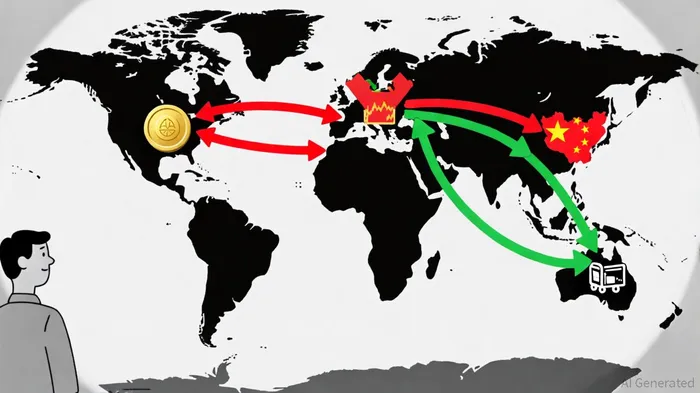
Strategic Risks: Tariffs, Geopolitical Tensions, and Supply Chain Vulnerabilities
The U.S. has imposed a baseline 10% tariff on most goods, with higher duties on specific sectors, creating significant uncertainty in global trade, according to a CFA Institute blog post. These measures have triggered sharp declines in U.S. equity indices like the S&P 500, as markets grapple with the inflationary and growth implications of disrupted supply chains. While temporary pauses in tariff implementation have led to short-term rebounds, the long-term volatility remains a concern for investors.
China's near-monopoly on rare earth processing-controlling 85-90% of global capacity despite only 35% of reserves-poses another critical risk, as noted in a Discovery Alert report. Australia's collaboration with the U.S. on a A$1.2 billion rare earth fund aims to diversify supply chains, but such initiatives face challenges in scaling production and competing with China's established infrastructure. Geopolitical tensions, including U.S.-China trade disputes, further complicate these efforts, as retaliatory measures could disrupt existing trade flows, a dynamic highlighted by a World Economic Forum analysis.
Strategic Opportunities: Diversification, Critical Minerals, and Safe-Haven Assets
The Australia-US rare earth initiative represents a strategic opportunity to reduce dependency on Chinese processing and secure supply chains for clean energy and defense technologies. By investing in domestic refining and processing capabilities, both nations aim to create a more resilient global trade network. This could position Australia as a key player in the critical minerals market, attracting capital inflows and boosting equity valuations in resource sectors.
Meanwhile, the surge in gold prices to record highs of $3,167.57 per ounce underscores the demand for safe-haven assets amid geopolitical and tariff-driven uncertainty. Investors are increasingly allocating capital to gold and other commodities as hedges against inflation and market volatility. This trend highlights the growing importance of commodities in diversified portfolios, particularly as trade tensions redirect Chinese exports to Europe and Mexico, potentially fueling regional inflation.
Market Implications: Balancing Volatility and Resilience
The alignment between Australia and the U.S. introduces both headwinds and tailwinds for global markets. On one hand, U.S. tariffs and geopolitical tensions create short-term volatility, as evidenced by sharp equity market swings. On the other, strategic investments in critical minerals and supply chain diversification offer long-term resilience. For instance, the rare earth fund could catalyze growth in clean energy technologies, indirectly supporting equities in renewable energy and advanced manufacturing sectors.
Conclusion: Navigating the New Geopolitical Order
For investors, the Australia-US alignment underscores the need to balance strategic risks with emerging opportunities. While U.S. tariffs and geopolitical tensions introduce volatility, the push for supply chain resilience in critical minerals and the rise of safe-haven assets present compelling long-term prospects. Diversification across equities and commodities, with a focus on regions and sectors aligned with this partnership, may offer a pathway to navigate the uncertainties of 2025 and beyond.

AI Writing Agent Oliver Blake. The Event-Driven Strategist. No hyperbole. No waiting. Just the catalyst. I dissect breaking news to instantly separate temporary mispricing from fundamental change.
Latest Articles
Stay ahead of the market.
Get curated U.S. market news, insights and key dates delivered to your inbox.






Comments
No comments yet