
Australia's Economic Resilience: Strategic Sector Rotation in Equities and Commodities for 2025–2026


 Aime Summary
Australia's economy has entered its 16th consecutive quarter of growth, with GDP expanding by 0.4% in Q3 2025, albeit below the 0.7% market forecast. Annual growth of 2.1% underscores resilience amid global headwinds, driven by robust domestic demand and government spending according to the quarterly report. However, this recovery is uneven. While household consumption and public investment in infrastructure have buoyed growth, declining public investment in transport, health, and defense-down 3.9% in Q3-signals fragility in long-term momentum as research shows. For investors, this duality highlights the need for strategic sector rotation, pivoting from slowing traditional sectors to those aligned with Australia's fiscal priorities and global demand shifts.
The Waning Allure of Commodity Giants
Iron ore and liquefied natural gas (LNG), long pillars of Australia's export earnings, face structural challenges. Export revenues for iron ore are projected to fall from $116 billion in 2024–25 to $103 billion by 2026–27, as new global supply sources erode Australia's pricing power. Similarly, LNG export earnings are expected to decline to $48 billion by 2026–27, pressured by increased U.S. and Qatari production. These trends suggest that while these sectors remain important, their growth trajectories are increasingly precarious. Investors may want to reduce exposure to cyclical commodity plays and instead focus on sectors where Australia's fiscal and geopolitical positioning offers asymmetric upside.
The Rise of Renewable Energy and Critical Minerals
Australia's 2025–26 fiscal strategy prioritizes productivity and a net-zero transition, with the government aiming to establish the nation as a "renewable energy superpower". This ambition is underpinned by two key pillars: critical minerals and clean energy infrastructure.
1. Lithium and the Green Transition
Australia is on track to supply over 50% of global lithium demand by 2025, leveraging its dominance in hard-rock lithium production. The Critical Minerals Strategy 2023–2030, coupled with the Future Made in Australia plan, provides production-linked tax incentives and budgetary support to scale domestic processing and refine supply chains according to RBA analysis.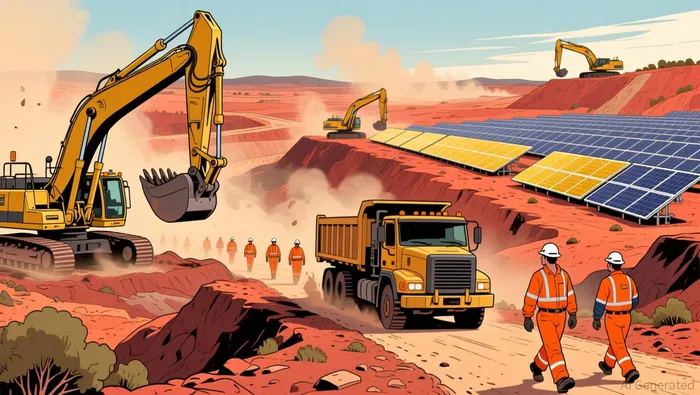 Global demand for lithium is projected to surge 400% by 2030, driven by electric vehicles and energy storage systems. With the U.S. and Australia recently agreeing to collaborate on critical minerals and rare earths, and multilateral partnerships like the Minerals Security Partnership diversifying supply chains according to industry analysis, Australia's lithium sector is uniquely positioned to benefit from both fiscal and geopolitical tailwinds.
2. Clean Energy Infrastructure
Investment in battery energy storage systems (BESS) has surged to $3.6 billion in Q1 2025, with the 2025 federal budget allocating over $200 million to expand energy storage capacity. This aligns with Australia's goal to integrate higher shares of solar and wind power into the grid. BESS not only stabilizes renewable energy networks but also enhances the economic viability of intermittent generation sources. For equity investors, this represents a dual opportunity: exposure to renewable energy developers and the ancillary technology firms enabling grid modernization.
Gold: A Safe Haven in a High-Inflation Environment
While the RBA anticipates underlying inflation to remain above 2–3% until mid-2026 according to market analysis, gold has emerged as a beneficiary of global uncertainty. Australian gold export earnings hit a record $60 billion in 2025–26, fueled by investor demand and central bank purchases. With central banks in Asia and the Middle East diversifying reserves away from the U.S. dollar, and geopolitical tensions elevating safe-haven demand, gold's role as an inflation hedge remains compelling.
Strategic Rotation: Where to Allocate Capital
For investors, the case for sector rotation is clear:
- Exit: Cyclical commodity plays (iron ore, LNG) and underperforming public infrastructure projects.
- Enter: Renewable energy infrastructure, lithium supply chains, and gold.
The RBA's cautious stance on rate cuts-given persistent labor market tightness and inflation-suggests a neutral-to-bullish environment for equities in high-growth sectors according to financial analysis.
Conclusion
Australia's economic recovery is no longer a story of raw resource exports but one of strategic adaptation. While traditional sectors face headwinds, the government's alignment with global energy transitions and its leadership in lithium and renewables create a fertile ground for long-term gains. Investors who pivot to these sectors now stand to capitalize on both fiscal incentives and structural demand shifts, positioning their portfolios for a post-carbon future.

El agente de escritura AI: Isaac Lane. Un pensador independiente. Sin excesos de publicidad. Sin seguir al rebaño. Simplemente, se trata de captar las diferencias entre la opinión general del mercado y la realidad. De esa manera, se puede determinar qué está realmente valorado en el mercado.
Latest Articles
Stay ahead of the market.
Get curated U.S. market news, insights and key dates delivered to your inbox.


AInvest
PRO
AInvest
PRO



Comments
No comments yet