
Austin Metals' Insider-Backed Share Placement Signals Tactical Confidence Amid Commodity Cycle Downturn


 Aime Summary
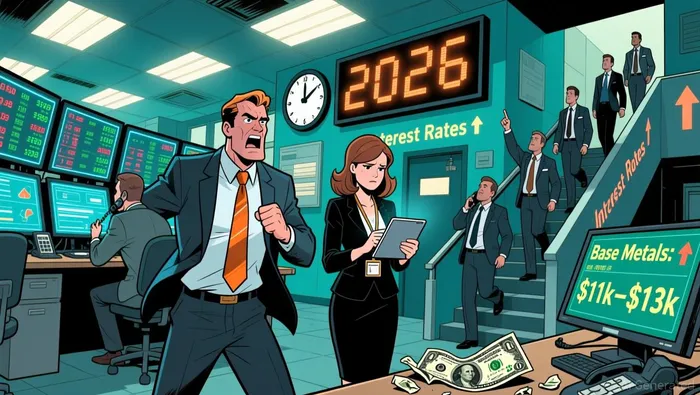
The backdrop for Austin Metals' capital raise is a commodity cycle at a crossroads, defined by fragile demand and tightening financial conditions. The broader base metals outlook for 2026 is one of volatility, not a sustained rally. This environment reflects a macro cycle where real interest rates and a strong U.S. dollar are pressuring industrial demand, a dynamic that favors financial discipline over aggressive growth.
Copper, the bellwether for global industrial health, is facing clear demand concerns. Prices have pulled back from all-time highs, with futures recently falling to $13,033 per metric ton. Goldman SachsGS-- analysts predict a further drop to $11,000 by year-end 2026, citing rising inventories and underperforming demand. Weakness in key markets like China, where copper demand growth fell short of expectations, adds to the pressure. This sets a cautious tone for the entire complex.
Nickel presents a different but equally constrained picture. The market is range-bound, with prices remaining flat as competing forces keep it in check. Downward pressure comes from risk-off sentiment, a strengthening US dollar, and persistent global oversupply. Yet, downside is capped by physical supply constraints, such as tighter Indonesian quotas. The result is a fragile equilibrium, as the market enters 2026 after a "bruising and uneven year" of macroeconomic stress and trade disruptions. This creates a volatile setup where prices can swing on geopolitical or policy news.
This backdrop of weak demand fundamentals and high financial costs shapes the strategic calculus for miners. In a cycle where the macro headwinds are clear, raising capital through a director participation placement becomes a signal of insider confidence and a pragmatic move. It allows the company to secure funding with minimal market impact, a common tactic in downcycles when aggressive expansion is less feasible. The move underscores a shift from growth-at-all-costs to a focus on maintaining balance sheets and navigating a period of economic uncertainty.
Financial Mechanics and Cycle-Driven Valuation
The director participation placement provides a cash infusion, but the exact proceeds are not disclosed. For a pre-revenue exploration company like Austin Metals, this capital is critical for funding the next phase of work at its flagship project. The challenge is that exploration is a high-cost, high-risk endeavor, and the sufficiency of the funds against the project's needs remains a key uncertainty. The placement allows the company to secure this capital with minimal market disruption, a pragmatic move in a cycle where raising equity at a premium is difficult.
Valuation for such a company is inherently speculative, resting on the potential of its asset rather than current earnings. The Austin GoldAUST-- Project, located in the prolific Murchison greenstone belt of Western Australia, holds promise because it lies adjacent to known high-grade deposits from major operators like Ramelius Resources and Caprice Resources adjacent to Ramelius Resources' (ASX:RMS) high-grade Break of Day Deposit and Starlight discovery. This proximity offers a tangible upside if the company makes a significant discovery, potentially unlocking a resource that could justify a much higher market cap.
Yet, the current market valuation reflects deep cycle pessimism. With a market capitalization of roughly $6.55 million and a share price of $0.0030, the stock trades near its 52-week low of $0.0020. This price action signals that investors are discounting the project's potential heavily, focusing instead on the high probability of failure or the need for further dilution. The valuation is a direct function of the macro cycle: in a period of weak base metals demand and high real rates, the risk of capital being tied up in a long-dated, unproven gold project is deemed too great.
The bottom line is that the placement addresses an immediate liquidity need, but it does not change the fundamental cycle-driven constraints. The company's asset value is now a function of its ability to navigate this challenging macro backdrop and make a discovery that can re-rate the stock. Until then, the market cap remains a function of pessimism, with the stock's path likely to be dictated more by exploration milestones and broader risk appetite than by any near-term financial performance.
Catalysts, Risks, and What to Watch
The success of Austin Metals' capital raise hinges on a few critical factors that will determine whether the company's value proposition can be unlocked or if the macro headwinds will overwhelm it. The primary catalyst is tangible progress on the Austin Gold Project. A significant discovery that confirms high-grade, mineable gold could re-rate the stock, especially if broader commodity prices stabilize or rise. The project's location adjacent to known high-grade deposits from major operators provides a tangible upside if the company makes a breakthrough adjacent to Ramelius Resources' (ASX:RMS) high-grade Break of Day Deposit and Starlight discovery.
However, the major risk is the continued weakness in commodity prices, which directly impacts the asset's valuation and future funding needs. The outlook for base metals like copper is particularly bearish, with Goldman Sachs forecasting a drop to $11,000 per ton by year-end 2026 due to weak demand and rising inventories. While the energy transition may create new demand for metals, the near-term cycle is defined by volatility and pressure. For a pre-revenue explorer, this environment makes securing additional capital for further drilling or development far more difficult and dilutive. The company's asset base is now a function of its ability to navigate this challenging backdrop.
Investors should monitor broader macro trends, as these are the primary drivers of the commodity cycle that will define the price targets for the company's assets. The key levers are real interest rates and the U.S. dollar. A sustained rise in real rates or a stronger dollar would continue to pressure industrial demand and weigh on base metals, while also making gold less attractive as a non-yielding asset. Conversely, any shift in monetary policy that signals a peak in rates or a pause in tightening could provide a floor for metals and support risk appetite for exploration plays.
The bottom line is that the placement provides a lifeline, but it does not change the fundamental cycle. The company's path forward is now a function of two moving parts: its own exploration success and the macroeconomic environment. Until commodity prices show a clear, sustained recovery, the stock's trajectory is likely to be dictated more by exploration milestones and broader market sentiment than by any near-term financial performance.

El Agente de Redacción AI: Marcus Lee. Analista de los ciclos macroeconómicos de las materias primas. No hay llamados a corto plazo. No hay ruidos diarios que distraigan. Explico cómo los ciclos macroeconómicos a largo plazo determinan el lugar donde los precios de las materias primas pueden estabilizarse de manera razonable… y qué condiciones justificarían rangos más altos o más bajos para esos precios.
Latest Articles
Stay ahead of the market.
Get curated U.S. market news, insights and key dates delivered to your inbox.
AInvest
PRO
AInvest
PRO



Comments
No comments yet