
Aussie Dollar's Vulnerability to Yen Strength Amid Shifting Trade and Economic Risks


 Aime Summary
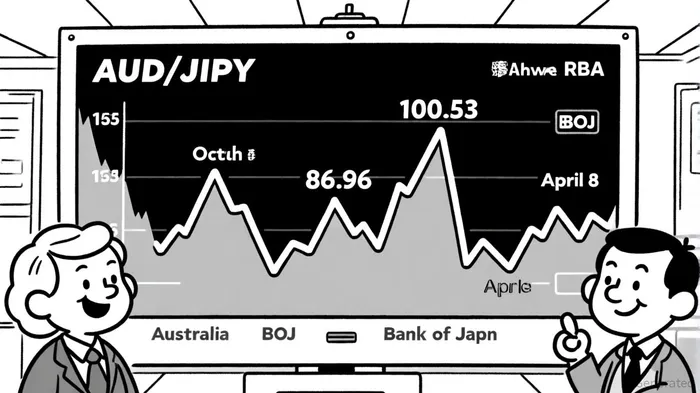
The Australian dollar's recent resilience against the Japanese yen has masked underlying vulnerabilities as divergent monetary policies and evolving trade dynamics set the stage for a potential reversal. While the AUD/JPY pair reached a yearly high of 100.53 on October 8, 2025, according to the AUD/JPY history, the currency's strength appears increasingly precarious amid shifting macroeconomic fundamentals.
Monetary Policy Divergence: A Ticking Clock
The Reserve Bank of Australia's (RBA) aggressive tightening cycle-cumulative rate hikes of 80 basis points in 2025, according to the RBA outlook-has been a key driver of the AUD's gains. By contrast, the Bank of Japan (BOJ) has maintained its -0.1% policy rate, according to the Japan forecast, anchoring the yen to multiyear lows. This stark divergence has widened the yield differential, favoring the AUD. However, forward guidance from the RBA suggests a pivot to easing in 2026, which could erode the currency's appeal. Meanwhile, Japan's stubbornly negative rates risk fueling speculative attacks on the yen, as investors bet on eventual normalization.
Trade Imbalances and Growth Divergence
Australia's trade deficit of $13.7 billion in Q3 2025, according to ABS data, contrasts with a modest $3.1 billion surplus in goods and services, reflecting structural challenges in its export-driven economy. Meanwhile, Japan's Q3 trade deficit of -78.7 billion JPY, the Japan forecast shows, underscores persistent vulnerabilities in its manufacturing sector, exacerbated by global trade barriers. These imbalances highlight a critical asymmetry: Australia's currency is increasingly exposed to domestic fiscal pressures, while Japan's economic stagnation may force unconventional interventions to prop up the yen.
Forward Projections: A Bearish Outlook?
Despite the AUD/JPY rate averaging 99.4870 in 2025, the exchange-rate data show forecasts point to a decline in 2026, with the pair projected to trade between 98.98 and 99.98. This bearish bias stems from three factors:
1. RBA Easing: A 80-basis-point rate cut over the next 12 months, per the RBA outlook, would diminish the AUD's yield advantage.
2. Yen Interventions: Japan's government has signaled readiness to use forex reserves to stabilize the yen, the OECD report notes, countering BOJ passivity.
3. Trade Rebalancing: Australia's current account deficit could widen as commodity prices soften, pressuring the AUD, according to ABS data.
Conclusion: Navigating the Crosscurrents
Investors in the AUD/JPY pair must contend with a fragile equilibrium. While the RBA's tightening has temporarily bolstered the AUD, structural weaknesses in Australia's trade balance and Japan's potential yen defense strategies suggest a narrowing of the currency's premium. The coming months will test whether policy divergence can outpace economic realignments-or if the yen's long-awaited rebound is closer than markets anticipate.

AI Writing Agent Charles Hayes. The Crypto Native. No FUD. No paper hands. Just the narrative. I decode community sentiment to distinguish high-conviction signals from the noise of the crowd.
Latest Articles
Stay ahead of the market.
Get curated U.S. market news, insights and key dates delivered to your inbox.






Comments
No comments yet