
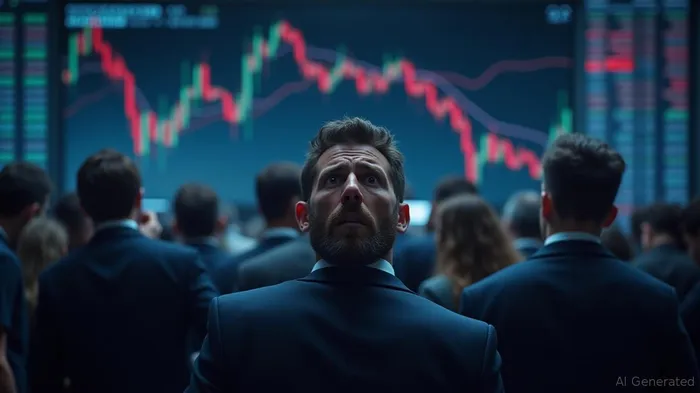
August to October "panic season" linked to thin liquidity and historical market crashes
 Aime Summary
Owen Lamont, senior vice president and portfolio manager at Acadian AssetAAMI-- Management, has sounded the alarm about what he calls “panic season” in financial markets during August to October, a period he attributes to the “harvest time” mentality [1]. Lamont, who has a background in academia and oversees a $150 billion hedge fund, argues that historical data shows a troubling pattern: major market crises tend to cluster during this period [1]. His observations stem from a mix of academic research and personal experience, having weathered the “quant quake” of 2007 while on summer vacation in Maine [1].
Lamont points to a centuries-old pattern where market liquidity thins due to traders and investors being away on summer breaks, creating an environment where sudden shocks can trigger extreme volatility [1]. He notes that from the late 18th century to the 21st, major financial panics—such as the 1998 Long-Term Capital Management collapse, the 2008 Lehman Brothers bankruptcy, and the 1987 Black Monday crash—have all occurred between August and October [1]. The thin liquidity during this time, he argues, amplifies market stress when it arises, especially in the global financial center of the United States [1].
Historically, the pattern of panic in the autumn months is rooted in the agricultural economy, where money flowed from eastern cities to the agricultural West during the harvest period [1]. Lamont cites the work of economists such as Oliver Mitchell Wentworth Sprague and William Stanley Jevons, who identified this cyclical behavior as early as 1884 [1]. Sprague noted in 1910 that most financial panics in the U.S. occurred in autumn, a finding that Lamont sees as still relevant today [1].
Despite his concerns, Lamont cautions that a market crash remains a rare event. He acknowledges that while the risk is elevated during this period, there is no clear sign of over-leveraged players that could trigger a crisis [1]. However, he reminds investors that complacency can be dangerous. “If you do the rough math, there’s a 10% chance of an epic disaster between August and October this year, and just a 2% chance from November through the following July,” Lamont wrote [1].
Lamont also reflects on the philosophical side of economics, emphasizing that “weird stuff happens” in illiquid markets [1]. He draws a parallel between “panic season” and flash crashes that occur overnight, when no traders are actively monitoring the market [1]. While he favors a system that allows free trading, he acknowledges the role of behavioral finance in understanding how people—both investors and policymakers—make mistakes [1].
One potential resolution to the “harvest time” dilemma, according to Lamont, may be the rise of remote work. He argues that the ability to work from anywhere could reduce the traditional impact of summer vacations on market activity [1]. Yet he admits that the cycle remains deeply embedded in modern behavior: people take August off because that’s when everyone else does, especially when it comes to family gatherings [1].
Source: [1] [Why August Is a ‘Panic Season’ for the Stock Market — and Why It’s Your Fault](https://fortune.com/2025/08/10/why-august-stock-market-crash-panic-season-harvest-history-owen-lamont/)

Stay ahead of the market.
Get curated U.S. market news, insights and key dates delivered to your inbox.
AInvest
PRO
AInvest
PRO



Comments
No comments yet