
The August CPI Report and Its Implications for Fed Policy and Stock Market Volatility: Navigating the Tightrope of Rate Cuts and Inflation Risks


 Aime Summary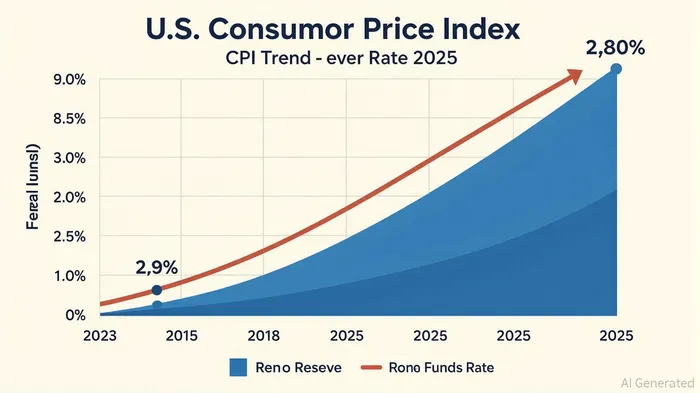
The August 2025 U.S. Consumer Price Index (CPI) report has emerged as a pivotal event for investors, central bankers, and policymakers. , the data underscores a stubbornly elevated inflationary environment. For equity investors, the report's implications extend beyond macroeconomic indicators, directly influencing Federal Reserve policy and, by extension, stock market volatility.
The Dual Forces: Tariffs and Services Inflation
The CPI report will scrutinize two critical drivers of inflation: President 's tariffs and the services sector's price pressures. Tariffs on goods such as electronics, furniture, and apparel have created a “slow-burn” inflationary effect, with costs incrementally passing through to consumers. Meanwhile, —encompassing shelter, transportation, , . . If services inflation surprises on the upside, the Fed may delay rate cuts, prioritizing price stability over labor market support.
Fed Policy: A Delicate Balancing Act
The Federal Reserve faces a classic dilemma: addressing inflation while mitigating the risks of a slowing labor market. . However, . Analysts at Goldman SachsGS-- and Deutsche BankDB-- note that while tariffs may distort short-term data, the broader trend of cooling inflation in sectors like housing and labor remains intact. This duality creates uncertainty, with the Fed likely to emphasize a “data-dependent” approach in its September meeting.
Market Volatility and Investor Positioning
, . However, . , compressing equity valuations, . Investors should monitor the (volatility index) and sector rotations, particularly in interest-rate-sensitive areas like utilities and real estate.
Strategic Recommendations for Equity Investors
- Hedge Against Volatility: Given the tight rate-cut outlook, .
- Sector Rotation: Position for a potential shift in monetary policy by overweighting sectors that benefit from lower rates (e.g., technology, industrials) while underweighting those sensitive to inflation (e.g., energy, materials).
- Duration Management: In fixed income, . .
- Active Management: Consider actively managed funds that can pivot quickly in response to Fed policy shifts, particularly in a market where macroeconomic surprises are likely.
Conclusion: A Tenuous Equilibrium
The August CPI report will test the Fed's resolve to balance inflation control with economic growth. For equity investors, the key lies in assessing the risk-reward trade-off between a potential rate-cut cycle and the persistence of inflationary pressures. While the market's current optimism is understandable, a nuanced approach—combining tactical hedging, sector agility, and active management—will be essential to navigate the volatility ahead. As the Fed inches closer to its policy decision, investors must remain vigilant, ready to adapt to a landscape where every CPI data point could tip the scales.

Stay ahead of the market.
Get curated U.S. market news, insights and key dates delivered to your inbox.
AInvest
PRO
AInvest
PRO



Comments
No comments yet