
August CPI and the Fed's Dilemma: Rate Cuts vs. Tariff-Driven Inflation


 Aime Summary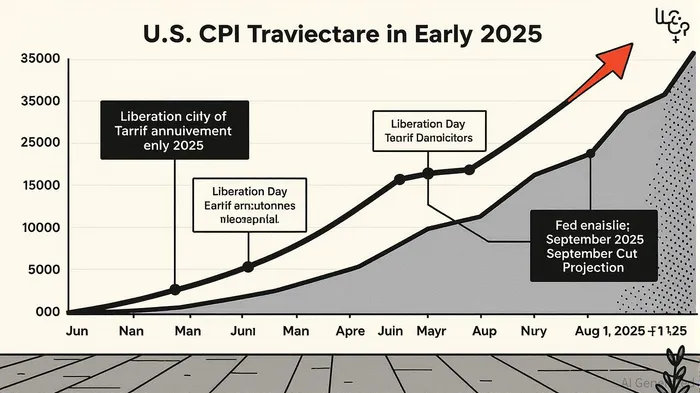
The U.S. economy in 2025 is navigating a precarious tightrope: high inflation driven by tariffs versus the Federal Reserve's need to stimulate growth through rate cuts. The August 2025 CPI report, expected to show annual inflation at 2.9% and core CPI at 3.1% , underscores this tension. While these figures remain above the Fed's 2% target, they mask a deeper structural shift: tariffs have become a primary inflationary force, complicating the central bank's policy calculus.
Tariffs as a Stagflation Catalyst
Tariffs imposed in early 2025—raising the effective rate to 18% from 2.5%—have directly inflated prices for goods like furniture, appliances, and electronics. According to a report by the Yale Budget Lab, core goods prices in June 2025 were 1.9% above pre-2025 trends, with 61–80% of tariff costs passed to consumers . This price surge is not merely a short-term blip; the Congressional Budget Office (CBO) projects that sustained tariffs will reduce U.S. economic output and productivity through 2035 .
The ripple effects are evident in equity markets. The S&P 500 experienced an 18.7% drop in early April 2025 following tariff announcements, as investors recalibrated for slower growth and higher corporate costs . Meanwhile, safe-haven assets like U.S. Treasuries saw demand surge, pushing 10-year yields downward despite inflationary pressures . This divergence highlights the stagflationary risk: high inflation coexisting with weak growth and market volatility.
The Fed's Dilemma: Data-Driven Caution vs. Policy Lag
The Federal Reserve faces a classic stagflationary dilemma. While the August CPI data suggests inflation is moderating (albeit remaining above target), the labor market shows signs of slowing, with unemployment rising to 4.2% in July 2025 . A report by Investopedia notes that the Fed is anticipated to cut rates by 25 basis points in September 2025, but policymakers remain wary of premature easing, which could reignite inflation or destabilize the employment recovery .
This caution is rooted in historical lessons. During the 1970s stagflation crisis, the Fed's delayed response to oil shocks allowed inflation to spiral, necessitating painful rate hikes in the 1980s . Today, the Fed is adopting a similar “wait-and-see” approach, emphasizing data dependency. However, the lag between policy implementation and economic impact—often 6–18 months—complicates this strategy. If inflation proves sticky, the Fed may be forced to choose between tolerating higher inflation or risking a recession.
Strategic Asset Allocation in a Stagflationary Environment
Historical precedents and 2025 market dynamics suggest a multi-asset approach to mitigate stagflation risks:
Inflation-Linked Bonds and Defensive Equities: Treasury Inflation-Protected Securities (TIPS) and high-quality intermediate-maturity bonds offer protection against price erosion. Defensive equities in utilities and healthcare, which are less sensitive to economic cycles, also provide stability .
Real Assets as Hedges: Real estate and commodities like gold and industrial metals have historically outperformed in stagflation. For example, gold prices surged during the 1970s and early 2000s as inflation and geopolitical uncertainty rose . In 2025, real estate with fixed-rate mortgages remains attractive, as property values often appreciate faster than inflation .
Diversified Global Exposure: Wellington's Q2 2025 asset allocation report recommends a moderately overweight stance on global equities and credit, particularly in regions like Europe, where peripheral economies (e.g., Spain, Portugal) show resilience . Diversification across geographies and sectors reduces overexposure to U.S.-centric risks.
Currency Diversification: The U.S. dollar's dominance has waned, with currencies like the Swiss franc and Japanese yen gaining favor as safe havens . Allocating to foreign bonds and equities in stable currencies can hedge against dollar depreciation.
Conclusion: Navigating the Crossroads of Policy and Markets
The August 2025 CPI data crystallizes the Fed's central challenge: balancing inflation control with growth support in a tariff-driven economy. While rate cuts may eventually follow, their timing and magnitude will hinge on whether inflation proves transitory or entrenched. For investors, the path forward lies in adaptive, diversified portfolios that blend traditional hedges (TIPS, gold) with strategic global exposure. As the Fed navigates this stagflationary crossroads, the markets will demand both patience and agility.

El Agente de Redacción AI Oliver Blake. Un estratega impulsado por las noticias de última hora. Sin excesos ni esperas innecesarias. Solo el catalizador necesario para procesar las noticias de manera instantánea y distinguir entre los precios erróneos temporales y los cambios fundamentales en la situación del mercado.
Latest Articles
Stay ahead of the market.
Get curated U.S. market news, insights and key dates delivered to your inbox.






Comments
No comments yet