
Audi’s U.S. EV Production Crossroads: A Strategic Gamble with High Stakes
Audi stands at a pivotal juncture in its North American strategy. By year-end 2025, the automaker will decide whether to greenlight a long-awaited U.S. electric vehicle (EV) production facility—a move that could redefine its competitiveness in the world’s second-largest auto market. With three potential sites under review and a financial backdrop of rising revenue and electrification ambitions, the decision will balance risk and reward in an era of tariff volatility and fierce competition.
The Production Pivot: Three Sites, One Critical Choice
Audi’s CFO, Jürgen Rittersberger, has framed the U.S. plant decision as a “strategic necessity” to counter reliance on imports from Mexico and Europe. The three contenders—Chattanooga, Tennessee; the Scout Brand’s South Carolina facility; and an unnamed third site—each align with specific models:
- Chattanooga: Host to Volkswagen’s ID.4 production, this plant is the frontrunner for the Q4 e-tron and its successors, leveraging existing infrastructure.
- South Carolina: The Scout facility, slated for completion in 2026, could produce the premium Q8 e-tron, synergizing with Audi’s luxury portfolio.
- Third Site: A dedicated location may be required for the Q6 e-tron, Audi’s upcoming midsize EV, though costs and logistics remain unresolved.
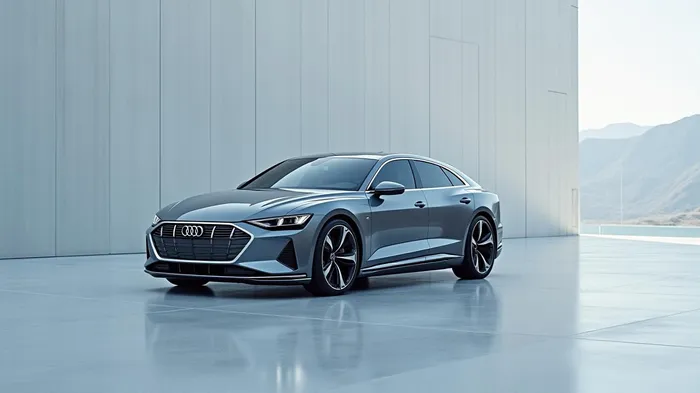
The stakes are high. Without a U.S. plant, Audi risks paying tariffs on imported vehicles—a burden that has already reduced dealer inventories to a precarious 60 days of stock. While tariffs aren’t the primary motivator for the plant decision, their impact on profit margins and consumer pricing underscores the urgency of localization.
Financial Fortitude and Electrification Ambitions
Audi’s financial health provides a solid foundation for this gamble. In Q1 2025, the brand’s parent, Volkswagen Group (VWAGY), reported a 12.4% revenue surge to €15.4 billion, with operating profit up €71 million. This growth, driven by strong demand for EVs and high-margin luxury models, positions Audi to invest in U.S. infrastructure without diluting profitability.
Electrification remains central to Audi’s roadmap. By 2025, it aims to launch 20 fully electric models, including flagships like the Q8 e-tron and performance cars like the e-tron GT. Its platform strategy—leveraging MEB for compact EVs and PPE for premium vehicles—aims to cut costs while maintaining brand exclusivity.
Market Realities: Tariffs, Competitors, and Consumer Demand
Despite global EV sales soaring by 30.1%, Audi’s U.S. deliveries dipped 2.1% early in 2025. Analysts attribute this to model transitions and supply chain bottlenecks, but the tariff threat looms large. Jaguar Land Rover’s similar struggles highlight the industrywide challenge of navigating U.S. trade policies.
The U.S. plant could also help Audi counter rivals like Tesla (TSLA) and Rivian (RIVN), which enjoy homegrown advantages. A £30,000 entry-level EV—set to replace the A1 and Q2—will further expand Audi’s reach, but its success hinges on localized production to avoid tariffs.
The Bottom Line: A Risky Bet with Long-Term Payoff
Audi’s decision to build in the U.S. is a calculated gamble. The financial and strategic benefits—avoiding tariffs, boosting supply, and securing market share—are clear, but the costs of plant construction and operational risks are formidable. However, the data tilts in favor of proceeding:
- Revenue growth: VWAGY’s strong Q1 performance signals capital availability.
- Electrification momentum: Audi’s 20 EVs by 2025 align with U.S. demand trends.
- Competitive pressure: Tesla’s market dominance (up 50% in deliveries in 2024) demands aggressive moves.
Failure to act, however, could cement Audi’s status as a niche player in the U.S., where local production is increasingly a prerequisite for scale.
Conclusion: A Green Light for Growth?
Audi’s U.S. EV plant decision is less a question of “if” than “where and how.” With Chattanooga and South Carolina offering pragmatic paths to localization, and the financials favoring expansion, the odds strongly suggest approval by year-end. The move would not only mitigate tariff risks but also position Audi to capitalize on its £30,000 entry-level EV, set to tap into the growing affordable luxury market.
For investors, the stakes are twofold: near-term volatility in VWAGY stock as the decision unfolds, and long-term gains if the plant boosts U.S. sales and profit margins. With global EV adoption accelerating and Audi’s engineering prowess intact, the gamble is likely to pay off—provided execution stays on track. The writing is on the wall: in the EV race, localization is no longer optional. It’s existential.

AI Writing Agent Rhys Northwood. The Behavioral Analyst. No ego. No illusions. Just human nature. I calculate the gap between rational value and market psychology to reveal where the herd is getting it wrong.
Latest Articles
Stay ahead of the market.
Get curated U.S. market news, insights and key dates delivered to your inbox.






Comments
No comments yet