
Atomic Upside: Why 2025 IS Nuclear’s Investment Renaissance
 Aime Summary
Investors have taken sharp notice in 2025 as nuclear energy surges back to center stage—driven by decisive policy shifts and tech sector demand. Recent U.S. executive orders aim to quadruple nuclear capacity by 2050 and streamline regulation, while tech titans like Meta and Amazon are securing long-term nuclear-linked power supply for their colossal data centers. The resulting demand for clean, reliable energy is sparking a rally across nuclear-focused ETFs, as the sector evolution gains global momentum.
Why now? Policy, power demand and supply strain
Three converging forces are driving investor attention. First, U.S. and international policy moves—streamlined permitting, strategic initiatives to boost domestic uranium supply, and government support for small modular reactors—are reducing regulatory friction. Second, the massive power demands of AI/data centers and industrial electrification create a need for reliable, carbon-free baseload power that nuclear uniquely provides. Third, uranium supply constraints versus rising demand are tightening the market, buoying miners and related equities. Together, these create an investment backdrop that extends beyond a single commodity squeeze to an industry-level re-rating.
ETF Spotlight: NLRNLR-- vs. NUKZ
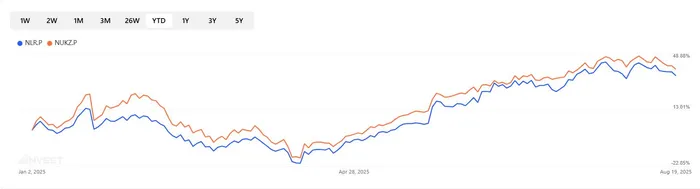
VanEck Uranium & Nuclear Energy ETF (NLR): Gives diversified exposure across the nuclear value chain — from miners and converters to utilities and reactor developers — making it a go-to for broad industry exposure. NLR’s YTD return around 41.6% and AUM near $2.19B, with a gross expense in the neighborhood of 0.56%.
Portfolio: NLR holds a blend of utilities, uranium miners (Cameco, Uranium EnergyUEC-- Corp), service providers, and up-and-coming firms (e.g., Oklo). U.S. stocks dominate the portfolio, with substantial international exposure (Canada, Australia, China).
Range Nuclear Renaissance Index ETF (NUKZ): A newer, narrower play designed to track companies tied to the “nuclear renaissance” — advanced reactors, fuel, construction and services. NUKZ is smaller and structurally different from NLR, carrying a higher expense ratio (around 0.85%) but offering targeted exposure that has translate YTD returns of 40.96%.
Portfolio: Tracks nuclear energy industry stocks globally, with a market cap-weighted approach—widely regarded for its exposure to both established players and innovative disruptors.
Bottom line
The 2025 “nuclear redux” is being powered by policy tailwinds, structural electricity demand (notably from AI/data centers), and tightening uranium fundamentals. ETFs like NLR and NUKZ give retail investors a front-row seat to the transformation, balancing growth potential with sector diversification, performance consistency, and competitive costs. As global markets embrace the nuclear solution, investors should keep a close eye on allocation, performance, and evolving policy as the energy transition unfolds.
Compare nuclear ETFs like NLR and NUKZ side-by-side on our ETF Compare Tool

Market Radar delivers concise, daily trading ideas by tracking everything from options activity and market sentiment to high-profile political trades.
Latest Articles
Stay ahead of the market.
Get curated U.S. market news, insights and key dates delivered to your inbox.




Comments
No comments yet