
ATOM Earnings Show Q2 Revenue Beat Amid Strategic Semiconductor Milestones
 Aime Summary
- Atomera reported Q2 2026 revenue of $158,000, beating estimates by $60,000, while shares rose 6.81% on the positive top-line surprise.
- The company achieved a significant manufacturability milestone with an active Gate-All-Around customer, signaling progress toward future royalty-based licensing deals.
- A new breakthrough in Gallium Nitride on Silicon technology offers potential for lower-cost, high-performance RF devices that challenge traditional Silicon Carbide substrates.
- Despite a widening net loss of $6.3 million, AtomeraATOM-- doubled its cash reserves to $38.4 million, providing a buffer against rising operational expenses in 2027.
Atomera Incorporated delivered its second-quarter 2026 financial results, presenting a mixed but strategically significant performance profile for investors and semiconductor analysts. The company reported a GAAP net loss of $6.3 million, or $0.17 per share, which represents a widening loss from the $5.0 million deficit recorded in the same period of 2025. On a non-GAAP basis, the adjusted EBITDA also widened to a loss of $5.0 million, up from $4.0 million in the prior-year quarter.
However, the market reaction to the earnings release was notably positive, with Atomera’s shares climbing 6.81% to approximately $5.65 following the announcement. This investor enthusiasm was primarily driven by the company's revenue performance, which came in at $158,000, significantly exceeding the consensus estimate of $100,000 by $58,000 . The top-line beat highlighted that despite the persistent cash burn, the company is successfully generating revenue, largely derived from wafer delivery fees to a large integrated device manufacturer .
Beyond the financial metrics, the core narrative for Atomera revolves around the commercialization of its Mears Silicon Technology (MST) across advanced logic and memory segments. The company cleared a critical manufacturability milestone with one of its two active Gate-All-Around (GAA) customers . This achievement confirmed that Atomera’s MST material could be successfully deposited in customer-relevant structures, yielding positive electrical results .
The successful integration into GAA structures directly addresses longstanding manufacturability concerns held by potential semiconductor clients . While the company has not yet finalized a licensing agreement, this technical validation is a mandatory prerequisite for entering formal royalty negotiations . Management noted that while a deal is unlikely to close within the immediate two months, the pathway to commercialization is now clearly established .
What Progress Has Atomera Made in RF and Memory Applications?
In addition to its work in advanced logic, Atomera has unveiled significant technological advancements in the RF and memory sectors, driven by the surging demand for high-performance computing. The company introduced a new approach to Gallium Nitride on Silicon (GaN-on-Silicon) specifically designed for Radio Frequency applications. This breakthrough aims to lower the cost and complexity traditionally associated with Silicon Carbide substrates .
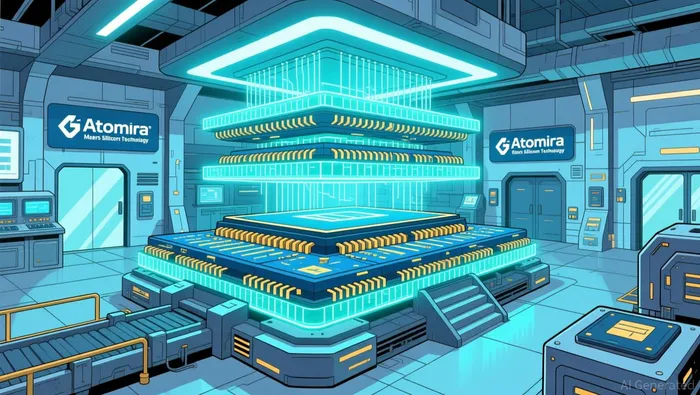
Independent testing demonstrated that MST-enhanced GaN-on-silicon offers effectively lossless RF behavior and superior harmonic distortion metrics . This performance profile could enable a new class of high-volume RF devices, generating substantial industry interest and opening a commercial pipeline for integrated RF front ends .
Simultaneously, shifting AI-driven demands have redirected manufacturer focus toward vertical memory architectures, such as 4F² and 3D DRAM . Atomera has developed a compelling value proposition for 4F² DRAM, utilizing MST starting wafers to facilitate vertical access transistors . This method is projected to reduce fabrication costs compared to current industry standards, and the technical feasibility has been accepted for presentation at an IEEE conference .
How Is Atomera Managing Rising Costs and Cash Burn?
While the technological pipeline is advancing, Atomera faces intensifying financial headwinds as it moves from research to commercial validation. The company raised its 2026 non-GAAP operating expense guidance to approximately $18.75 million, up from previous estimates . This increase is attributed to higher costs for outsourced engineering, device fabrication, and essential tool leases.
Atomera ended the second quarter with a robust cash position of $38.4 million in cash, cash equivalents, and short-term investments . This figure represents a doubling of its liquidity from the $19.2 million held at the end of 2025, providing a necessary buffer against the anticipated cost pressures . Despite this strong balance sheet, management cautioned that cost pressures will intensify in 2027 as tool lease costs are expected to increase significantly .
Cash used in operations was $3.9 million for the quarter, marking a sequential improvement from the $4.8 million used in the first quarter, though it remains above the prior year's pace . The company's stock trajectory will heavily depend on its ability to convert its technical pipeline into tangible licensing deals before the rising operational costs erode its cash cushion .

Blending traditional trading wisdom with cutting-edge cryptocurrency insights.
Latest Articles
Stay ahead of the market.
Get curated U.S. market news, insights and key dates delivered to your inbox.


AInvest
PRO
AInvest
PRO




Comments
No comments yet