
Atlassian (TEAM) Drops 4.55% as Bearish Patterns Extend Three-Day 5.63% Slide
 Aime Summary
Atlassian (TEAM) closed at $154.76 on the most recent session, marking a 4.55% decline and extending its downward trend for three consecutive days, with a cumulative drop of 5.63% in three trading sessions. This sharp correction has pushed the stock below key psychological and technical levels, warranting a detailed analysis of its price behavior and potential turning points.
Candlestick Theory
The price action suggests a bearish bias, with recent candles forming lower highs and lower lows. 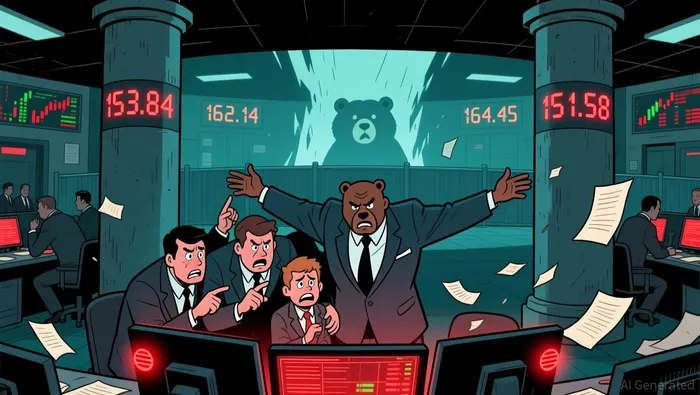 Key support levels can be identified at $153.84 (a recent low) and $151.58, while resistance clusters emerge around $162.14 and $164.45. A breakdown below $153.84 may trigger further tests of the $149.52 support (a prior swing low). Conversely, a rebound above $162.14 could signal a short-term consolidation phase. The formation of a "bearish engulfing" pattern during the recent decline adds weight to the potential for continued selling pressure.
Moving Average Theory
The 50-day moving average (calculated as $159.00) currently lies below the 100-day ($163.50) and 200-day ($168.00) averages, indicating a bearish trend in the intermediate term. The narrowing gap between the 50-day and 100-day MAs suggests decelerating downward momentum, though the 200-day MA remains a critical long-term resistance. A sustained close above the 100-day MA would imply a potential trend reversal, but given the current price’s distance from these levels, a retest of the $153.84 support appears more probable.
MACD & KDJ Indicators
The MACD histogram has turned negative, with the MACD line crossing below the signal line, reinforcing bearish momentum. The KDJ indicator (Stochastic oscillator) shows the stock in oversold territory (K: 25, D: 30), suggesting a potential near-term bounce. However, divergence between the KDJ and price action—where the oscillator forms higher lows while the price makes lower lows—may indicate waning bearish conviction. A stochastic crossover above 30 could signal a short-term rebound, but a failure to break above $162.14 would likely keep the broader downtrend intact.
Bollinger Bands
Volatility has expanded recently, with the price testing the lower Bollinger Band at $153.84. The band’s width suggests heightened volatility, and the price’s proximity to the lower band implies oversold conditions. A rebound from this level would likely see the price retrace toward the 20-day moving average ($156.00), though a break below the lower band could accelerate the decline toward $149.52. The absence of significant band contraction (which would indicate a potential breakout) suggests that the current range-bound pattern is more likely to persist.
Volume-Price Relationship
Trading volume has surged during the recent decline, validating the bearish move. The most recent session’s volume of 2.67 million shares exceeds the 30-day average, indicating strong seller participation. However, a divergence in volume—where volume tapers off despite continued price declines—could signal exhaustion in the bearish trend. The high volume during the 4.55% drop suggests that the current sell-off is not yet exhausted, but a volume spike on a rebound would be a positive sign for short-term buyers.
Relative Strength Index (RSI)
The 14-day RSI stands at 28, confirming oversold conditions. While this level historically suggests a potential rebound, the RSI’s failure to form higher lows despite the price’s decline points to bearish divergence. A close above 35 would be a critical trigger for a short-term bounce, but a retest of the 28 level without a corresponding price rebound could deepen the correction. Traders should monitor for a "RSI bottom" formation, where the indicator forms a double bottom before the price follows suit.
Fibonacci Retracement
Key Fibonacci levels from the recent high of $164.45 to the low of $153.84 include 38.2% at $159.30, 50% at $159.14, and 61.8% at $158.98. The current price of $154.76 is approaching the 78.6% retracement level at $154.50, which could act as a short-term support. A break below this level would target the 88.6% retracement at $153.30. Conversely, a recovery above $159.30 would invalidate the bearish scenario and suggest a potential consolidation phase.

If I have seen further, it is by standing on the shoulders of giants.
Latest Articles
Stay ahead of the market.
Get curated U.S. market news, insights and key dates delivered to your inbox.




Comments
No comments yet