

On September 1, Citi raised its price target on Atlassian to $225 and kept a Buy, the first increase after a year in which the firm's target fell from $300 to $160. The market had not waited for a blessing: the stock had already more than tripled from its April low near $56 and jumped roughly 35% in after-hours trading on the August 6 earnings report before the rating landed. Whatever the upgrade added, the beaten-down entry closed months ago. The useful question is what the re-rate is built from — and the answer, read off the operating print rather than the tape, is a year of real acceleration, alongside a guided slowdown that now sets the test.
Start with the revenue sequence. Through fiscal 2026, Atlassian's year-over-year growth stepped up four quarters running: +20.6% in Q1, +23.3% in Q2, +32% in Q3 and +28% in Q4, a full-year gain of about 26%. Wall Street spent 2025 debating whether generative AI would displace Atlassian's seat-based business entirely, and the stock and its sell-side targets fell together into early 2026. Post-earnings coverage now reads the same technology as a demand driver rather than a displacement risk — and the difference is visible in the quarter-by-quarter line, not in any management promise.
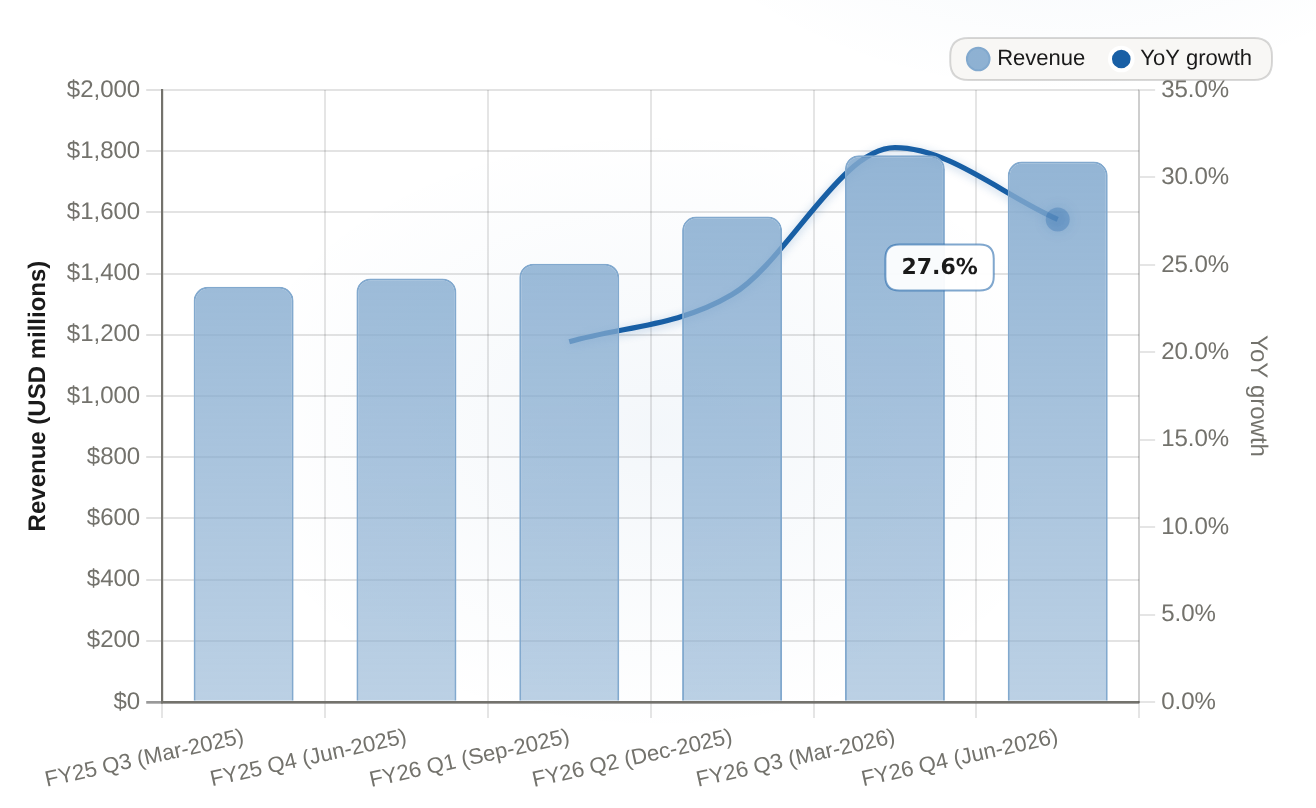
Revenue stepped up from ~$1.36B to a $1.79B peak (FY26 Q3) while YoY growth re-accelerated from +20.6% (FY26 Q1) to +31.7% (FY26 Q3) — the printed turn behind the re-rate.
| Period | Revenue | YoY growth |
|---|---|---|
| FY25 Q3 (Mar-2025) | 1356.7 | N/A |
| FY25 Q4 (Jun-2025) | 1384.3 | N/A |
| FY26 Q1 (Sep-2025) | 1432.6 | 20.6 |
| FY26 Q2 (Dec-2025) | 1586.3 | 23.3 |
| FY26 Q3 (Mar-2026) | 1787 | 31.7 |
| FY26 Q4 (Jun-2026) | 1766 | 27.6 |
The dip in the chart from Q3 to Q4 is Atlassian's usual seasonality, not a loss of momentum; the June quarter still grew 28% from a year earlier. The breadth of that Q4 print is where the story gets concrete. Cloud revenue came to $1.213 billion, up 31% and $49 million above the company's own guidance. Subscription annual recurring revenue — the annualized value of contracts in force — reached $6.6 billion, up 23%. Remaining performance obligations, the contracted revenue not yet booked that foreshadows coming quarters, jumped 44% to $4.8 billion. Net revenue retention ran above 120%, meaning existing customers were spending more than a fifth more than a year earlier before a single new logo.
Adjusted earnings hit $1.87 a share against the $1.50 consensus, adjusted profit rose 83% to $473 million, and the company printed a 12% GAAP operating margin — the first quarter of book profits after years of GAAP losses, following a March quarter that still lost $98 million.
The same report explains why the acceleration has legs. AtlassianTEAM-- booked an all-time record quarter of deals at and above $1 million, $3 million and $5 million in annual contract value, and signed the largest enterprise deal in company history with one of the world's largest consumer technology companies; the $3 million-and-up ARR cohort grew more than 50% and the $5 million-and-up cohort more than 70%. Those larger, longer contracts are what push RPO growth above 40% while subscription ARR grows in the low 20s — enterprise consolidation, not seat inflation, is doing the work, and it is engraved in contracts rather than in promises.
Then the part that disciplines the story. The same report guided fiscal 2027 subscription-ARR growth down to 18% from the 23% just delivered, and full-year GAAP operating margin to just 4.5%, with the first quarter guided at 6.5%. The CFO called it a "thoughtful and prudent approach" against macro, fiscal and geopolitical uncertainty. Two asterisks belong here: GAAP profitability is one quarter old, and roughly a percentage point of the fiscal 2026 growth came from the DX acquisition rather than from the organic base. Sell-side revenue estimates put fiscal 2027 growth around 13%, still below the 18% subscription-ARR path the company guided, and a sign the market is not yet fully convinced the acceleration is durable. An 18% ARR grower earning a 4.5% GAAP margin is a slower company than the 28% revenue growth that drew the cheers in August, and the persistence question lives in that gap.
By early September the market had already priced most of that outcome. Ainvest data put the stock near $187, up about 148% over 120 days and roughly 7.2 times trailing sales — above the mean targets of FactSet's $177 and ChartMill's $144, with Citi's $225 the outlier at the top. The multiple now pays for continuation of a 20%-to-30% grower, not another leg of acceleration. And the bridge this kind of deep-value work usually leans on is not yet built: trailing free cash flow near $1.3 billion at a roughly 20% margin is real, but free cash flow itself fell about 7% from a year earlier. Cash has not yet followed the revenue re-acceleration. That is the honest weakness of the whole setup — the re-rate is carried by printed revenue and margin, not yet by cash, so the uncertainty sits higher than the multiple implies.

So the thesis compresses to one falsifiable check, no DCF required. The re-rate holds if fiscal 2027's quarterly prints stay on the guided line: subscription-ARR growth near 18% and GAAP operating margin building toward 4.5%. Hold that, and the re-rate stands on delivery rather than hope, with the multiple's support real instead of assumed. Slip below the guide — ARR growth dips, margins stay thin — and a stock trading above the average sell-side target has little left underneath it; the disciplined move is to let the setup reset. You do not need to chase the beaten-down story; that entry closed in April. What is on sale near $187 is a printed, slowing, newly profitable execution story, and the evidence either lands each quarter or it does not.








Comments
No comments yet